AgrifoodV ·
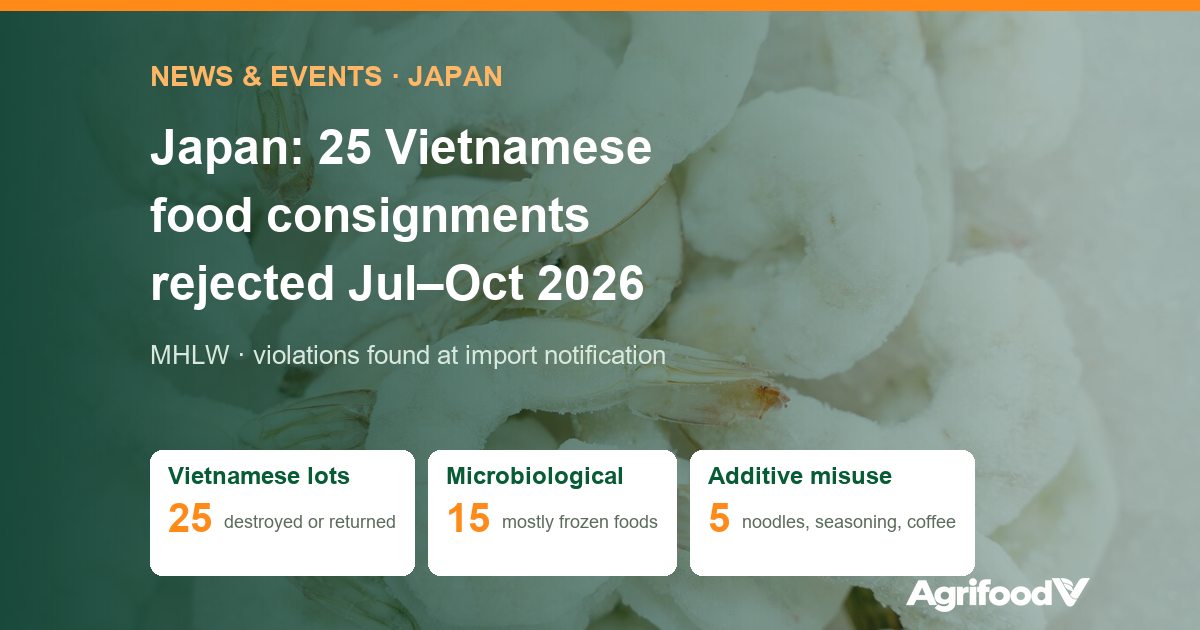
According to the flash lists of Food Sanitation Act violations found at import notification, published by Japan’s Ministry of Health, Labour and Welfare (MHLW), 25 consignments of food from Vietnam were ordered to be destroyed or returned between July and October 2026. More than half failed microbiological criteria, mostly frozen seafood and frozen fruit and vegetables; the rest involved misused additives, pesticide residues and veterinary drugs.
Key points
- MHLW’s four lists for July, August, September and October 2026 record 233 violations in total, 25 of them with Vietnam as the exporting country; October alone had 10, second only to China (24).
- 15 of the 25 consignments failed microbiological criteria (E. coli, coliforms, viable bacterial count), mainly frozen pangasius, shrimp, squid, octopus, jackfruit, okra and corn.
- 5 consignments breached additive rules: cyclamic acid in a seasoning, sorbic acid in rice noodles, SO₂ in frozen longan, and an emulsifier used outside its permitted food category in instant coffee.
- All 25 consignments were directed by Japanese quarantine stations to be destroyed or returned; this article does not name the companies.
What the MHLW violation list is
Every month MHLW publishes the table “Recent Cases of Violation of the Food Sanitation Act that were Found on the Occasion of Import Notification (Flash)” on its imported food safety page. Each row gives the product, exporting country, manufacturer, article violated, details of the violation, quarantine station, importer, disposal of the cargo and the type of inspection that detected it. Under the Imported Foods Monitoring and Guidance Plan for FY 2026, MHLW publishes these violations under Article 69 of the Food Sanitation Act and may enhance inspections at import when violations are found.
The table shows three main types of inspection. Monitoring inspections are planned annual sampling under Article 28. An inspection order under Article 26 requires importers to have every consignment of high-risk foods tested. The third type is instruction-based inspection, carried out on the instruction of the quarantine station.
The 25 Vietnamese consignments by type of violation
| Type of violation | Consignments | Products and details (per MHLW table) |
|---|---|---|
| Microbiological (E. coli, coliforms, viable bacterial count) | 15 | Frozen pangasius (3 consignments), frozen black tiger shrimp and breaded fried shrimp, squid, octopus, mackerel, salmon, trout, seedless jackfruit, half-cut okra, cut corn, frozen éclairs, instant durian coffee mix |
| Misused or non-permitted additives | 5 | Seasoning paste for Hue noodle soup: cyclamic acid 180 μg/g; fresh rice vermicelli and bun bo Hue noodles (2 consignments): sorbic acid 0.03 g/kg in a non-permitted food; frozen longan: SO₂ 0.14 g/kg; instant salted coffee: sodium stearoyl lactylate used outside its permitted food category |
| Pesticide residues | 2 | Fresh centella (pennywort): chlorfenapyr 6 ppm, plus tebuconazole 0.26 ppm and buprofezin 0.03 ppm; frozen red chilli: etoxazole 0.14 ppm |
| Veterinary drugs | 2 | Frozen peeled vannamei shrimp: furazolidone 0.002 ppm (table notes cultured shrimp from India); frozen baby shrimp: enrofloxacin 0.10 ppm |
| Other criteria | 1 | Instant noodles: acid value 5.3 |
Source: MHLW, violations found at import notification, July–October 2026; grouping and counts by AgrifoodV. Company names are not given.
By month, Vietnamese consignments numbered 8 (July), 3 (August), 4 (September) and 10 (October). The November list published on 4 November 2026 already adds one consignment of Vietnamese frozen snow crab exceeding the viable bacterial count. Of the 25 consignments in July–October, 9 were detected by monitoring inspection, 12 by instruction-based inspection, 3 under inspection orders (frozen red chilli and two shrimp consignments) and 1 by administrative inspection.
Microbiology on frozen products is the biggest weakness
Japan classifies frozen foods by how they are consumed: eaten without heating, eaten after heating (further split by whether the product was heated immediately before freezing), and frozen fish and shellfish for raw consumption. The MHLW table states the category of each consignment, and the criterion cited differs by category. For example, among pangasius consignments, one listed as “eaten after heating, not heated before freezing” was rejected for positive E. coli, while one “heated immediately before freezing” was rejected for a viable bacterial count of 4.1×10⁶/g.
The eaten-without-heating group includes jackfruit, okra, corn and éclairs; recorded counts ranged from 1.2×10⁵/g to 1.9×10⁶/g, jackfruit and corn were also coliform-positive, and okra was recorded only as coliform-positive. For seafood eaten raw, three consignments of salmon, trout and squid were coliform-positive, and the octopus consignment had a viable bacterial count of 3.4×10⁵/g. The product category declared at import is therefore directly tied to the microbiological criterion the consignment is tested against.
Related developments: a new inspection order and one already in force
On 30 October 2026, MHLW ordered testing of every consignment of Chinese okra and simply processed okra products for mepiquat chloride, after monitoring inspections found 3 consignments above 0.01 ppm (0.04–0.24 ppm). MHLW said this was the first time this pesticide residue inspection order had been applied to Chinese okra. Vietnamese frozen okra also appeared in the July list, for coliforms.
For Vietnamese products, according to a notice dated 27 March 2026, MHLW applies an inspection order for cyclamic acid to foods from certain designated manufacturers, and that notice added one more Vietnamese manufacturer to the list after voluntary testing at import detected cyclamic acid. The noodle seasoning rejected in July 2026 also breached this rule.
What companies should do
The following are AgrifoodV’s recommendations, not content published by MHLW.
- Agree the correct frozen food category with the importer before production, because microbiological criteria differ between ready-to-eat products, products eaten after heating and seafood eaten raw. The HACCP plan and sampling frequency must follow the declared category.
- Control hygiene after the heating step (blanching, steaming, frying) and during cutting and tray-loading before freezing; this is where coliform recontamination of ready-to-eat fruit, vegetables and seafood commonly occurs.
- Check Japan’s additive list for each product rather than reusing domestic formulations: sorbic acid, cyclamate sweeteners and emulsifiers may all be prohibited in a specific food category.
- Follow MHLW’s monthly violation tables to see what faults are being found in similar products, and use them when planning pre-export testing.
Companies that need to review plant processes for frozen export products can refer to AgrifoodV’s processing plant advisory services.
References
- Ministry of Health, Labour and Welfare of Japan (MHLW), Recent Cases of Violation of the Food Sanitation Act that were Found on the Occasion of Import Notification (Flash), tables for July, August, September, October and November 2026, Imported Food Safety page. mhlw.go.jp (accessed 7 November 2026).
- MHLW, Imported Foods Monitoring and Guidance Plan for FY 2026 (effective 1 April 2026–31 March 2027). mhlw.go.jp (PDF) (accessed 7 November 2026).
- MHLW, press release 輸入食品に対する検査命令の実施(中国産おくら、その加工品) [Inspection order on imported foods (okra from China and its processed products)], 30 October 2026. mhlw.go.jp (accessed 7 November 2026).
- MHLW, Notice 健生食輸発0327第2号 of 27 March 2026 adding a manufacturer to the cyclamic acid inspection order for foods from Vietnam. mhlw.go.jp (PDF) (accessed 7 November 2026).
Article by AgrifoodV, compiled from the sources above (accessed 7 November 2026). This content is not a substitute for legal advice.
Cover image: Deane Bayas / Pexels
Looking at Vietnam as a sourcing origin or a place to build a value chain?
Tell us your product, target market and expected volumes. In a 30–45 minute online call, AgrifoodV reviews buyers, standards, processing capacity and growing areas with you, starting from the market.
Book a call →Sourcing from Vietnam© 2026 AgrifoodV. Nội dung được phép trích dẫn khi ghi rõ nguồn và đặt liên kết tới bài gốc; không sao chép toàn văn. Xem Điều khoản sử dụng nội dung.