AgrifoodV ·
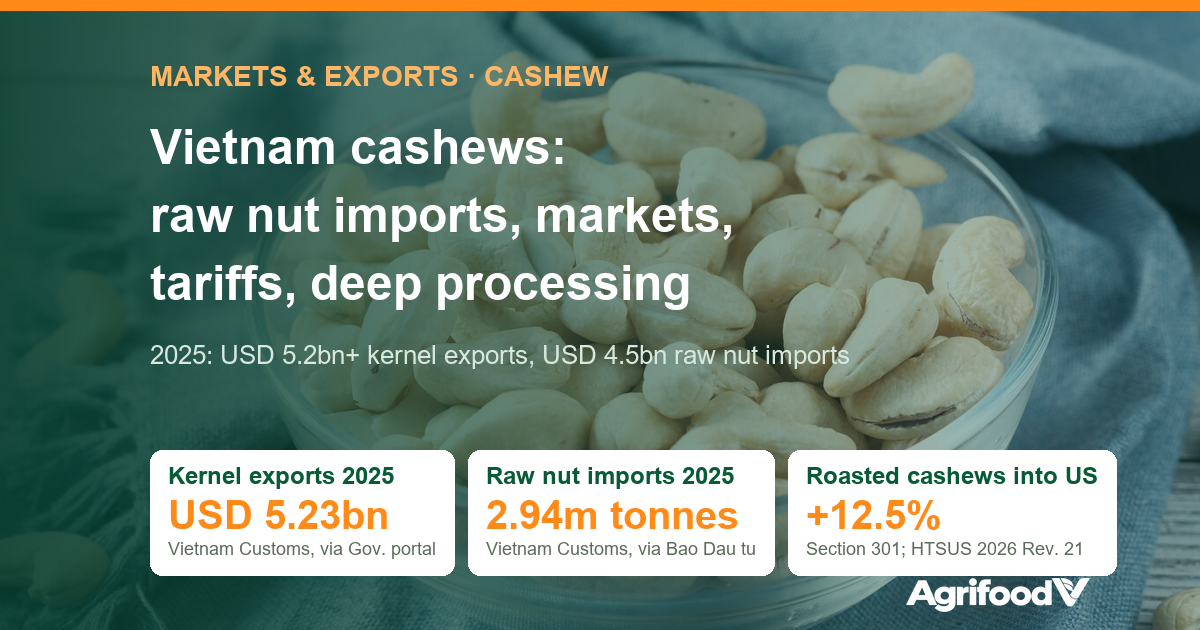
In 2025 Vietnam’s cashew exports passed USD 5 billion for the first time, yet in the same year its plants spent about USD 4.5 billion importing nearly 3 million tonnes of raw cashew nuts. The cashew industry is a processing industry built on imported raw material: the value added lies in the gap between the price of raw nuts from Africa and Cambodia and the price of kernels sold to buyers in China, the United States and Europe. This article sets out four areas an investor should understand before putting money into a cashew plant: raw-material supply, markets, tariffs by product form, and buyer standards.
Key points
- In 2025 Vietnam exported 766,585 tonnes of cashew kernels worth USD 5.229 billion and imported 2.942 million tonnes of raw cashew nuts worth USD 4.5 billion. Domestic raw-nut output was 293 thousand tonnes, covering only about 10% of processing demand.
- China overtook the United States as the number one market in 2025 (USD 1.12 billion against USD 975.4 million). In the first nine months of 2026, value rose 1.9% while volume fell 2.2%: growth came from price.
- US tariffs hit the deep-processing step: cashew kernels are exempt from the Section 301 duty, roasted cashews pay an extra 12.5%. The EU works the other way: kernels are duty-free for every country, and roasted cashews are where EVFTA gives a real advantage (0% against 7–8%).
- Raw-nut supply is tightening: West Africa is processing more, and Cambodia aims to keep raw material at home. In 2026, up to 29 October, RASFF has no notification recording cashews of Vietnamese origin.
Raw material: a processing industry built on imported raw nuts
According to the General Statistics Office, national cashew output in 2025 was 293.0 thousand tonnes, down 4.3% year on year; the 2025 release does not publish the planted area. Dong Nai City (including former Binh Phuoc) is the largest cashew area, with over 176,000 ha, about 58% of the national area, according to figures presented at the province’s cashew sector conference on 23 May 2026. The Vietnam Cashew Association (VINACAS) estimates that domestic supply meets only about 10% of processing demand.
The rest is imported raw cashew nuts (RCN, in-shell). According to Vietnam Customs figures cited by Bao Dau tu, in 2025 Vietnam imported 2.942 million tonnes worth USD 4.5 billion, up 17.7% in volume and 39.3% in value; the average import price was USD 1,526.9 per tonne, up 18.4%. Cambodia supplied 32.9% of the volume, Côte d’Ivoire 25.3%, Nigeria 9.7% and Ghana 8%. In the first eight months of 2026, according to preliminary Vietnam Customs figures, imports exceeded 2.1 million tonnes (down 2%) but value exceeded USD 3.5 billion (up nearly 6%); Cambodia alone supplied more than 1 million tonnes, about half.
Globally, the International Nut and Dried Fruit Council (INC) records that in 2023 Vietnam and India accounted for 92% of world raw cashew imports (49% and 43%). Vietnam is also the largest cashew exporter, with 31% of world exports in 2023 on a kernel-equivalent basis, and an average of 33% in 2019–2023.
The concern lies on the supply side. According to the African Cashew Alliance (ACA), citing estimates by N’Kalô, West Africa processed 732,000 tonnes of raw nuts in 2025, up 51%, with Côte d’Ivoire alone at about 600,000 tonnes. Côte d’Ivoire set the 2026 farm-gate floor price at 400 CFA/kg, and Ghana at 12 cedi/kg. Nigeria ruled out a raw-nut export ban in its 2025–2035 policy framework but targets 50% domestic processing by 2035. Cambodia, according to secondary sources, aims to process 25% of its crop by 2027. AgrifoodV has not found any raw-nut export ban currently in force in the main origin countries, but the general trend is to keep raw material for local kernel production.
Markets: China moves to number one, Europe is where Vietnam’s share is highest
| Indicator | 2025 | First nine months of 2026 |
|---|---|---|
| Cashew kernel exports | 766,585 tonnes; USD 5.229 billion | 542,768 tonnes (−2.2%); USD 3.84 billion (+1.9%) |
| Average export price | about USD 6,820/tonne (own calculation) | USD 7,082/tonne (+4.1%) |
| China | 172,700 tonnes; USD 1.12 billion (+49.4%) | 131,463 tonnes; about USD 964 million |
| United States | 146,000 tonnes; USD 975.4 million (−15.5%) | 114,225 tonnes; about USD 782 million |
| Netherlands | USD 495 million (third) | – |
| Raw-nut imports | 2.942 million tonnes; USD 4.5 billion | 8 months: over 2.1 million tonnes; over USD 3.5 billion |
Source: Vietnam Customs figures via the Government News portal, Dan tri (11 January 2026), Bao Dau tu (1 August 2026), Dan Viet (15 October 2026), CafeBiz (18 September 2026). These are figures reported by the press; AgrifoodV has not been able to check them against the original Vietnam Customs tables.
In 2025 cashews were Vietnam’s fourth-largest agricultural export, after coffee, fruit and vegetables, and rice, and over the full year the sector had a trade surplus of more than USD 700 million. But as of 15 July 2026 the sector showed a trade deficit of about USD 390–400 million, because the first half of the year is the raw-nut import season. Anyone reading quarterly figures should keep this cycle in mind to avoid wrong conclusions.
Europe is where Vietnam’s share is highest. According to CBI (Netherlands Ministry of Foreign Affairs, updated 23 March 2026), in 2024 Europe imported 215,729 tonnes of cashew kernels from outside the region; Vietnam supplied 90% of the United Kingdom’s imports, 75% of the Netherlands’, 63% of France’s and 62% of Germany’s. CBI also notes that most kernels entering Europe are reprocessed (roasted, salted, packed for retail), that the Netherlands is a re-export hub, and that buyers expect IFS Food certification (especially in Germany), social compliance under the Sustainable Nut Initiative’s standards, and digital traceability. In other words, Vietnam sells plain kernels to Europe, while roasting, packing and branding happen in European plants.
Tariffs by product form: the most important point
| Market | Cashew kernels (0801.32) | Roasted, prepared cashews (2008.19) |
|---|---|---|
| EU | 0% for every country (since 2005); EVFTA adds no advantage | MFN 7% (packs over 1 kg), 8% (packs up to 1 kg); Vietnamese goods 0% under EVFTA |
| United States | MFN 0%; exempt from Section 301 (note 52(b), entered under 9903.05.86) | MFN 0% (2008.19.10.40) +12.5% Section 301 from 24 July 2026 |
| China | MFN 10%, interim rate 7%, ACFTA 0%, RCEP 5% | Not checked in this round |
| UAE | MFN 5%; CEPA rate for cashews not yet checked | Not checked in this round |
Source: TARIC (reference date 17 October 2026), HTSUS 2026 Revision 21 and Chapter 99, China’s 2026 import tariff schedule, Dubai Customs HSCodeMaster v3.2. In-shell cashews (0801.31) into China: MFN 20%, interim rate 5%, ACFTA 0%.
The table shows that the two largest markets treat deep processing in opposite ways. In the United States, cashew kernels are on the exemption list from the Section 301 duty (the 12.5% measure applied to Vietnamese goods from 24 July 2026), but roasted salted cashews are not, so the more roasting, seasoning and packing is done in Vietnam, the higher the duty on goods entering the United States. In the EU, kernels have long been duty-free for all countries, while roasted and prepared cashews from other countries pay 7–8%, so EVFTA creates a real advantage only for processed goods. China is where tariffs explain the growth: ACFTA brings Vietnamese kernels to 0% while the interim rate for other countries is 7%. For cashew butter entering the United States, the tariff line (2008.19.10 or 2008.19.90) has not been determined; an advance classification ruling is needed.
Buyer standards: aflatoxin, Salmonella, foreign bodies and contracts
- EU, contaminants. Regulation (EU) 2023/915 (consolidated version of 19 August 2026) applies to cashews within the tree nut group: products placed on the market for the final consumer or used as a food ingredient have maximum levels of 2.0 µg/kg aflatoxin B1 and 4.0 µg/kg total aflatoxins; products still to be sorted or physically treated have 5.0 and 10.0 µg/kg. Cadmium in tree nuts is limited to 0.20 mg/kg.
- United States, trade specifications. The cashew kernel specification of the Association of Food Industries (AFI, updated September 2023) requires moisture of 3–5%, Salmonella negative in 375 g, Listeria monocytogenes negative in 125 g, airtight packaging flushed with at least 60% food-grade CO₂, and bans methyl bromide. Vietnam’s TCVN 4850:2010 sets a maximum moisture of 5%; W180 and W320 grade counts under AFI and TCVN differ by a few nuts per kg, so contracts must state which standard applies.
- Gulf. GSO member states are consulting on a draft cashew kernel regulation GSO 788 until 11 December 2026, detailed in the article on GSO 788 for cashew kernels.
- Actual alerts. A RASFF search on 29 October 2026 (filtering titles containing “cashew”) shows no 2026 notification recording cashews of Vietnamese origin. The most recent case was glass fragments in Vietnamese cashews in 2024; the two Salmonella cases in 2025 concerned cashews from Côte d’Ivoire. The main risk recorded for Vietnamese goods is foreign bodies, not aflatoxin.
- Payment risk. The 100 containers of cashews sold to Italy in 2022 were paid by D/P (documents against payment) through a broker; 35 containers lost their original documents. According to the Vietnam Trade Office in Italy, by 16 June 2022 all 100 containers had been returned to the companies’ ownership, with the help of Italian courts and police. The lesson is the risk of D/P with new counterparts, not “a total loss”.
Deep processing: published figures are still missing
The plan for key industrial crops to 2030 (reported by VietnamPlus on 14 February 2024) targets 280,000–300,000 ha of cashew and output of 0.36–0.4 million tonnes; full automation of shelling and peeling in all processing facilities; and more than 95% of facilities holding ISO, HACCP or GMP. The targets focus on the kernel stage; for deeper products such as packed roasted salted cashews, cashew butter, cashew milk and cashew nut shell liquid (CNSL) used in the chemical industry, AgrifoodV has not found official production or export figures. On the market side, CBI notes that roasted salted cashews remain the main snack form in Europe, while unsalted and minimally processed products are growing.
Read together with the tariff table, the sensible market direction is: kernels for the United States and China; roasted, packed products for the EU, where EVFTA brings duties to 0% and buyers need suppliers with IFS Food. The choice of shelling, peeling and sorting line technology is a separate topic; this article stops at the questions of who to sell to, in what product form and at what duty.
What companies should do
The following are AgrifoodV’s recommendations.
- Plan raw-material supply across several origins and seasons: Cambodia early in the year, West Africa mid-year. Track floor-price and local-processing policies in origin countries as an input risk, not just a price movement.
- Calculate duties by product form before investing in roasting and packing: a roasted line for the EU, a kernel line for the United States and China; for the United States, add the 12.5% Section 301 duty to roasted-product quotes.
- State the grading standard (AFI, TCVN or ISO 6477) in the contract; test aflatoxin at final-consumer levels when selling to EU roasters; invest in foreign-body detection because this is the recorded risk.
- With new counterparts, avoid unsecured D/P; use a letter of credit or check the counterpart through the Trade Office before releasing documents.
AgrifoodV helps companies with market and product-form tariff analysis and processing plant direction. Further reading: the design brief for an export processing plant and traceability from growing areas to the plant.
Cashew sector series
In-depth articles on roasted cashews and deep processing, imported raw material, standards and markets, updated as new articles are published:
References
- General Statistics Office of Vietnam. Thông cáo báo chí tình hình kinh tế – xã hội quý IV và năm 2025 [Press release on the socio-economic situation in Q4 and 2025], January 2026. nso.gov.vn.
- Government News portal. Xuất khẩu hạt điều lần đầu tiên vượt 5 tỷ USD [Cashew exports exceed USD 5 billion for the first time], 11 January 2026. baochinhphu.vn; Dan tri, Xuất khẩu hạt điều lập kỷ lục 5,2 tỷ USD, Trung Quốc soán ngôi Mỹ [Cashew exports hit a record USD 5.2 billion, China overtakes the US], 11 January 2026. dantri.com.vn.
- Bao Dau tu. Xuất nhập khẩu điều vượt 5,6 tỷ USD nhưng nhập siêu 400 triệu USD [Cashew trade exceeds USD 5.6 billion but with a USD 400 million deficit], 1 August 2026. baodautu.vn.
- Dan Viet. Việt Nam xuất khẩu hạt điều trên 3,8 tỷ USD… [Vietnam’s cashew exports exceed USD 3.8 billion…], 15 October 2026 (citing Vietnam Customs). danviet.vn; CafeBiz, import figures for the first eight months of 2026, 18 September 2026. cafebiz.vn.
- WTO and Integration Center (VCCI). Hạt điều Việt Nam gia nhập câu lạc bộ 5 tỷ USD [Vietnamese cashews join the USD 5 billion club], 12 January 2026. trungtamwto.vn; VietnamPlus, Dong Nai cashew sector conference 2026–2030, 23 May 2026. vietnamplus.vn; VietnamPlus, targets to 2030, 14 February 2024. vietnamplus.vn.
- International Nut and Dried Fruit Council (INC). Statistical Yearbook 2024, pp. 22–23. inc.nutfruit.org.
- CBI. What is the demand for cashew nuts on the European market?, updated 23 March 2026. cbi.eu.
- African Cashew Alliance. Ivory Coast cuts cashew prices 6% amid US market uncertainty, 10 February 2026. africancashewalliance.com; Tribune Nigeria, Nigeria unveils cashew roadmap, rules out raw nut export ban, 17 September 2026. tribuneonlineng.com.
- European Commission. TARIC, codes 0801 32 00 and 2008 19, origin Vietnam, reference date 17 October 2026. ec.europa.eu.
- USITC. Harmonized Tariff Schedule of the United States 2026, Revision 21, lines 0801.31, 0801.32, 2008.19 and Chapter 99 (U.S. note 52). hts.usitc.gov.
- Customs Tariff Commission of the State Council of China. 2026 import tariff schedule (税委会公告2025年第12号). gss.mof.gov.cn; Dubai Customs, HSCodeMaster v3.2. dubaicustoms.gov.ae.
- European Commission. Commission Regulation (EU) 2023/915 on maximum levels for certain contaminants in food, consolidated version CELEX 02023R0915-20260819, points 1.1.6, 1.1.7, 3.2.1.5.1. eur-lex.europa.eu.
- Association of Food Industries (AFI). Specifications for Cashew Kernels, updated September 2023. afius.org; VINACAS, TCVN 4850:2010 Nhân hạt điều [Cashew kernels] (bilingual edition). vinacas.com.vn.
- European Commission. RASFF Window, public search for “cashew”, 29 October 2026. webgate.ec.europa.eu.
- Tap chi Cong Thuong (Industry and Trade Magazine). 100 container hạt điều nghi bị lừa tại Italia đã được trả cho doanh nghiệp Việt [100 cashew containers suspected of fraud in Italy returned to Vietnamese companies], 20 June 2022. tapchicongthuong.vn.
Article by AgrifoodV, compiled from the sources above (accessed 17 October 2026 and 29 October 2026). Trade figures are Vietnam Customs figures reported by the press; Cambodia’s processing target comes from secondary sources; the UAE CEPA rate for cashews and the duty on roasted cashews in China and the UAE have not been checked. The recommendations are AgrifoodV’s assessment. This content is not a substitute for legal advice. Cover image: Towfiqu barbhuiya / Pexels.
Looking at Vietnam as a sourcing origin or a place to build a value chain?
Tell us your product, target market and expected volumes. In a 30–45 minute online call, AgrifoodV reviews buyers, standards, processing capacity and growing areas with you, starting from the market.
Book a call →Sourcing from Vietnam© 2026 AgrifoodV. Nội dung được phép trích dẫn khi ghi rõ nguồn và đặt liên kết tới bài gốc; không sao chép toàn văn. Xem Điều khoản sử dụng nội dung.