AgrifoodV ·
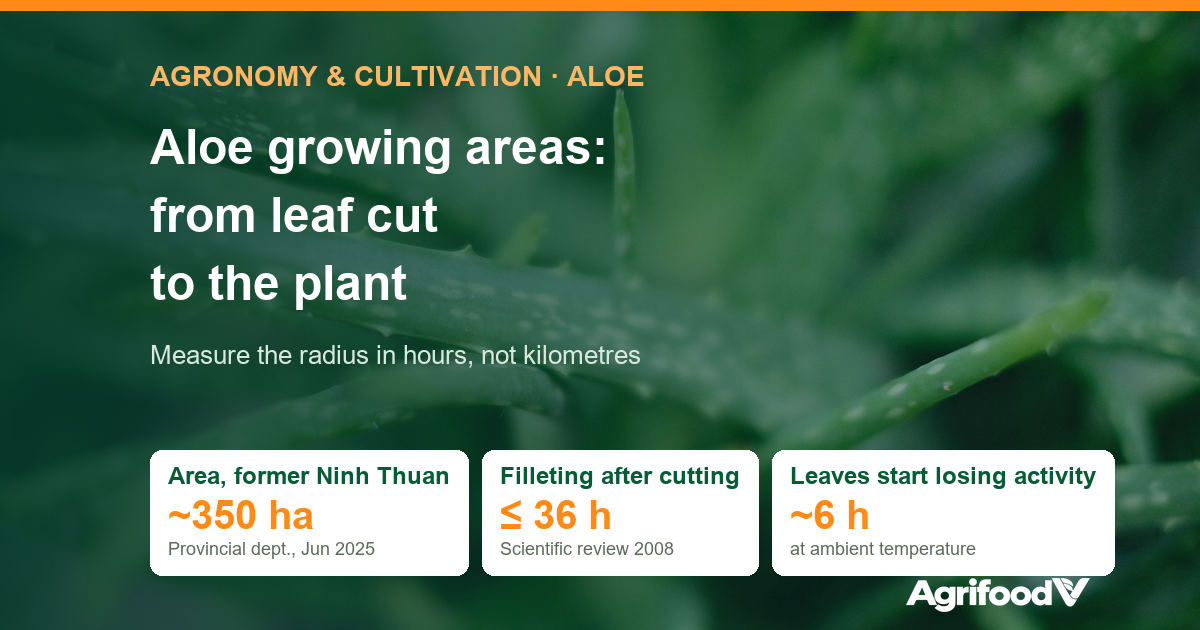
With aloe vera, the growing area and the plant cannot be separated. Leaves start to lose bioactivity about 6 hours after cutting if kept at ambient temperature, and the inner leaf should be filleted within 36 hours. So the first question when planning a plant for aloe gel, powder or cosmetic ingredients is not which machines to buy, but how many hours the fields are from the plant, which planting material is used, and what harvest rhythm the fields follow. This article brings together what is documented on planting material, cultivation, harvesting and the time from leaf cutting to the plant.
Key points
- Vietnam’s largest aloe area is in former Ninh Thuan province (now part of Khanh Hoa): about 350 ha, with about 800 ha planned under the crop production plan for 2021–2025 with a vision to 2030 (Ninh Thuan Department of Agriculture and Environment, via VTC News, June 2025).
- The plant prefers sandy or loamy, well-drained soils and tolerates drought and salinity; it is propagated from suckers or by tissue culture. Nitrogen is the most important nutrient (PROTA, 2006).
- According to Ninh Thuan growers: first harvest 6–8 months after planting, 10–11 cuts a year, 2–5 productive years. International sources describe a different rhythm under other climates; no published Vietnamese field trials were found.
- Decisive time points: chill the leaves or start processing within 4–6 hours, finish filleting within 36 hours (scientific review, 2008). The growing-area radius must be measured in hours, not kilometres.
Existing growing areas in Vietnam
According to the Ninh Thuan Department of Agriculture and Environment (VTC News, 17 June 2025), the province had about 350 ha of aloe, concentrated in Phan Rang – Thap Cham and the districts of Ninh Phuoc, Thuan Bac, Ninh Hai and Ninh Son. The province’s crop production plan for 2021–2025, with a vision to 2030, sets a target of about 800 ha: Phan Rang – Thap Cham 400 ha, Ninh Phuoc, Ninh Hai and Ninh Son 100 ha each, Thuan Bac 50 ha. This includes a company-linked area of about 200 ha working towards VietGAP and GlobalG.A.P., using tissue-culture planting material. Ninh Thuan aloe received a certification mark in 2019 (Industry and Trade Magazine); AgrifoodV has not been able to check the registration number and owner in the database of the Intellectual Property Office of Vietnam.
From 1 July 2025, Ninh Thuan was merged into Khanh Hoa province. The 350 ha and 800 ha figures refer to former Ninh Thuan; 2026 area and output for the merged Khanh Hoa have not been published. Farm-gate leaf prices in June 2025 were about VND 2,200–2,800/kg depending on quality (VTC News).
Planting material and propagation
The commercial species is Aloe vera (L.) Burm.f., also recorded as Aloe barbadensis Miller. According to PROTA (Afolayan and Adebola, 2006), the plant is usually propagated from suckers rather than seed, because seedling emergence is poor and suckers grow faster at first; suckers are cut from the mother plant when 15–20 cm long and may be grown in a nursery for the first year; water deficiency reduces sucker formation; in-vitro propagation from meristems or leaf bases is possible. For the plant, planting material is not only about yield: the species name in food and cosmetic ingredient files must match the plants in the field, so growing areas need a traceable source of planting material and records by lot.
Cultivation: ecology, density, pests and diseases
PROTA describes aloe as growing in a wide range of climates, preferring sandy or loamy, well-drained soils, surviving on poor soils but thriving on rich ones; it tolerates salinity; established plants survive drought well despite a shallow root system; it prefers full sun or light shade; it survives −3 °C with only slight injury. These traits explain why the dry, sandy coastal land of south-central Vietnam suits the crop.
On density, the trials summarised by PROTA gave the highest gel yields at about 60,000 plants/ha; in large plantations the distance between and within rows is usually at least 50 cm; about 15,000 plants/ha is considered optimal for intensive cultivation with drip irrigation and polythene ground cover. Lower densities give larger leaves but lower gel yields per hectare. Nitrogen is the most important nutrient. In the documented growing areas pests are few because of the tough leaf skin; recorded diseases include leaf spot caused by Alternaria alternata and Fusarium solani (India) and leaf rot caused by Erwinia chrysanthemi (Aruba).
In Ninh Thuan, growers say the crop has few pests and diseases and almost no insecticides are used, mainly weeding, irrigation and light fertilising after each cut (VTC News). For an export plant, these statements do not replace records: buyers need field logs, a list of inputs used and residue analysis by lot. Dry-season irrigation water is the main variable in dry areas; see also Dry-Season Water Management for High-Value Crops: Drought and Salinity in 2026–2027.
Harvesting: two different rhythms in the sources
According to Ninh Thuan growers (VTC News, June 2025), plants start giving stable harvests 6–8 months after planting and keep producing for 2–5 years; each sao (1,000 m²) yields 5–7 tonnes of leaves per cut, with 10–11 cuts a year. PROTA records a different rhythm: plants take about 3 years to reach harvestable size, after which leaves can be harvested for about 7 years; in Aruba, plants with good moisture and enough nitrogen produce 16–20 leaves a year. The two sources describe different climates, densities and harvesting practices; AgrifoodV did not find published yield trials for Vietnamese planting material or growing areas. Companies planning raw-material supply should use measured data from their linked growing areas over at least one year, not averages from the literature.
Leaves are cut close to the stem. Just under the leaf skin is a layer of yellow latex containing aloin and anthraquinones; when the leaf is cut, this latex drains from the cut (PROTA). For gel products, aloin is the parameter that decides market access, so handling in the field (no bruising, no latex on the inner fillet, tidy stacking for transport) is the first step of quality control, not a task for the plant alone.
The 36-hour clock from field to plant
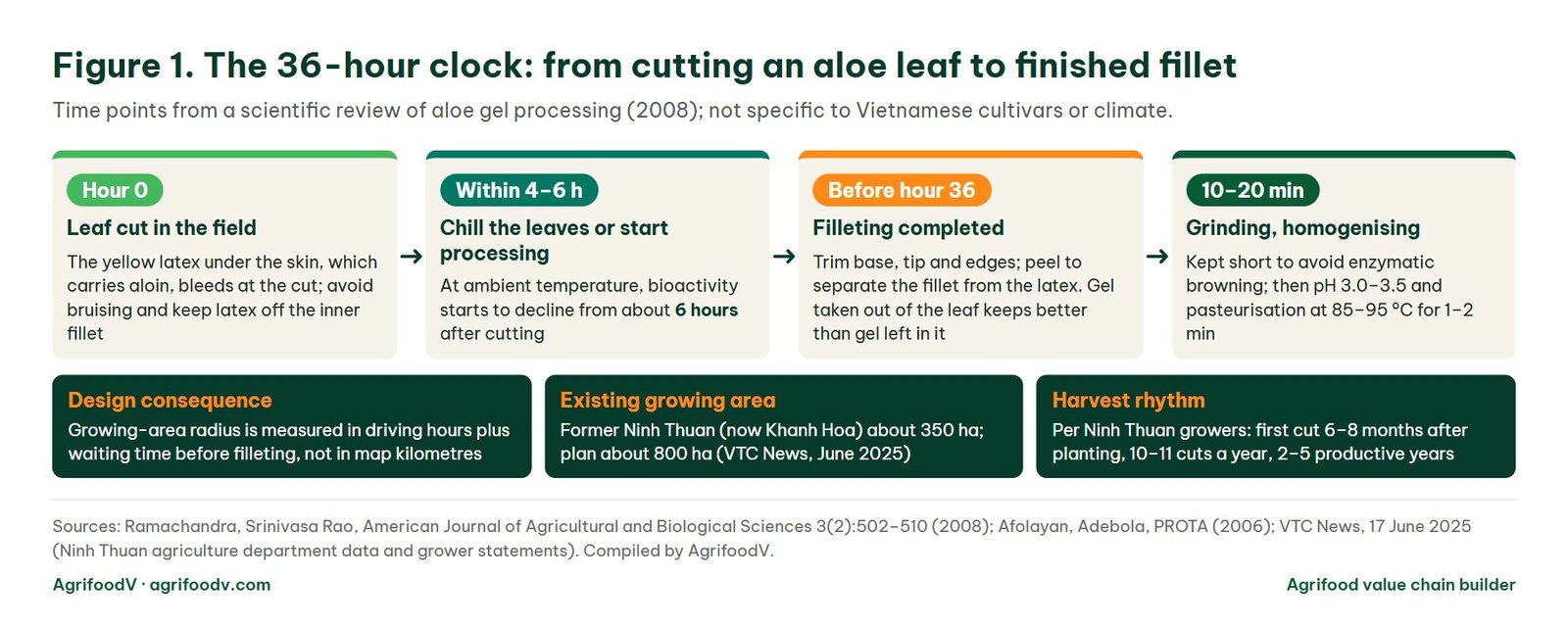
The review by Ramachandra and Srinivasa Rao (2008) on aloe gel processing gives the following time points.
| Time point | What happens or must be done | Consequence for growing area and plant |
|---|---|---|
| About 6 hours after cutting | Leaves kept at ambient temperature start to lose bioactivity | Harvest must match production shifts; leaves must not stay outdoors overnight |
| Within 4–6 hours | Chill the leaves, or send them straight into production | A chilled collection point is needed, or the plant must sit inside the growing area |
| Within 36 hours | Filleting completed: trim base, tip and edges, peel so the inner leaf does not mix with the yellow latex | Filleting capacity must keep up with the leaf volume of peak harvest days |
| After filleting | Gel taken out of the leaf keeps better than gel left in the leaf | Shipping leaves over long distances, even chilled, still loses activity; ship processed gel instead |
| 10–20 minutes | Grinding and homogenising time, kept short to avoid enzymatic browning; then pH 3.0–3.5 and pasteurisation at 85–95 °C for 1–2 minutes | Continuous line, no work-in-progress waiting |
Source: Ramachandra, C. T., Srinivasa Rao, P. (2008), review article; some figures in the review are quoted from manufacturers. These are not parameters specific to Vietnamese planting material or climate.
Design consequence: the growing-area radius of an aloe plant is measured in driving time plus the time leaves wait before filleting, not in map distance. That is why a gel plant should sit inside the growing area, while later stages (concentration, drying, blending) can be located further away because the product is already stable. Sizing area and harvest calendars to plant needs is covered in Raw-material growing areas: area, harvest calendar and growing-area codes; the product range from leaf to gel, powder and extracts in the pillar article Vietnam Aloe Vera: From Fresh Leaves to Gel, Powder and Extracts for Premium Markets.
What companies should do
AgrifoodV recommendations:
- Map growing areas in hours: the time from each field cluster to the filleting point, plus waiting time; only contract areas within that limit.
- Standardise planting material: one source of species-verified planting material, recorded by lot, preferably clean propagated plants; keep records that match the species name in the ingredient file.
- Schedule harvests by plant shift, not by market day; measure actual yields by field lot for at least one year before fixing capacity.
- Write leaf cutting, stacking and transport into the growing-area procedure (no bruising, no yellow latex on the inner leaf) and test aloin, residues and microbiology by lot at the plant.
- Locate the filleting point or gel plant inside the growing area; deeper processing stages can sit in an industrial park.
AgrifoodV supports companies in planning raw-material growing areas linked to the plant, from area selection and harvest calendars to traceability files for export buyers.
References
- VTC News. Từ cát nóng thành ‘vàng xanh’: Nông dân Ninh Thuận giàu lên nhờ Nha Đam [From hot sand to ‘green gold’: Ninh Thuan farmers prosper with aloe vera], 17 June 2025 (data from the Ninh Thuan Department of Agriculture and Environment; yields and prices as stated by growers). vtcnews.vn.
- Afolayan, A. J., Adebola, P. O. Aloe vera (L.) Burm.f. In: PROTA (Plant Resources of Tropical Africa), 2006. plantuse.plantnet.org.
- Ramachandra, C. T., Srinivasa Rao, P. Processing of Aloe Vera Leaf Gel: A Review. American Journal of Agricultural and Biological Sciences 3(2):502–510, 2008. DOI: 10.3844/ajabssp.2008.502.510.
- Industry and Trade Magazine. Ninh Thuận: Nha đam phủ xanh vùng cát trắng [Ninh Thuan: aloe vera greens the white sands]. tapchicongthuong.vn.
Article by AgrifoodV, compiled from the sources above (accessed 25–30 October 2026). Yields, leaf prices and harvest rhythm in Ninh Thuan are figures stated by growers and the press, not published trial results; the certification mark registration number has not been checked. Processing time points come from international literature, not parameters specific to Vietnam. This content is not a substitute for technical advice. Cover image: Alexey Demidov / Pexels.
Looking at Vietnam as a sourcing origin or a place to build a value chain?
Tell us your product, target market and expected volumes. In a 30–45 minute online call, AgrifoodV reviews buyers, standards, processing capacity and growing areas with you, starting from the market.
Book a call →Sourcing from Vietnam© 2026 AgrifoodV. Nội dung được phép trích dẫn khi ghi rõ nguồn và đặt liên kết tới bài gốc; không sao chép toàn văn. Xem Điều khoản sử dụng nội dung.