AgrifoodV ·
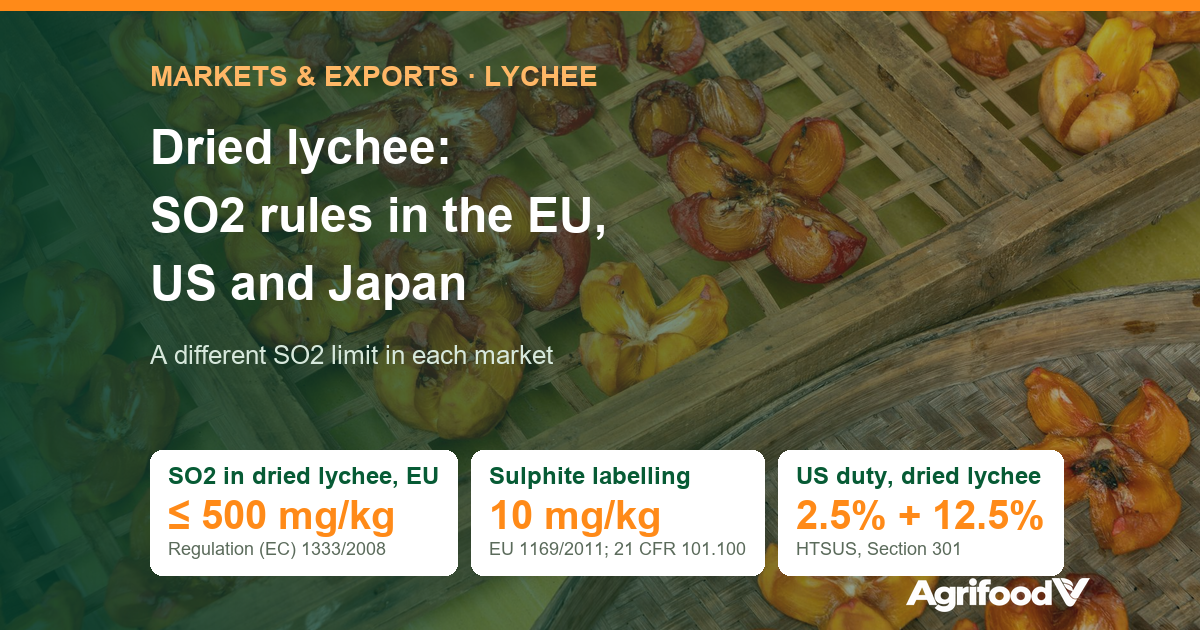
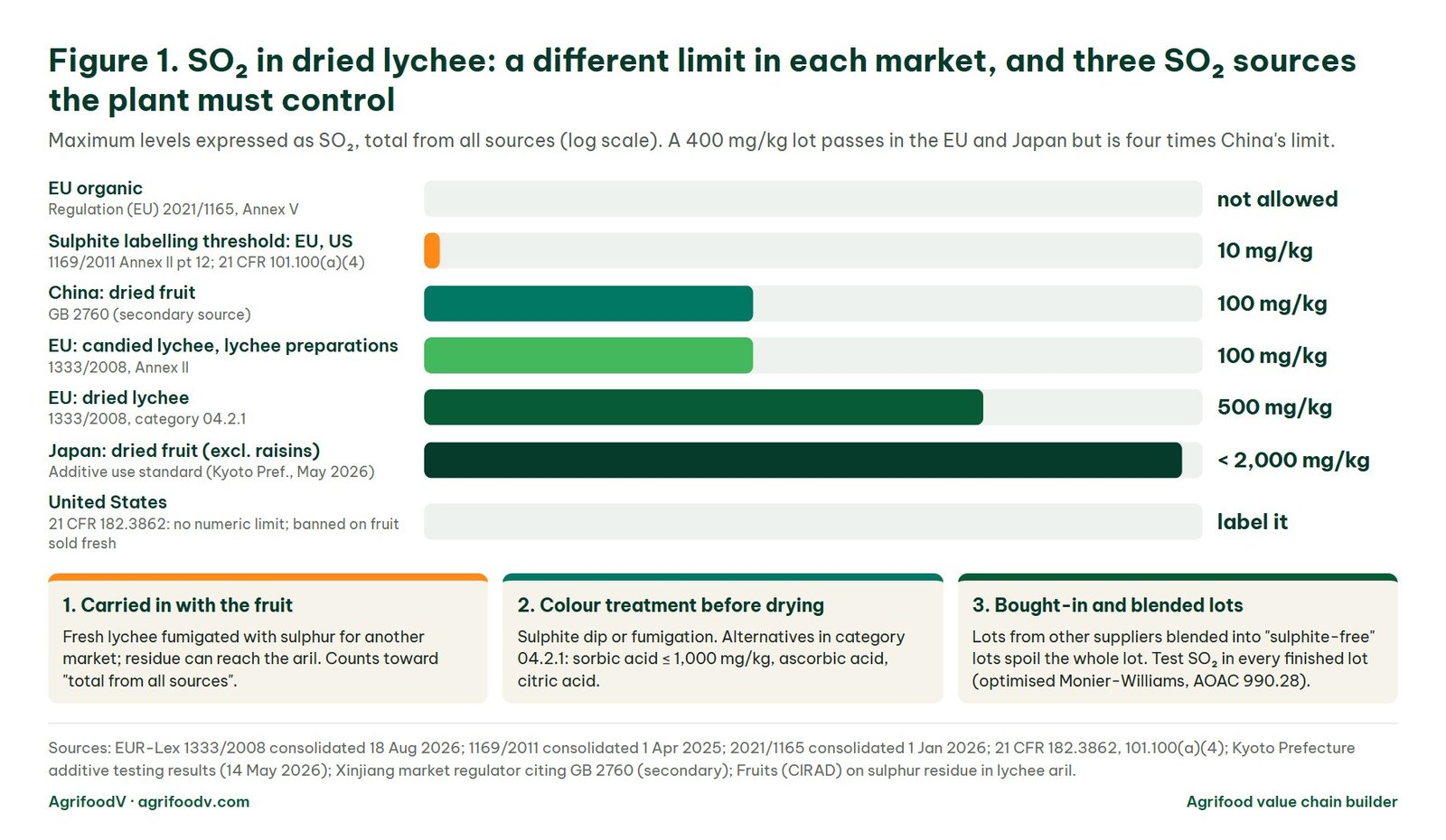
Dried lychee is the easiest processed lychee line to start: no cold chain, no aseptic equipment, and it sells all year round. In demanding markets, however, what decides whether a lot of dried lychee is accepted or rejected is sulphur dioxide (SO₂). The EU allows up to 500 mg/kg, Japan less than 2,000 mg/kg, China only 100 mg/kg for dried fruit, and EU organic products may not use SO₂ at all. EU alert data also show that the most common failure of Vietnamese dried fruit is not exceeding the limit, but containing sulphites that are not declared on the label.
Key points
- In the EU, dried lychee falls under “dried fruit, excluding apples, pears, bananas, apricots, peaches, grapes, prunes and figs”: SO₂ up to 500 mg/kg, total from all sources. The 2,000 mg/kg level applies only to apricots, peaches, grapes, prunes and figs (Regulation (EC) 1333/2008, consolidated 18 August 2026).
- Above 10 mg/kg, sulphites must be labelled as an allergen in the EU (Regulation (EU) 1169/2011, Annex II, point 12); in the US, sulphites detectable at 10 ppm or more must be declared (21 CFR 101.100(a)(4)).
- A RASFF title search on 29 October 2026 found 6 sulphite alerts since 2022 on dried mango, candied fruit, coconut strips and processed fruit from Vietnam, mostly for undeclared sulphites. There has been no alert on dried lychee.
- Duties on dried lychee of Vietnamese origin fall to 0% in the EU, Japan, Korea and China under the relevant agreements; the US charges 2.5% plus 12.5% under Section 301, while fresh and frozen lychee are exempt from the 12.5%.
Where dried lychee sits in EU additive law
Our pillar article on Vietnamese lychee showed that dried lychee is one of four product lines that extend the selling season beyond May–July. For this line, the first technical question is how much SO₂ may be used. Annex II of Regulation (EC) 1333/2008 sets SO₂ and sulphites (E 220–228) by food category, and lychee appears in three different entries depending on the product form. Levels are expressed as SO₂, total from all sources; a content of no more than 10 mg/kg is considered not present.
| Product (EU) | Maximum SO₂ | Legal basis |
|---|---|---|
| Fresh lychee | 10 mg/kg, measured on edible parts | Category 04.1.1 (table grapes, fresh lychees, blueberries only) |
| Dried lychee (“other” dried fruit) | 500 mg/kg | Category 04.2.1 |
| Comparison: dried apples, pears / dried bananas / dried apricots, peaches, grapes, prunes, figs | 600 / 1,000 / 2,000 mg/kg | Category 04.2.1 |
| Fruit preparations with lychee, rehydrated dried fruit | 100 mg/kg | Category 04.2.4.1 |
| Candied, crystallised or glacé fruit | 100 mg/kg | 1333/2008, Annex II |
| Organic dried lychee | Not allowed | Regulation (EU) 2021/1165, Annex V: E 220 only for fruit wines and mead; E 223 only for crustaceans |
Two details are often overlooked. First, “total from all sources” means SO₂ carried in with the raw material also counts. Fresh lychee fumigated with sulphur to keep the skin red for another market will carry the residue into the dried product; according to a study published in the journal Fruits (CIRAD), sulphur residue from skin fumigation can reach the aril. Second, within category 04.2.1 the EU allows sorbic acid and potassium sorbate up to 1,000 mg/kg for dried fruit only, as well as Group I additives such as ascorbic acid and citric acid. These are the tools of a process that uses little or no SO₂.
The US, Japan and China: three different approaches
The US sets no numeric SO₂ limit for dried fruit. SO₂ and sulphite salts are “generally recognised as safe”, but may not be used on fruit and vegetables intended to be served raw, sold raw or presented as fresh (21 CFR 182.3862). Where the US is strict is labelling: sulphites present in the finished food at 10 ppm or more must be declared and cannot be treated as an insignificant amount (21 CFR 101.100(a)(4)). Japan works through additive use standards: dried fruit (excluding raisins) must contain less than 2.0 g/kg of residual SO₂ and raisins less than 1.5 g/kg, according to published testing results of Kyoto Prefecture (updated 14 May 2026). China is the strictest: according to a document of the Xinjiang market regulator citing standard GB 2760, the maximum SO₂ for dried fruit (水果干类) is 0.1 g/kg; a 2026 news report citing GB 2760-2024 says this level is unchanged. AgrifoodV has not been able to read the original table of GB 2760-2024 or the original Korean text.
| Market | SO₂ in dried lychee | Label | Duty on dried lychee of Vietnamese origin |
|---|---|---|---|
| EU | ≤ 500 mg/kg; organic: not allowed | > 10 mg/kg: label as allergen | 0813 40 65: 0% |
| US | No numeric limit; banned on fruit sold fresh | ≥ 10 ppm: must be declared | 0813.40.90: 2.5% + 12.5% Section 301 |
| Japan | < 2,000 mg/kg (dried fruit excluding raisins) | Additive declaration | 0813.40-021: 7.5% → VJEPA 0% |
| China | ≤ 100 mg/kg (secondary source) | — | 25% → ACFTA 0% (secondary tariff source) |
| Korea | Original text not yet read | — | 0813409000: VKFTA 0% |
AgrifoodV’s view: no single SO₂ level sells into every market. A lot of dried lychee at 400 mg/kg is compliant in the EU and Japan but four times China’s limit. The plant therefore has to choose its market before fixing the colour treatment recipe, and for the US it must also price in the 12.5% Section 301 duty that makes dried lychee more expensive than frozen lychee.
The common failure is not exceeding the limit but failing to declare
AgrifoodV searched the EU RASFF database by words in the alert title (lychee, litchi, longan, sulphite, sulphur dioxide and variants) on 29 October 2026. For lychee, there are only two sulphite-related alerts, both on fresh fruit: excessive sulphite in lychees from Madagascar (2021.0072) and undeclared sulphite on lychees from South Africa (2021.0858). Recent alerts on Vietnamese lychee (2025.5476, 2026.5369, 2026.7466) all concern pesticide residues on fresh lychee; none concerns dried lychee.
For other dried and processed fruit from Vietnam, the picture is different: 2022.1821 (dried mango, notified by Denmark), 2023.0668 (candied fruit, via Czechia), 2024.0953 (candied fruit, via Czechia), 2025.6275 (dried mango, Czechia), 2026.0847 (coconut strips, via Czechia) and 2026.5036 (fruit, notified by France). Almost all of them concern sulphites present in the product but not stated on the label. Under Regulation (EU) 1169/2011, sulphites above 10 mg/kg must appear in the ingredients list and be emphasised as an allergen; without that line, the lot is mislabelled even if its content is below the maximum level. A title search of RASFF may miss alerts, and there is no denominator of imported lots, so these figures are not violation rates.
Pesticide residues are the second risk. Regulation (EC) 396/2005 (Article 20) allows the residue limit for processed products to take account of changes caused by processing; when fruit loses water, residues per kilogram rise. The growing area for dried lychee must therefore be controlled for residues as tightly as the area for fresh lychee, not used as an outlet for rejects. In 2025, uncertified lychee in Bac Ninh sold for VND 5,000–15,000/kg and went mainly to drying, juice, peeling and freezing (Bac Ninh Department of Industry and Trade, via Saigon Times); in other words, today’s drying raw material is mostly fruit that did not meet the standard for fresh export. AgrifoodV has found no published figure for Vietnam’s dried lychee output or export value.
Premium buyers: sulphite-free is a separate product line
In the EU organic segment, the question of an SO₂ level disappears: Annex V of Regulation (EU) 2021/1165 (consolidated 1 January 2026) does not allow SO₂ or sulphites in organic dried fruit. To sell into this segment, the plant must hold colour and prevent browning through time and process: fruit reaches the plant the same day, preparation does not wait, only additives permitted under organic rules are used, and the drying regime is chosen accordingly. Browning in lychee is linked to polyphenol oxidase activity when the tissue is damaged (Fruits, CIRAD), so peeling and destoning, not drying, are the steps that decide colour.
Beyond organic, industrial buyers and premium retail chains usually buy against a certificate of analysis for each lot: SO₂ content, moisture or water activity, microbiology, pesticide residues and foreign matter. Unlike fresh lychee, dried lychee competes on consistency between lots. A supplier whose SO₂ ranges from below 10 mg/kg to several hundred mg/kg forces the buyer to label every lot “contains sulphites”, and the plant loses the “sulphite-free” advantage it intended to sell.
What companies should do
AgrifoodV recommendations:
- Choose the market and segment before fixing the recipe: standard product for the EU and Japan (below 500 mg/kg), product for China (below 100 mg/kg) and organic product (no SO₂) are three different processes, so separate lines or shifts and separate lots.
- Check SO₂ at intake: do not accept sulphur-fumigated fresh lychee for the sulphite-free line, and write this into growing-area contracts.
- Test SO₂ in every finished lot at a laboratory using a recognised method (for example the optimised Monier-Williams method, AOAC 990.28), and set a labelling rule: above 10 mg/kg, declare sulphites for the EU and the US.
- Treat the growing area for drying as an export growing area: growing-area codes, spray records and pre-harvest residue analysis, as in the procedure in our article on raw-material intake and incoming checks.
- Price US sales with 15% duty (2.5% + 12.5%) before choosing the US as the main market for dried lychee.
AgrifoodV supports market-by-market analysis of import requirements and processing plant direction for lychee product lines.
References
- European Union. Regulation (EC) 1333/2008 on food additives, Annex II (categories 04.2.1, 04.2.4.1, fresh fruit, candied fruit), consolidated CELEX 02008R1333-20260818 (read 29 October 2026). eur-lex.europa.eu.
- European Union. Regulation (EU) 1169/2011 on food information to consumers, Annex II point 12, consolidated CELEX 02011R1169-20250401. eur-lex.europa.eu.
- European Union. Implementing Regulation (EU) 2021/1165 on products and substances authorised in organic production, Annex V Part A1, consolidated CELEX 02021R1165-20260101. eur-lex.europa.eu.
- European Union. Regulation (EC) 396/2005 on maximum residue levels of pesticides, Article 20 (processed products), consolidated CELEX 02005R0396-20260819. eur-lex.europa.eu.
- European Commission. RASFF Window, search by alert title on 29 October 2026 (2021.0072, 2021.0858, 2022.1821, 2023.0668, 2024.0953, 2025.5476, 2025.6275, 2026.0847, 2026.5036, 2026.5369, 2026.7466). webgate.ec.europa.eu.
- United States. 21 CFR 182.3862 (sulfur dioxide) and 21 CFR 101.100(a)(4) (sulfites in food), eCFR. ecfr.gov; ecfr.gov.
- Kyoto Prefecture (Japan). Food additive testing results for fiscal year 2025, including SO₂ use standards for dried fruit and raisins, updated 14 May 2026. pref.kyoto.jp.
- Xinjiang Uygur Autonomous Region Market Supervision Administration (China). Explanatory document on non-compliant parameters, citing GB 2760 on SO₂ in dried fruit (secondary source). scjgj.xinjiang.gov.cn.
- Fruits (CIRAD). Research on post-harvest pericarp browning of lychee and the effect of SO₂. revues.cirad.fr.
- Bac Ninh Department of Industry and Trade, via Saigon Times (Tuoi Tre). Bắc Ninh dự kiến tiêu thụ vải thiều kỷ lục với hơn 205.000 tấn [Bac Ninh expects record lychee sales of over 205,000 tonnes], 24 August 2025. tuoitre.vn.
- European Commission, TARIC (code 0813 40 65, origin Vietnam); USITC, HTSUS and USTR Section 301 notice of 23 July 2026; Japan Customs, tariff schedule of 8 August 2026; Korea Customs, yesFTA portal (checked 25 October 2026). ec.europa.eu; ustr.gov (PDF); customs.go.jp.
Article by AgrifoodV, compiled from the sources above (accessed 25–29 October 2026). China’s SO₂ limit and Chinese tariff rates come from secondary sources; Japan’s level comes from material published by Kyoto Prefecture and has not been checked against the original text of the Ministry of Health, Labour and Welfare. The 10-digit HS code and the classification of candied lychee must be confirmed by a customs broker. This content is not a substitute for legal advice. Cover image: Peter Xie / Pexels.
Looking at Vietnam as a sourcing origin or a place to build a value chain?
Tell us your product, target market and expected volumes. In a 30–45 minute online call, AgrifoodV reviews buyers, standards, processing capacity and growing areas with you, starting from the market.
Book a call →Sourcing from Vietnam© 2026 AgrifoodV. Nội dung được phép trích dẫn khi ghi rõ nguồn và đặt liên kết tới bài gốc; không sao chép toàn văn. Xem Điều khoản sử dụng nội dung.