AgrifoodV ·
Lychee in syrup is the oldest processed lychee product, and it is also the product whose paperwork buyers in the US and the EU scrutinise most closely: lychee flesh has a natural pH above 4.6, so every can must sit in the correct regulatory category and come with a validated thermal process. There is no dedicated Codex standard for canned lychee; the commercial specification is set by the contract and by the importing country’s law. This article covers the four things a plant must settle: the pH category, the product specification, thermal processing and pinking, and the duties in each market.
Key points
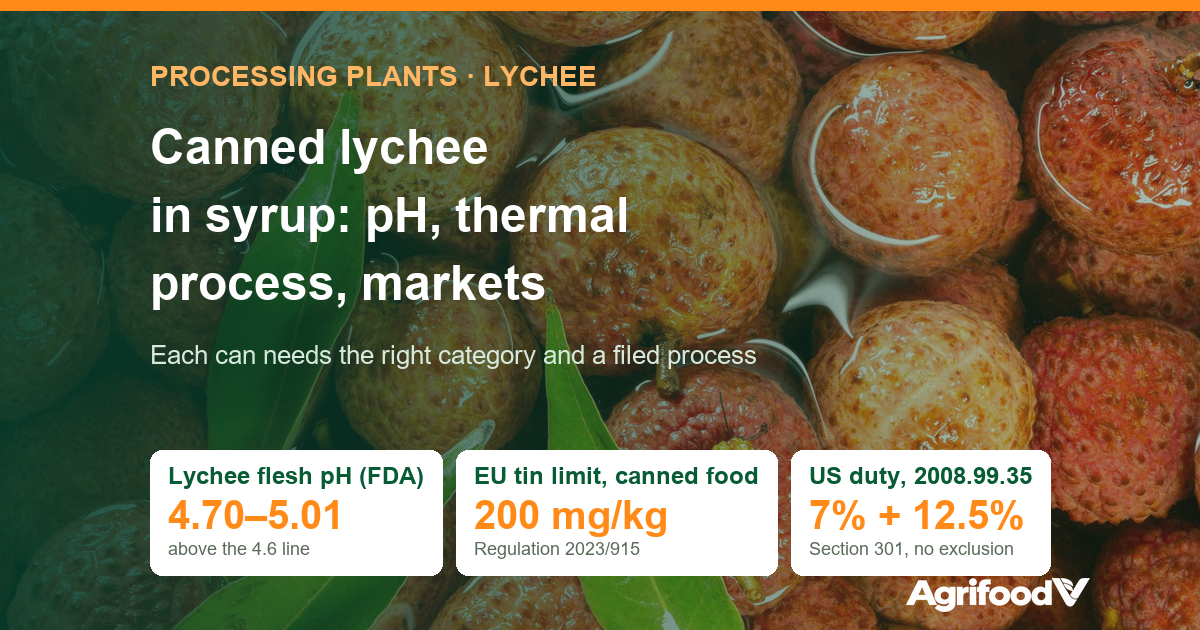
- FDA’s pH list gives lychee flesh a pH of about 4.70–5.01. Canned lychee without added acid is a low-acid canned food (21 CFR 113); with acid added so that the equilibrium pH is 4.6 or below, it becomes an acidified food (21 CFR 114). Both categories require establishment registration and a filed thermal process with FDA before export.
- The US has no standard of identity for canned lychee in 21 CFR 145; Codex CXS 196-1995 covers fresh lychee only. Vietnam has TCVN 1577:2007 “Canned lychee”.
- In the EU, additive category 04.2.3 (canned fruit) has no entry allowing SO₂ for lychee and allows colours only for red fruit; citric acid, ascorbic acid and calcium chloride may be used quantum satis. Tin in canned food is capped at 200 mg/kg; the label must state the drained net weight.
- Duties: EU 11% to 0% under EVFTA, Japan 14% to 0% under VJEPA; into the US, line 2008.99.35 pays 7% plus 12.5% under Section 301 because it is not on the exclusion list.
pH decides the regulatory category of every can
FDA’s “Approximate pH of Foods and Food Products” list (2003 edition) gives lychee a pH of 4.70–5.01. The 4.6 threshold is the legal line in the US: under 21 CFR 113.3, a low-acid food is any food with a finished equilibrium pH greater than 4.6 and a water activity greater than 0.85; under 21 CFR 114.3, an acidified food is a low-acid food to which acid or acid foods are added so that the finished equilibrium pH is 4.6 or below. Lychee in syrup has a high water activity, so a can of lychee can only fall into one of these two categories; there is no third route.
The two categories lead to two different ways of working. Lychee that is not acidified must be commercially sterilised in a pressure retort under 21 CFR 113, with the process filed on Form FDA 2541d. Lychee acidified with citric acid can be heat-treated at lower temperatures, but the equilibrium pH of every batch must be controlled under 21 CFR 114 and the process filed on Form 2541e. Both require registration of the canning establishment on Form 2541 (21 CFR 108.25 and 108.35). Where FDA finds that a facility does not control the Clostridium botulinum hazard, shipments can be detained automatically under Import Alert 99-38 (version of 27 October 2026). The natural pH of the flesh varies with cultivar and ripeness, so the plant must measure the equilibrium pH of the finished product, not the pH of the syrup at filling.
The specification: what standards say and what contracts say
Codex has a standard for lychee, CXS 196-1995, but it applies only to fresh lychee and excludes lychee for industrial processing. AgrifoodV did not find a dedicated Codex standard for canned lychee. In the US, 21 CFR 145 contains standards of identity for peaches, pears, pineapple, apricots, cherries and several other fruits, but not lychee. In Vietnam, TCVN 1577:2007 “Canned lychee” (replacing TCVN 1577:1994) provides, according to its public summary, that where the packing medium is water or juice without added sugar, the soluble solids of the product must be below 14 °Brix, and that fruit and medium must occupy at least 90% of the water capacity of the container. The rest of the specification is written by the buyer into the contract, according to the importing country’s law.
| Parameter | Basis checked | What the plant must have |
|---|---|---|
| Equilibrium pH | US: 21 CFR 113.3, 114.3 (4.6 threshold) | pH of finished product for every batch, data kept by cultivar and ripeness |
| Syrup Brix, drained weight | EU: Regulation (EU) 1169/2011 Annex IX point 5, a solid food in a liquid medium must also state the drained net weight; Brix per contract | Syrup Brix after equilibration, drained weight for every lot |
| Fill of container | TCVN 1577:2007: fruit and medium at least 90% of the water capacity of the container | Fill, vacuum and seam checks |
| Tin | EU: Regulation (EU) 2023/915, item 3.5.1, canned food maximum 200 mg/kg; canned beverages 100 mg/kg | Can lacquer suited to an acid product, tin results over the shelf life |
| SO₂, sulphites | EU: category 04.2.3 of Regulation (EC) 1333/2008 has no SO₂ entry for lychee. US: sulphites may be left off the label only when not detectable (21 CFR 101.100(a)(4)) | No sulphur-fumigated raw fruit; SO₂ result for each lot |
| Colour, additives | EU 04.2.3: colours only for red fruit; citric acid (E 330), ascorbic acid (E 300), calcium chloride (E 509) quantum satis | Additive list and actual use levels for each market |
The last two rows have direct consequences on the factory floor. Uncertified lychee, or lychee fumigated with sulphur to keep the skin red, that enters a canning line for the EU will carry residues that this product category is not allowed to have. And when canned lychee changes colour, the plant has no way to “fix” it with colours in the EU market; colour must be protected through raw material and process. How to build the specification sheet sent to buyers is explained in From market requirements to product specifications: Brix, product form, packaging.
Thermal processing and pinking
The characteristic quality defect of canned lychee is flesh turning pink during storage. A thesis at Chulalongkorn University (Thailand) studied the factors behind pinking, including ripeness, can type, processing time and temperature, and the addition of 100–200 ppm sodium bisulphite to the syrup; under the EU rules above, the bisulphite route cannot be used for goods destined for the EU. A short study by Wu and Chen (Journal of Food Quality, 1999) on two Taiwanese cultivars showed that adding 0.2% citric acid to the syrup reduced pinking, and that flesh texture was better when the syrup sugar content was close to that of the flesh.
Processing temperature is another trade-off. A study in RSC Advances (2020) compared canned lychee treated at 70 °C and 121 °C: samples at 121 °C retained more phenolics and antioxidant activity, but were darker and had poorer texture. For a plant, this means there is no “standard” process to copy. The process must be established by a process authority for the specific can size, fruit-to-syrup ratio, equilibrium pH and initial temperature, and only then filed with FDA. Filling, seaming and thermal processing should also sit in the clean zone of the layout, following the principles in One-way flow and clean–dirty zoning.
Duties and markets
| Market | Tariff line for lychee in syrup, canned | Duty on Vietnamese goods |
|---|---|---|
| EU | 2008 99 48 99 (with added sugar, packings over 1 kg) | MFN 11% → EVFTA 0% |
| US | 2008.99.35.00 “Lychees and longans” | 7% + 12.5% Section 301 (not excluded) |
| Japan | 2008.99-216 (with added sugar) | 14% → VJEPA 0% |
| South Korea | 2008999000 | VKFTA 0% |
| China | 2008.99.90 | MFN 5% → ACFTA 0% |
Table sources: AgrifoodV data set compiled from TARIC, USITC, Japan Customs and Korea’s yesFTA portal on 25 October 2026; Section 301 duty per the USTR notice of 23 July 2026, applied from 24 July 2026. Retail packings under 1 kg in the EU fall under a different TARIC line and should be confirmed by a customs broker. In the US, fresh and frozen lychee are excluded from the Section 301 duty, but canned lychee is not, so the total duty into the US is 19.5%.
On competitive position, the pillar article Vietnam Lychee Export: Markets, Duties, Standards and Deep Processing noted that China’s lychee output in 2025 was expected at about 3.45 million tonnes, roughly 11 times Vietnam’s forecast, and that Vietnamese fresh lychee ripens in May–July, the same season as China. AgrifoodV’s view: canned lychee is one of the few product forms that allow lychee to be sold all year, but against a competitor of that scale the advantage has to come from lot-to-lot consistency and complete documentation, not from price.
What companies should do
AgrifoodV recommendations:
- Choose the market and the regulatory category first: measure flesh pH by cultivar and ripeness over at least one season, then decide between an acidified and a low-acid product; only then choose the thermal processing equipment.
- Engage a process authority to establish the thermal process for each can size, and complete establishment registration and process filing with FDA before offering to US buyers.
- Keep raw material for canning separate from sulphur-fumigated lychee, record field lot and ripeness at receiving, and keep retained samples of finished goods to monitor pinking and tin throughout the shelf life.
- For the US, build the 19.5% duty into the offer price; for the EU and Japan, prepare EVFTA and VJEPA certificates of origin to obtain 0%.
AgrifoodV supports companies with reviews of processing plant flows, layout and documentation against the requirements of the target market.
References
- FDA/CFSAN. “Approximate pH of Foods and Food Products”, October 2003 (archived copy). webharvest.gov.
- United States. 21 CFR 113.3 (low-acid canned foods) and 21 CFR 114.3 (acidified foods): definitions. law.cornell.edu; law.cornell.edu.
- FDA. Guidance for Industry: Submitting Form FDA 2541 and Forms FDA 2541d, 2541e, 2541f, 2541g (Food Process Filing Forms), November 2016. fda.gov.
- FDA. Import Alert 99-38, Detention without physical examination of low-acid canned foods or acidified foods due to inadequate process control, version of 27 October 2026. accessdata.fda.gov.
- United States. 21 CFR Part 145, Canned fruits (list of standards of identity) and 21 CFR 101.100(a)(4) (sulphites). ecfr.gov; ecfr.gov.
- Codex Alimentarius. CXS 196-1995, Standard for Litchi (scope: fresh lychee). Cited via Tanzania’s TBT notification, WTO 2023. members.wto.org.
- TCVN 1577:2007 Vải hộp [Canned lychee] (public summary). thuvienphapluat.vn.
- European Union. Regulation (EC) 1333/2008 on food additives, Annex II Part E category 04.2.3, consolidated version of 18 August 2026. eur-lex.europa.eu.
- European Union. Regulation (EU) 2023/915 on maximum levels for contaminants, section 3.5 (tin), consolidated version of 19 August 2026. eur-lex.europa.eu.
- European Union. Regulation (EU) 1169/2011 on food information, Annex IX point 5, consolidated version of 1 April 2025. eur-lex.europa.eu.
- Wang Z. et al. “Comparison of the phenolic profiles and physicochemical properties of different varieties of thermally processed canned lychee pulp”. RSC Advances 10:6743–6751, 2020. DOI: 10.1039/C9RA08393F.
- Wu M.C., Chen C.S. “A research note: effect of sugar types and citric acid content on the quality of canned lychee”. Journal of Food Quality 22(4):461–469, 1999 (abstract on AGRIS). agris.fao.org.
- Chulalongkorn University. Thesis on factors causing pink discoloration of canned lychee (abstract). cuir.car.chula.ac.th.
- USTR. Notice of final action under Section 301 on goods of Vietnam, Federal Register, 23 July 2026. ustr.gov.
- European Commission. TARIC, consulted 25 October 2026; USITC HTS; Japan Customs, Tariff Schedule Chapter 20 (version of 8 August 2026). ec.europa.eu; hts.usitc.gov; customs.go.jp.
Article by AgrifoodV, compiled from the sources above (accessed 25–30 October 2026). The pH and temperature figures in this article are published values; the thermal process for each product must be established and validated by a process authority. HS codes and duty rates should be confirmed by a customs broker for each product. This content is not a substitute for legal advice. Cover image: Vung Nguyen / Pexels.
Looking at Vietnam as a sourcing origin or a place to build a value chain?
Tell us your product, target market and expected volumes. In a 30–45 minute online call, AgrifoodV reviews buyers, standards, processing capacity and growing areas with you, starting from the market.
Book a call →Sourcing from Vietnam© 2026 AgrifoodV. Nội dung được phép trích dẫn khi ghi rõ nguồn và đặt liên kết tới bài gốc; không sao chép toàn văn. Xem Điều khoản sử dụng nội dung.