AgrifoodV ·
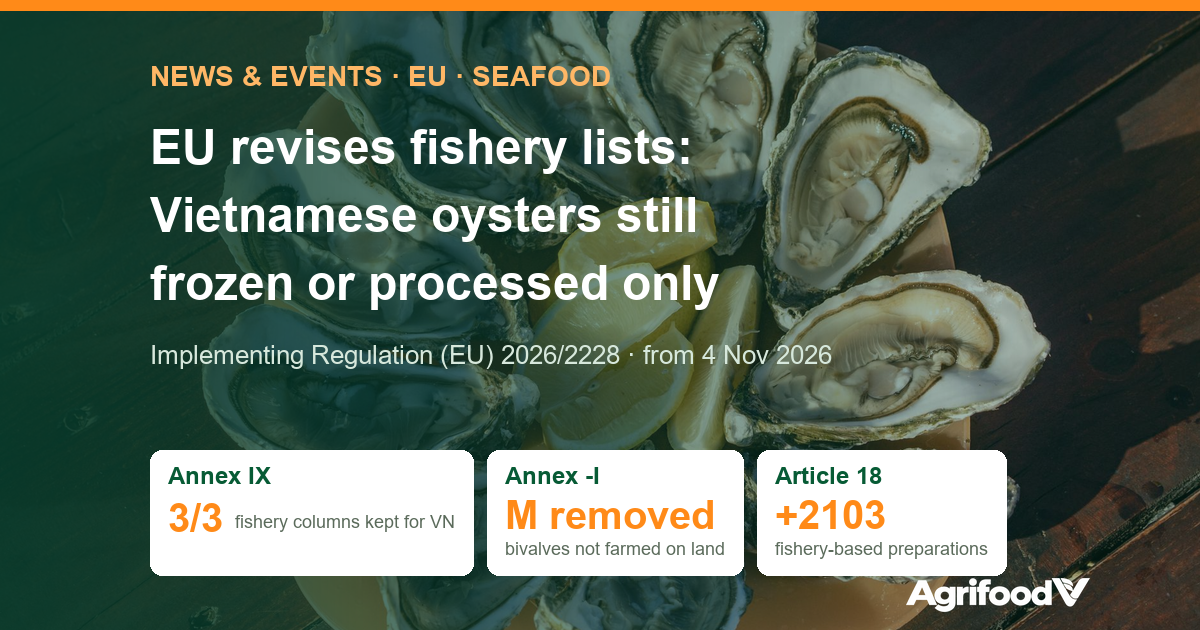
The European Commission has adopted Implementing Regulation (EU) 2026/2228 of 14 October 2026, applicable from 4 November 2026, amending the lists of countries authorised to ship animals and goods intended for human consumption into the EU. Vietnam remains authorised for fish, fish products and crustaceans from both wild catch and aquaculture, while bivalve molluscs such as oysters, clams and cockles may still enter the EU only frozen or processed. Alongside it, Delegated Regulation (EU) 2026/1304 removes the residue control plan requirement for bivalves not farmed on land and brings more fishery-based food preparations under the rule that goods must come from listed establishments.
Key points
- The list of countries authorised for fishery products (Annex IX to Regulation 2021/405) has been rebuilt into three columns: wild catch; aquaculture finfish and finfish products; aquaculture crustaceans. Vietnam is marked in all three, so its scope is unchanged.
- In the list of countries with approved residue control plans (Annex -I), Vietnam keeps its X for aquaculture but loses the M mark. The M mark now applies only to countries farming bivalves in premises on land.
- The list of countries authorised for bivalve molluscs (Annex VIII) is unchanged for Vietnam: frozen or processed products only.
- Since 13 September 2026, Article 18 of Regulation 2022/2292 also covers heading 2103 (sauces, mixed condiments and seasonings): fishery-based preparations under this heading must come from establishments on the EU list.
Two acts, one line of change
Animal products entering the EU face three layers of conditions. Delegated Regulation (EU) 2022/2292 sets out which goods must come from a listed country, requires that country to have an EU-approved control plan for veterinary medicines, pesticides and contaminants, and requires the goods to come from listed establishments with an official certificate. Implementing Regulation (EU) 2021/405 is where each country is named for each product group.
Delegated Regulation 2026/1304 was signed on 12 June 2026, published in the Official Journal on 24 August 2026 and entered into force on the twentieth day after publication, that is 13 September 2026. It amends 2022/2292. Implementing Regulation 2026/2228 was signed on 14 October 2026, published on 15 October 2026 and applies from 4 November 2026; it amends the annexes to 2021/405 to match that change and to clarify the structure of the fishery list. The consolidated version of 2021/405 on EUR-Lex has been updated to 4 November 2026.
Vietnam in three lists, before and after 4 November 2026
| List in Regulation 2021/405 | Before 4 November 2026 | From 4 November 2026 |
|---|---|---|
| Annex -I: countries with approved control plans, aquaculture column | X and M | X (M removed) |
| Annex VIII: bivalve molluscs, echinoderms, tunicates, marine gastropods | Frozen or processed products only | Unchanged |
| Annex IX: fishery products | One line, footnote “can export all fishery products (finfish, products of finfish and crustaceans)” | Marked in all three columns: wild catch; aquaculture finfish and finfish products; aquaculture crustaceans |
Source: EUR-Lex, consolidated versions of Implementing Regulation (EU) 2021/405 of 3 September 2026 and 4 November 2026; Implementing Regulation (EU) 2026/2228. AgrifoodV compared the Vietnam entries in the two versions.
According to the recitals of 2026/2228, Annex IX was rebuilt because Member State authorities found the old table ambiguous: it did not state clearly which countries could ship wild-caught products and which could ship farmed products. In the same round, several countries were narrowed or removed: Mozambique was deleted from Annex -I and is now limited to wild catch; Canada keeps farmed finfish but no longer farmed crustaceans; Curaçao and Sint Maarten were removed from Annex IX for failing to provide the required guarantees. Egypt’s control plan for farmed finfish and crustaceans was approved.
Bivalve molluscs: one requirement fewer, no new access
Regulation 2026/1304 places live, chilled, frozen and processed bivalve molluscs, echinoderms, tunicates and marine gastropods among the products to which Articles 6 to 12 of 2022/2292, the provisions on residue and contaminant control plans, do not apply. The exception is bivalves farmed in premises on land. The recitals explain that these species are usually farmed and harvested in the natural environment without feed or other substances, so such a control plan is justified only for on-land production. Accordingly, 2026/2228 removes the M mark for countries without on-land bivalve farming, Vietnam among them.
This does not widen the product forms Vietnam may ship. Annex VIII still lists Vietnam for frozen or processed bivalves only; live and chilled oysters from Vietnam still cannot enter the EU. Other requirements of 2022/2292 for Chapter 3 goods remain: the dispatching establishment must be listed (Article 13) and each consignment must carry an official certificate (Article 21). A full picture of the sector’s markets, tariffs and standards is available in our article on Vietnamese oyster processing.
Fishery-based preparations: heading 2103 added
Article 18 of 2022/2292 provides that fishery products under the listed headings may enter the EU only if they were obtained or prepared, at any stage, in an on-land establishment, factory or freezer vessel, or stored in a cold store or reefer vessel, that appears on a list published by the Commission. The new Article 18 adds heading 2103 (sauces and preparations therefor, mixed condiments and seasonings) compared with the original 2022 text, alongside headings 0301–0309, 1504, 1516, 1517, 1603–1605 and 2106. The recitals state the aim is to cover food preparations based on fishery and dairy products that the earlier code lists had missed.
The articles on country lists (Article 3), establishment lists (Article 13) and certificates (Article 21) have also been rewritten with broader code lists than the original text, including 1901, 2103 and CN code 2202 99. For Vietnamese companies, this concerns products such as dipping sauces, sauces and food preparations containing fishery ingredients; the exact code of each product must be determined from the tariff and the product description.
What companies should do
The following are AgrifoodV’s recommendations, not content of the EU acts.
- Oyster and bivalve plants: continue to design products for the EU market in frozen or processed form; do not offer live or chilled oysters to EU buyers while Annex VIII is unchanged.
- Check that every establishment is on the EU list before signing contracts, including outsourced cold stores and processors, because Article 18 applies at every stage of production and storage.
- Review the HS codes of processed products containing fishery ingredients (dipping sauces, sauces, ready-to-eat preparations). If a code falls under heading 2103 or another newly added heading, ask the buyer and the competent authority about establishment and certificate requirements before shipping.
- Keep growing-area monitoring and residue records: removing the M mark does not change food safety requirements when consignments are checked at EU border control posts.
If your company needs a review of its plant and documentation against EU market requirements, see AgrifoodV’s processing plant advisory services.
References
- European Union, Commission Implementing Regulation (EU) 2026/2228 of 14 October 2026 amending Implementing Regulation (EU) 2021/405 as regards the lists of third countries authorised for the entry into the Union of certain animals and goods intended for human consumption (OJ L, 15 October 2026). eur-lex.europa.eu (accessed 17 November 2026).
- European Union, Commission Delegated Regulation (EU) 2026/1304 of 12 June 2026 amending Delegated Regulation (EU) 2022/2292 as regards the requirements for the entry into the Union of certain dairy products, certain fishery products and bivalve molluscs (OJ L, 24 August 2026). eur-lex.europa.eu (accessed 17 November 2026).
- European Union, Implementing Regulation (EU) 2021/405, consolidated versions of 3 September 2026 and 4 November 2026 (Annexes -I, VIII, IX). eur-lex.europa.eu (accessed 17 November 2026).
- European Union, Delegated Regulation (EU) 2022/2292 of 6 September 2022, original text (Articles 3, 5, 13, 18, 21). eur-lex.europa.eu (accessed 17 November 2026).
Article by AgrifoodV, compiled from the sources above (accessed 17 November 2026). The comparison table was prepared by AgrifoodV from the two consolidated versions. This content is not a substitute for legal advice.
Cover image: Atlantic Ambience / Pexels
Looking at Vietnam as a sourcing origin or a place to build a value chain?
Tell us your product, target market and expected volumes. In a 30–45 minute online call, AgrifoodV reviews buyers, standards, processing capacity and growing areas with you, starting from the market.
Book a call →Sourcing from Vietnam© 2026 AgrifoodV. Nội dung được phép trích dẫn khi ghi rõ nguồn và đặt liên kết tới bài gốc; không sao chép toàn văn. Xem Điều khoản sử dụng nội dung.