AgrifoodV ·
Food manufacturers in Europe and the US buy ground spices and spice blends the way they buy any technical ingredient: every lot must come with results for extraneous matter, moisture, microbiology and contaminants, plus a validated microbial reduction process. Most of those figures are not in law but in trade association documents and in contracts. This article sets the European Spice Association (ESA) minima, FDA defect levels and EU legal limits side by side, so a plant knows which specification it must have before offering to buyers.
Key points
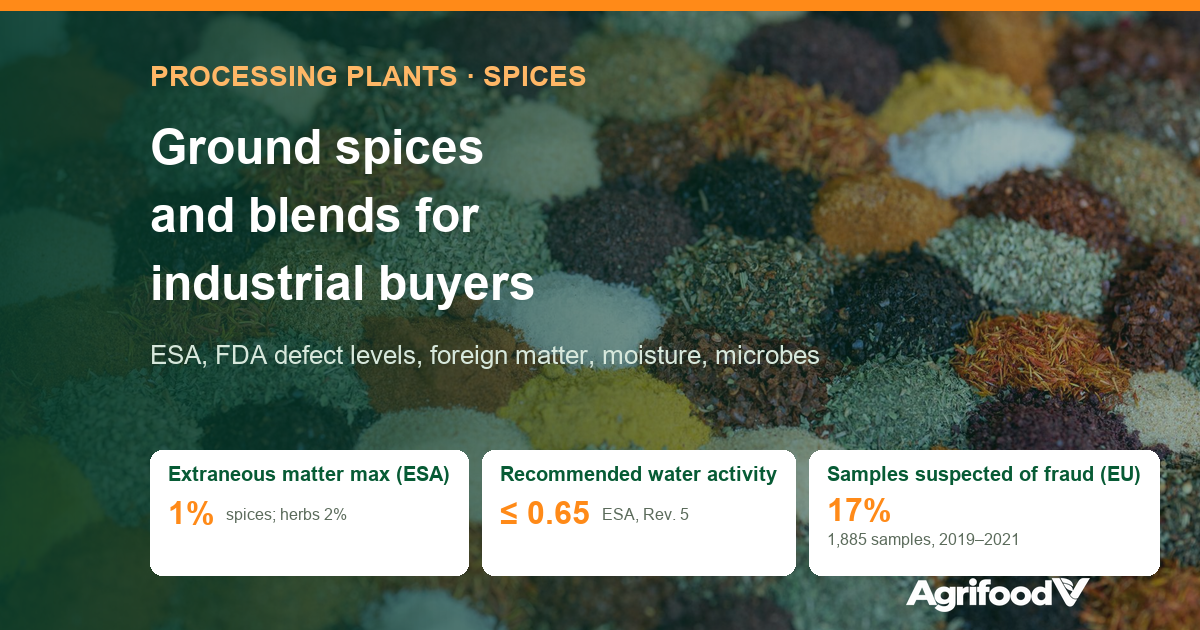
- ESA Quality Minima Document (Rev. 5, 2015, reviewed 2018): extraneous matter at most 1% for spices and 2% for dried herbs; hazardous foreign matter larger than 2 mm is the critical threshold; recommended water activity at most 0.65. ESA sets no numerical microbiological limits.
- US: FDA’s defect action level for ground pepper is 475 insect fragments/50 g, for ground cinnamon 400 fragments/50 g. FDA prohibits blending a lot above the defect level with other lots to “dilute” it, even if the final lot is below the level.
- Salmonella in the EU is handled under the unsafe-food principle (Article 14 of Regulation 178/2002); in the US, a single positive can put a company on Import Alert 99-19. The EU bans ethylene oxide; the US still allows it.
- Spice blends add two risks: allergens under EU labelling law (celery, mustard, sesame) and fraud. The EU coordinated control plan 2019–2021 found signs of fraud in 17% of 1,885 herb and spice samples.
Industrial buyers buy a specification sheet
In the EU, the common reference is the ESA Quality Minima Document, Revision 5, adopted on 27 October 2015 and reviewed on 26 March 2018 with the conclusion that no revision was needed; the copy republished in February 2026 is still Rev. 5. It sets minimum requirements for goods imported into the EU: extraneous matter at most 1% by weight for spices and 2% for dried herbs; no live or dead insects, insect fragments or rodent contamination visible to the naked eye; recommended water activity at most 0.65. The physico-chemical annex includes, for example, chilli: total ash at most 10%, acid-insoluble ash at most 1.6%, moisture at most 11%; black pepper: ash at most 7.0%, moisture at most 12%, volatile oil at least 2.0 ml/100 g.
In the US, the American Spice Trade Association (ASTA) publishes Cleanliness Specifications, but the tables are open only to members; ASTA describes them as meeting or exceeding FDA’s Defect Action Levels (DAL). The DALs are public, and they are the point at which FDA regards goods as “adulterated” under the law, not an acceptable quality level.
| Ground product | FDA defect action level | Note |
|---|---|---|
| Ground pepper | Average of 475 or more insect fragments/50 g; 2 or more rodent hairs/50 g | Whole pepper: 1% or more by weight infested or mouldy; 1% or more foreign matter |
| Ground cinnamon | Average of 400 or more insect fragments/50 g; 11 or more rodent hairs/50 g | Whole cinnamon bark: 5% or more by weight mouldy or insect-infested |
| Ground capsicum (excluding paprika) | More than 50 insect fragments/25 g; more than 6 rodent hairs/25 g; mould count above 20% | Paprika has its own levels |
| Curry powder (blend) | Average of 100 or more insect fragments/25 g; 4 or more rodent hairs/25 g | Applies to the finished blend |
Table source: FDA, Food Defect Levels Handbook (content current as of 7 September 2018). The handbook states two things a blending plant must read carefully: the defect levels are not averages, the actual averages are much lower; and mixing or blending a lot with defects at or above the action level with another lot is not permitted, and the finished food is unlawful regardless of its final defect level. In other words, blending must not be used to “rescue” poor raw material.
Foreign matter and metal
Two thresholds are often confused. ESA treats hazardous foreign matter (glass, metal, stone, wood) larger than 2 mm as the critical threshold. FDA, in Compliance Policy Guide Sec. 555.425 (issued 1999, revised 2005), regards ready-to-eat or minimally prepared food containing a hard or sharp object 7–25 mm long as adulterated; the guide notes that objects under 7 mm rarely cause injury, except in risk groups such as infants and the elderly. European buyers therefore usually set far tighter thresholds than the US legal level. With ground spices, metal fragments can be generated inside the line itself (mills, sifters, screw conveyors), so AgrifoodV’s view is that magnets, metal detection after milling and before packing, and shift-by-shift sensitivity check records are what buyers will ask about at every plant audit. Foreign-matter control starts at receiving, as described in Raw material receiving and storage: incoming checks, residues, retained samples.
Moisture, microbiology and the microbial reduction step
Moisture and water activity determine whether a ground spice will mould or cake in the buyer’s warehouse; ESA recommends water activity of at most 0.65, with the method and value agreed between the parties. On microbiology, ESA only states that products must not contain microorganisms at levels harmful to health and leaves specific limits to the contract; the phrase “Salmonella absent in 25 g” that many documents attribute to ESA does not appear in the Rev. 5 text. In the EU, the legal basis for rejecting a lot with Salmonella is Article 14 of Regulation (EC) 178/2002 on unsafe food.
In the US, FDA’s spice risk profile (draft, October 2013) recorded about 6.6% of imported spice shipments positive for Salmonella and about 12% contaminated with filth during 2007–2009. Import Alert 99-19 allows detention without physical examination by company; according to AgrifoodV’s data set consulted on 10 October 2026, the list includes 57 Vietnamese companies. The preventive controls rule 21 CFR 117 allows shipment of untreated goods if the customer in the US takes on the microbial reduction step and gives an annual written assurance (§117.136); outside that case, the plant must demonstrate a validated microbial reduction step.
| Microbial reduction method | EU | US |
|---|---|---|
| Ethylene oxide | Banned; residue limit for spices 0.1 mg/kg, equal to the limit of quantification (Regulation 2015/868) | Allowed; residue tolerance on crop group 19 dried herbs and spices 7 ppm (40 CFR 180.151) |
| Irradiation | At most 10 kGy (Directive 1999/3/EC), only at EU-approved facilities; Vietnam has no facility on the list | At most 30 kGy, retail labels must carry the Radura symbol (21 CFR 179.26) |
| Steam | No residue limit; supported by ESA | No residue limit; must be validated under FSMA |
Blending: allergens, fraud and contaminants in each ingredient
Spice blends sold into the EU must label allergens under Annex II of Regulation (EU) 1169/2011, which includes celery, mustard and sesame, three ingredients common in seasoning blends. If the same blending line runs recipes with and without these ingredients, the plant needs a cleaning plan, production sequencing and verification to control cross-contact.
Fraud is the second risk. In the European Commission’s coordinated control plan on herbs and spices for 2019–2021, the Joint Research Centre (JRC) analysed 1,885 samples, mostly ground, taken at the start of the supply chain: 17% showed signs of fraud, oregano 48%, pepper 17%, cumin 14%, turmeric 11%, chilli and paprika 6%; the adulterants were mainly undeclared plant material, and 2% of samples contained non-permitted colours. Ground goods are hard to check by eye, so buyers rely on supplier origin documentation and analytical results.
Finally, contaminant limits apply to each ingredient and to the blend. Under Regulation (EU) 2023/915, consolidated version of 19 August 2026: aflatoxin B1 at most 5.0 µg/kg and total aflatoxins 10.0 µg/kg for dried Capsicum, pepper, nutmeg, turmeric and mixtures of them; ochratoxin A at most 15 µg/kg for other dried spices (including spice mixtures) and 20 µg/kg for dried Capsicum. A minor ingredient with high contamination can spoil a whole batch, so each raw material must be tested before blending.
On duties, according to AgrifoodV’s data set consulted on 25 October 2026: in the EU, other ground spices (0910 99 99) carry an MFN rate of 12.5% and ground chilli (0904 22) 5%, both falling to 0% with an EVFTA certificate of origin; in the US, spices under 0904–0910 are excluded from the additional 12.5% Section 301 duty. The overall picture of the sector and the value ladder from raw spices to extracts are set out in the pillar article Spice and Herb Processing Plants in Vietnam: Meeting EU, US and Japan Standards.
What companies should do
AgrifoodV recommendations:
- Build a specification for each buyer, using ESA or the FDA defect levels as the floor, then state the contractual parameters: extraneous matter, moisture, water activity, microbiology, aflatoxins, OTA, pesticide residues, heavy metals.
- Test each raw material before milling and blending; never blend a failing lot with a passing lot, because for FDA the finished product is still in violation.
- Install magnets and metal detection after milling, record sensitivity checks by shift, and set foreign-matter thresholds by customer, not by FDA’s 7 mm level.
- Select and validate a microbial reduction step suited to the market (no ethylene oxide for the EU), and keep the validation file to show buyers and US importers.
- For blends, manage allergens by recipe and keep origin records for every ingredient to answer anti-fraud questions.
AgrifoodV supports companies with reviews of processing plant flows, layout and documentation against the requirements of buyers in the target market.
References
- European Spice Association. Quality Minima Document, Rev. 5 (27 October 2015, reviewed 26 March 2018), republished 11 February 2026. esa-spices.org.
- American Spice Trade Association. ASTA Cleanliness Specifications (overview page). astaspice.org.
- FDA. Food Defect Levels Handbook (content current as of 7 September 2018). fda.gov.
- FDA. CPG Sec. 555.425 Foods, Adulteration Involving Hard or Sharp Foreign Objects (issued 23 March 1999, revised May 2005). fda.gov.
- FDA. Questions and Answers on the Risk Profile: Pathogens and Filth in Spices (updated 2 March 2018). fda.gov.
- FDA. Import Alerts, industry 28 (spices), including IA 99-19. accessdata.fda.gov.
- United States. 21 CFR 117.136; 40 CFR 180.151; 21 CFR 179.26. law.cornell.edu; law.cornell.edu; law.cornell.edu.
- European Union. Regulation (EC) 178/2002, Article 14. eur-lex.europa.eu.
- European Union. Regulation (EU) 2015/868 (maximum residue levels for ethylene oxide), via the DG SANTE pesticides database, consulted 25 October 2026. food.ec.europa.eu.
- European Union. Directive 1999/3/EC (irradiated foods) and Decision 2002/840/EC (list of approved irradiation facilities). eur-lex.europa.eu; eur-lex.europa.eu.
- European Union. Regulation (EU) 1169/2011, Annex II, consolidated version of 1 April 2025. eur-lex.europa.eu.
- European Union. Regulation (EU) 2023/915, items 1.1.14, 1.2.17, 1.2.18, consolidated version of 19 August 2026. eur-lex.europa.eu.
- European Commission. EU coordinated control plan on herbs and spices 2019–2021. food.ec.europa.eu.
- European Commission. TARIC, consulted 25 October 2026; USTR, notice on Section 301 for goods of Vietnam, Federal Register, 23 July 2026. ec.europa.eu; ustr.gov.
Article by AgrifoodV, compiled from the sources above (accessed 10–30 October 2026). The thresholds in this article are trade association minima and legal limits; individual buyers’ contract specifications are usually stricter. HS codes and duty rates should be confirmed by a customs broker for each product. This content is not a substitute for legal advice. Cover image: Engin Akyurt / Pexels.
Looking at Vietnam as a sourcing origin or a place to build a value chain?
Tell us your product, target market and expected volumes. In a 30–45 minute online call, AgrifoodV reviews buyers, standards, processing capacity and growing areas with you, starting from the market.
Book a call →Sourcing from Vietnam© 2026 AgrifoodV. Nội dung được phép trích dẫn khi ghi rõ nguồn và đặt liên kết tới bài gốc; không sao chép toàn văn. Xem Điều khoản sử dụng nội dung.