AgrifoodV ·
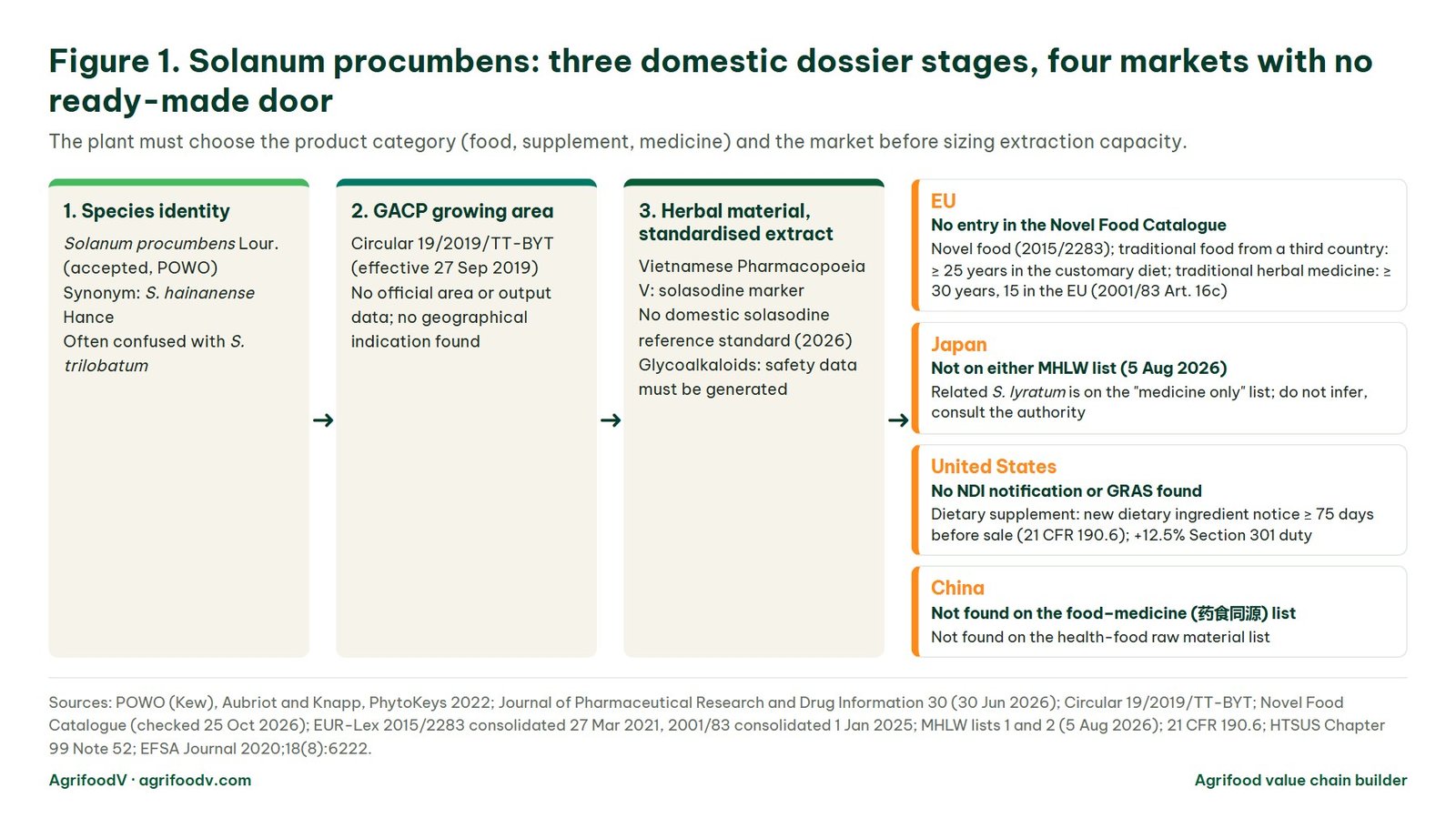
The medicinal herb Solanum procumbens has a monograph in the Vietnamese Pharmacopoeia, appears in many health-supplement products on the domestic market and is being cultivated towards GACP-WHO. Outside Vietnam, however, no regulatory door is ready-made: the EU has no entry in its novel food catalogue, Japan has not placed it on either of its two herbal lists, and AgrifoodV has not found it on China’s list of substances that are both food and traditional medicine. For an extraction plant, the question is not how to extract, but under which product category, for which market and with which dossier to sell.
Key points
- The accepted scientific name is Solanum procumbens Lour.; Solanum hainanense Hance is a synonym (Plants of the World Online, Royal Botanic Gardens, Kew; Aubriot and Knapp, PhytoKeys 2022). The plant is easily confused with S. trilobatum.
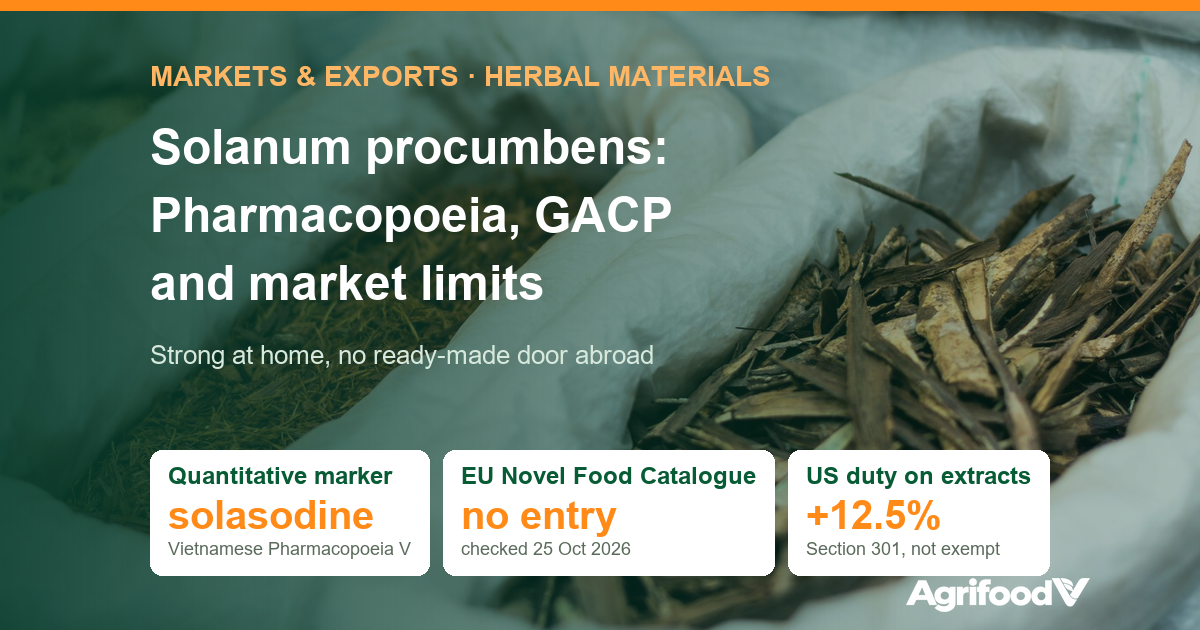
- The Vietnamese Pharmacopoeia V uses solasodine as the quantitative marker; a study published on 30 June 2026 reports that Vietnam has no domestically established solasodine reference standard.
- EU: no entry in the Novel Food Catalogue (checked 25 October 2026). The traditional-food-from-a-third-country route requires 25 years of use in the customary diet; the traditional herbal medicine route requires 30 years, including 15 in the EU.
- Duties: dried herb and extract enter the EU and Japan at 0%; the US adds 12.5% under Section 301 because they are not in the exempt spice group.
Identity: one common name, two scientific names, one easily confused species
The export dossier for any herbal material starts with the species name. For this plant, Vietnamese documents use two names: Solanum procumbens Lour. in the Pharmacopoeia and pharmaceutical journals, and Solanum hainanense Hance in a GACP-WHO cultivation handbook from an EU-funded project (2020). The Plants of the World Online database of the Royal Botanic Gardens, Kew lists S. procumbens as the accepted name, native from south-east China to Indo-China, with S. hainanense as a synonym, following the revision of Asian Solanum by Aubriot and Knapp (PhytoKeys, 2022). Dossiers sent to foreign buyers should give the accepted name together with the synonym, so that regulators do not treat them as two different species.
The second risk is confusion in the field. A microscopy study published in the Ho Chi Minh City Journal of Medicine (2017) notes that people often confuse the plant with S. trilobatum. For the plant, this means species identification by morphology, microscopy or analysis must be an intake check, not a matter of trusting the product name on the delivery note.
Domestic standards: Pharmacopoeia, GACP and three types of GMP
The Vietnamese Pharmacopoeia V has a monograph for the herb (Herba Solani procumbentis) with solasodine as the quantitative marker. According to the authors writing in the Journal of Pharmaceutical Research and Drug Information (issue 30, 30 June 2026), Vietnam has no domestically established solasodine reference standard; the team isolated solasodine at 96.5% purity by HPLC–DAD as candidate reference material. For the plant, a reference standard is the condition for stating active content on the certificate of analysis, the first thing a buyer of standardised extract will ask for.
| Stage | Standard applied in Vietnam | Note |
|---|---|---|
| Growing area, harvesting | GACP: Circular 19/2019/TT-BYT (effective 27 September 2019) | The Traditional Medicine Administration receives dossiers and publishes herbal materials meeting GACP |
| Herbal material | Monograph in the Vietnamese Pharmacopoeia V | Solasodine marker; no domestic reference standard (2026) |
| Herbal medicine plant | GMP: Annex V of Circular 35/2018/TT-BYT, amended by Circular 12/2022/TT-BYT | Applies to herbal medicines |
| Health supplement plant | GMP: Circular 18/2019/TT-BYT, amended by Circular 29/2020/TT-BYT | Validity status in 2026 to be checked in the legal database |
These three standards cannot be merged into a single “GMP-WHO”, and which one applies depends on whether the final product is a medicine or a food. The plant is also not on the list of 100 high-value medicinal materials in Decision 3657/QD-BYT (2019). AgrifoodV has found no official data on its cultivated area or output in Vietnam, and no geographical indication or collective mark for it. The area figures in circulation are self-reported by companies.
Foreign markets: no door is open yet
EU. The European Commission’s Novel Food Catalogue has no entry for S. procumbens or S. hainanense (AgrifoodV checked all 979 entries on 25 October 2026). Under Regulation (EU) 2015/2283, food not used for human consumption to a significant degree in the EU before 15 May 1997 is novel food and must be authorised before sale. The regulation has a separate route for “traditional food from a third country”, but it requires safety evidence from compositional data and at least 25 years of continued use in the customary diet of a significant number of people in at least one third country. Use of the plant as a herbal medicine does not necessarily count as “customary diet”. On the medicine route, Directive 2001/83/EC (Article 16c) requires evidence of medicinal use for at least 30 years, including at least 15 years in the EU, for registration as a traditional herbal medicinal product.
Japan. The plant is on neither the “exclusively medicinal” list nor the list of items “not regarded as medicines unless medicinal effects are claimed” of the Ministry of Health, Labour and Welfare (update of 5 August 2026). A species of the same genus, Solanum lyratum (whole plant), is on the “exclusively medicinal” list. It cannot be inferred that S. procumbens would be classified the same way or differently; importers must consult the competent authority before placing it on the market as a food.
United States. If sold as a dietary supplement, an ingredient not marketed in the US before 15 October 1994 must be notified to FDA as a new dietary ingredient at least 75 days before marketing (21 CFR 190.6). AgrifoodV has found no new dietary ingredient notification or GRAS dossier for S. procumbens.
China. AgrifoodV has not found the plant on the list of substances that are both food and traditional Chinese medicine (药食同源, the 2002 list and later additions), or on the list of health-food raw materials.
One safety question will accompany every dossier: solasodine is the aglycone of a group of steroidal glycoalkaloids in the genus Solanum. The 2020 scientific opinion of the European Food Safety Authority (EFSA) on glycoalkaloids in food covered tomato and aubergine as well, but occurrence data were available only for α-solanine and α-chaconine, mostly in potatoes; for tomato and aubergine glycoalkaloids, EFSA could not characterise the risk for lack of data. AgrifoodV’s view: for S. procumbens, standardising solasodine and total glycoalkaloid content is both a quality parameter and safety data that must exist before any conversation with a foreign regulator.
Duties: cheap in the EU and Japan, expensive in the US
| Product form | EU (EVFTA) | US | Japan |
|---|---|---|---|
| Dried herb (HS 1211.90) | 1211 90 86 90: 0% | 1211.90.89: MFN free, plus 12.5% Section 301 | 1211.90-999: 2.5% → VJEPA 0% |
| Plant extract (HS 1302.19) | 1302 19 70: 0% | 1302.19.91: MFN free, plus 12.5% Section 301 | 1302.19-239: 0% |
| Beverage base from a single plant | — | — | 1302.19-110: 10% → VJEPA 0% |
Under Note 52 to Chapter 99 of the US tariff schedule, the additional 12.5% on Vietnamese goods exempts tea and spices 0904–0910, but not herbal materials 1211.90 or extracts 1302.19. Duty is not the main barrier for this plant; the regulatory door is.
What companies should do
AgrifoodV recommendations:
- Choose one market and one product category (food, food supplement or herbal medicine) first, then size the extraction capacity. Each category brings its own dossier and its own plant standard.
- Make species identification an intake control point: reference voucher specimens, microscopy or analysis of each lot, and the name S. procumbens with its synonym on every document.
- Build a GACP growing area linked to the plant, with cultivation records and lot traceability, using the framework in our article on raw-material growing areas for processing plants.
- Invest early in quantitative methods for solasodine and total glycoalkaloids with a traceable reference standard; these data serve both the certificate of analysis and the safety dossier.
- Do not use curative claims in sales material abroad: each market has its own rules on health claims, and one advertising sentence can turn a food into an unauthorised medicine.
The overall picture of the spice and herb line is in our pillar article on spice and herb processing plants for export. AgrifoodV supports market-by-market regulatory analysis and growing-area design.
References
- Nguyen Lam Hong, Tran Thanh Ha, Do Thi Ha, Tran Viet Hung. Extraction, Isolation and Structural Confirmation of Solasodine from Herba Solani Procumbensis for Reference Standard Material. Tạp chí Nghiên cứu Dược và Thông tin thuốc [Journal of Pharmaceutical Research and Drug Information] 30 (2026), 30 June 2026. vjol.info.vn.
- Ho Thi Bich Hang, Lieu Ho My Trang. Article on the morphology and microscopy of Solanum procumbens. Tạp chí Y học TP.HCM [Ho Chi Minh City Journal of Medicine] 21(1), 2017. tapchiyhoctphcm.vn.
- Royal Botanic Gardens, Kew. Plants of the World Online: Solanum procumbens Lour. and Solanum hainanense Hance (checked 29 October 2026). powo.science.kew.org.
- Aubriot X., Knapp S. Revision of Asian Solanum species (including S. procumbens). PhytoKeys, 2022. plazi.org.
- Ministry of Health of Vietnam. Circular 19/2019/TT-BYT on good agricultural and collection practices for medicinal materials (GACP), 30 July 2019; Circular 35/2018/TT-BYT (amended by 12/2022/TT-BYT); Circular 18/2019/TT-BYT (amended by 29/2020/TT-BYT); Decision 3657/QD-BYT, 20 August 2019. hoatieu.vn.
- European Commission. Novel Food Catalogue (checked 25 October 2026). ec.europa.eu.
- European Union. Regulation (EU) 2015/2283 on novel foods, Article 3, consolidated CELEX 02015R2283-20210327. eur-lex.europa.eu.
- European Union. Directive 2001/83/EC on medicinal products for human use, Article 16c, consolidated CELEX 02001L0083-20250101. eur-lex.europa.eu.
- Ministry of Health, Labour and Welfare of Japan. Lists 別添1 (“exclusively medicinal”) and 別添2 (“not regarded as medicines”), updated 5 August 2026. mhlw.go.jp (PDF 1); mhlw.go.jp (PDF 2).
- United States. 21 CFR 190.6 (new dietary ingredient notification), eCFR. ecfr.gov.
- EFSA CONTAM Panel. Risk assessment of glycoalkaloids in feed and food, in particular in potatoes and potato-derived products. EFSA Journal 2020;18(8):6222. pmc.ncbi.nlm.nih.gov.
- European Commission, TARIC (1211 90 86, 1302 19 70, origin Vietnam, checked 25 October 2026); USITC, HTSUS 2026 Rev. 21 and Chapter 99, Note 52; Japan Customs, tariff schedule of 1 April 2026. ec.europa.eu; hts.usitc.gov; customs.go.jp.
Article by AgrifoodV, compiled from the sources above (accessed 25–29 October 2026). AgrifoodV has not read the full monograph in the Vietnamese Pharmacopoeia V (the marker information comes from a scientific article citing the Pharmacopoeia); the status of the plant in China and in FDA’s new dietary ingredient records reflects searches that found nothing, not a confirming document. The article makes no curative claims. This content is not a substitute for legal advice. Cover image: Evandro Paula Alves / Pexels.
Looking at Vietnam as a sourcing origin or a place to build a value chain?
Tell us your product, target market and expected volumes. In a 30–45 minute online call, AgrifoodV reviews buyers, standards, processing capacity and growing areas with you, starting from the market.
Book a call →Sourcing from Vietnam© 2026 AgrifoodV. Nội dung được phép trích dẫn khi ghi rõ nguồn và đặt liên kết tới bài gốc; không sao chép toàn văn. Xem Điều khoản sử dụng nội dung.