AgrifoodV ·
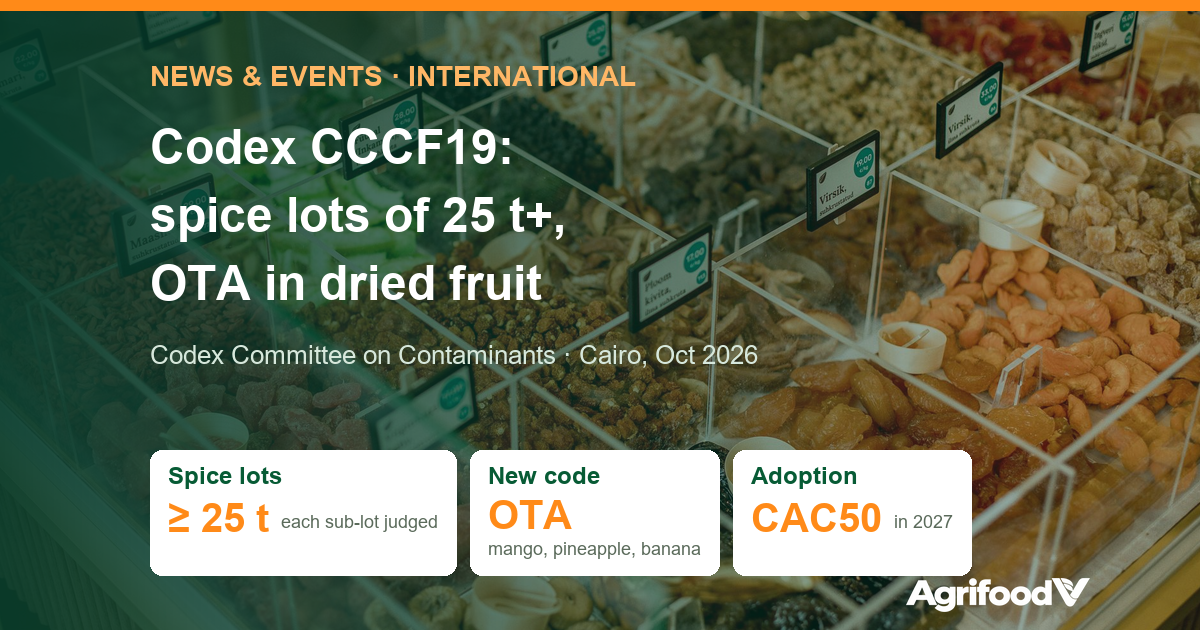
The 19th Session of the Codex Committee on Contaminants in Foods (CCCF19) closed on 23 October 2026 in Cairo, Egypt. According to the draft report of the session, the Committee settled how spice lots of 25 tonnes or more are to be handled when tested for aflatoxins and ochratoxin A, and proposed a code of practice to prevent ochratoxin A in dried fruits, under which dried mango, pineapple and banana may be brought into scope if countries supply enough data. These texts bear directly on Vietnam’s exports of pepper, spices and dried fruit.
Key points
- Spice lots divided into physically separate sub-lots: a sub-lot exceeding the maximum level (ML) for total aflatoxins or ochratoxin A is rejected on its own; the remaining sub-lots may be accepted only if each has been sampled and tested individually and meets the ML, with physical separation and traceability ensured.
- New work proposal: a code of practice for the prevention and reduction of ochratoxin A in dried fruits, sent to the Codex Alimentarius Commission (CAC50, 2027) for approval; dried mango, pineapple and banana are cited as examples that could be added to the scope.
- Three codes of practice forwarded to CAC50 for adoption at Step 5/8: tropane alkaloids, weed control to reduce pyrrolizidine alkaloids (revision of CXC 74-2014) and aflatoxin B1 in feed for milk-producing animals (revision of CXC 45-1997).
- The cadmium code of practice (with annexes on rice and seaweed) was returned to Step 2 for redrafting; aflatoxins in cereals, including husked rice, will go through a call for data before any discussion of maximum levels.
Background: CCCF sets maximum levels and sampling rules for contaminants
CCCF is the Codex committee that develops the General Standard for Contaminants and Toxins in Food and Feed (CXS 193-1995), together with codes of practice that help producers reduce mycotoxins, heavy metals and plant alkaloids. The 19th Session was co-hosted by Egypt and the Netherlands in a hybrid format. A Codex Secretariat news item of 27 October 2026 said three codes of practice were completed just one year after being approved as new work at CAC48 (2025). Ms Susanne Sütterlin (the Netherlands) took over the chair of the Committee from Ms Sally Hoffer.
Spice lots of 25 tonnes or more: each sub-lot judged separately
According to the draft report, the Committee on Methods of Analysis and Sampling (CCMAS45, 2026) endorsed the sampling plans for total aflatoxins and ochratoxin A in certain spices, but asked CCCF to clarify whether, for lots of 25 tonnes or more, a sub-lot exceeding the ML means rejecting the entire lot or only that sub-lot.
At the session, the views differed mainly on what happens to sub-lots that have not been tested. One Member proposed treating each sub-lot independently. A Member Organization argued that if only one sub-lot is tested and it fails, the result should apply to the whole lot unless the food business operator shows the remaining sub-lots comply, which in practice requires sampling and testing at the operator’s cost.
CCCF19 agreed a note for tables 1, 3 and 5 of the sampling plans: a sub-lot exceeding the ML is rejected on its own; the other sub-lots may be accepted only if they have been sampled individually, have results not exceeding the ML, and physical separation and traceability are ensured. Brazil was tasked with reviewing the other sampling plans in CXS 193 to align them with the same principle, reporting to CCCF20 (2027), after which the changes go to CCMAS for endorsement and to CAC for adoption.
Ochratoxin A in dried fruits: a door open for mango, pineapple and banana
CCCF19 agreed to send CAC50 (2027) a project document for a code of practice for the prevention and reduction of ochratoxin A in dried fruits. According to Appendix VIII of the draft report, the code will cover planting, harvesting, drying (sun-drying and mechanical drying), storage, processing and distribution, and will apply to whole and cut dried fruits intended for human consumption and international trade.
| Group | Commodities named in the project document |
|---|---|
| Named explicitly | Raisins, dried figs, dried apricots, dates, dried prunes, dried mulberries, dried cranberries |
| May be added during drafting | Tropical fruits such as dried mango, dried pineapple and dried banana, if Members provide sufficient occurrence data, commodity-specific risk factors and effective preventive measures |
Source: Codex, draft report REP26/CF19, Appendix VIII and paragraphs 142–145.
The tropical fruit examples were added during the session itself. Members also stressed that water activity, rather than moisture content alone, is the key parameter for mould growth and ochratoxin A formation, and that post-harvest steps such as fermentation and drying must be considered. The Codex Secretariat noted that the code could have annexes by commodity, processing technology and climatic zone, tropical or temperate. An electronic working group chaired by Türkiye and co-chaired by the United Kingdom will prepare the first draft for CCCF20.
Other items to watch
- Spice mixtures: guidance on applying MLs to mixtures of dried spices and culinary herbs, with or without edible salt, limited to lead; the working group is chaired by Japan and co-chaired by India, Panama and the United States, reporting to CCCF20.
- Pyrrolizidine alkaloids: the revised code of practice for weed control CXC 74-2014 was forwarded to CAC50 for adoption at Step 5/8, omitting Steps 6 and 7.
- Aflatoxins in cereals: the JECFA Secretariat will issue a call for data; the working group is chaired by Brazil and co-chaired by Thailand. CCCF20 (2027) will only evaluate the data; new or revised MLs for cereals, including husked rice, will be considered from 2028 onwards.
- Cadmium: the general code of practice with annexes on rice and seaweed, integrating the code for cocoa beans CXC 81-2022, was returned to Step 2 and will be considered again at Step 4 at CCCF20.
- Recycled plastic packaging: a new work proposal on guidelines for the safe use of recycled plastics in food packaging awaits approval by CAC50.
What it means for Vietnamese products
The sub-lot note only works if a consignment is divided into physically separate, identifiable sub-lots. For pepper and spices shipped in large lots, packing, sub-lot numbering and traceability records decide whether one result above the ML costs part of the lot or all of it. For dried fruit, mango, pineapple and banana are not yet on the named list; whether they are brought into scope depends on the data that countries, Vietnam among them, supply to the working group.
What companies should do
The following are AgrifoodV’s recommendations, not the content of the Codex texts.
- Organise large spice lots into sub-lots with their own codes, kept separate in storage and loading, with test records for each sub-lot, so that one failing result does not take down the whole lot.
- Bring water activity into control at the drying and storage stages for dried fruit and spices, rather than measuring moisture alone, and keep records sufficient to serve as evidence when buyers ask.
- Share ochratoxin A data for dried mango, pineapple and banana with Vietnam’s Codex contact point or the relevant industry association, so that tropical commodities are assessed under real domestic production conditions.
- Follow CAC50 (2027), where the codes of practice and new work proposals above will be adopted or approved.
If your company needs a review of drying and storage steps to reduce mycotoxins, see AgrifoodV’s processing plant advisory services.
References
- Codex Alimentarius (FAO/WHO), “Contaminants committee advances codes of practice for final adoption and new work proposals for approval by CAC”, news item, 27 October 2026. codex.fao.org (accessed 11 November 2026).
- Codex Alimentarius, Draft REP26/CF19, draft report of the 19th Session of the Codex Committee on Contaminants in Foods, Cairo, October 2026, and Appendix VIII (project document on a code of practice for ochratoxin A in dried fruits). CCCF19 meeting page (accessed 11 November 2026).
Article by AgrifoodV, compiled from the sources above (accessed 11 November 2026). The official report REP26/CF19 will be published by Codex later; in case of any difference, the official text prevails. This content is not a substitute for legal advice.
Cover image: Valeria Boltneva / Pexels
Looking at Vietnam as a sourcing origin or a place to build a value chain?
Tell us your product, target market and expected volumes. In a 30–45 minute online call, AgrifoodV reviews buyers, standards, processing capacity and growing areas with you, starting from the market.
Book a call →Sourcing from Vietnam© 2026 AgrifoodV. Nội dung được phép trích dẫn khi ghi rõ nguồn và đặt liên kết tới bài gốc; không sao chép toàn văn. Xem Điều khoản sử dụng nội dung.