AgrifoodV ·
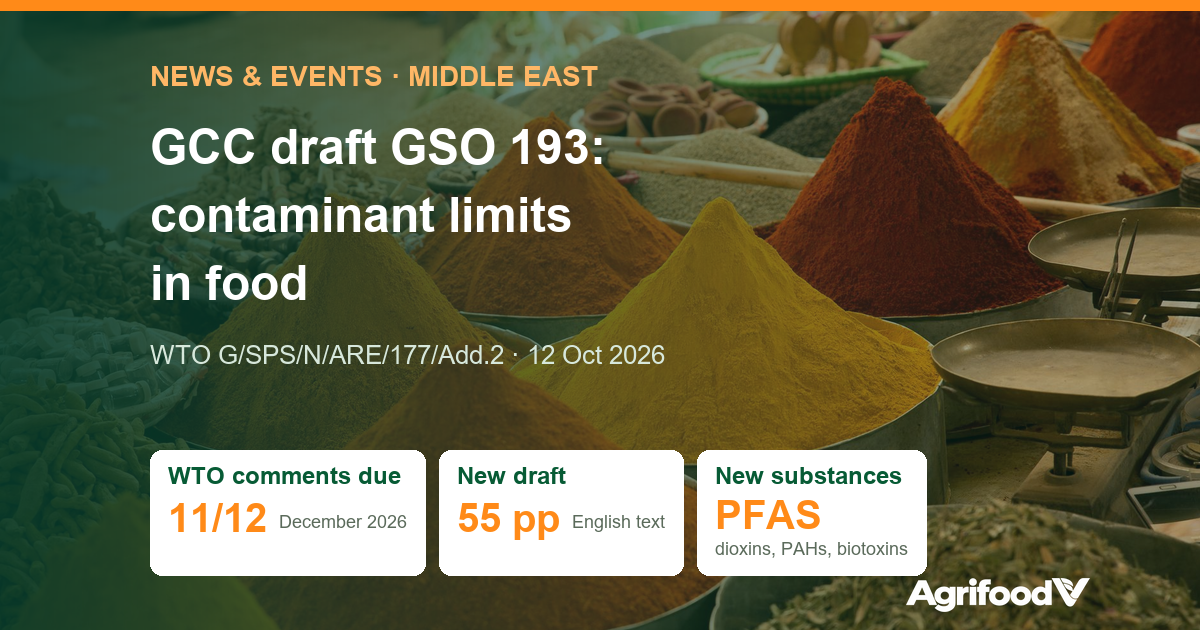
On 12 October 2026, Saudi Arabia, on behalf of the Cooperation Council for the Arab States of the Gulf (GCC), notified the WTO of a new draft of the technical regulation “Contaminants and toxins in food and feed” (GSO 05 FDS 193:2026), with comments due by 11 December 2026. The draft introduces many substance groups that were not in the 2019 version, including maximum levels for chilli, dried ginger, dried herbs, tea, dried spices, catfish, crustaceans and bivalve molluscs, all products that Vietnam exports.
Key points
- Notification G/SPS/N/ARE/177/Add.2 (with the corresponding symbols of Bahrain, Kuwait, Oman, Qatar, Saudi Arabia and Yemen) was circulated on 12 October 2026; the comment deadline is 11 December 2026.
- The attached document runs to 55 pages in English and sets maximum levels for mycotoxins, marine biotoxins, dioxins and PCBs, PFAS, PAHs, plant alkaloids, nitrates, perchlorate and glycidyl esters.
- Dioxins, PFAS, PAHs, marine biotoxins, pyrrolizidine alkaloids and perchlorate do not appear in the 2019 draft (78 pages) notified to the WTO on 10 April 2019.
- Heavy metals are listed among the exclusions from the scope of the new draft, together with pesticide residues and veterinary drug residues.
What the notification says
The GCC contaminants regulation was first notified to the WTO on 10 April 2019 (G/SPS/N/ARE/177). The first addendum, dated 8 August 2019, stated that the text had been reviewed in light of comments from WTO members, mainly on the maximum levels for arsenic and aflatoxin. The second addendum, circulated on 12 October 2026, attaches a new draft numbered GSO 05 FDS 193:2026, prepared by Technical Committee TC05. The notification gives no proposed date of adoption or entry into force.
According to its definitions section, the draft applies to any substance that meets the definition of a contaminant, including in feed for food-producing animals, with six exceptions: substances of quality significance only (for example copper), pesticide residues, residues of veterinary drugs and feed additives, microbial toxins such as botulinum toxin, residues of processing aids, and heavy metals. The reference list at the end of the document cites Codex General Standard 193-1995 and EU Regulation (EC) 1881/2006. The notification does not state whether the new draft replaces the 2019 text in full or supplements it.
Maximum levels relevant to Vietnamese products
The table below selects only the lines linked to products Vietnam exports, using the units of the draft.
| Substance group | Product | Maximum level in the draft |
|---|---|---|
| Total aflatoxins (B1+B2+G1+G2) | Chilli pepper, whole, crushed or ground | 20 μg/kg |
| Ochratoxin A | Dried herbs; dried ginger root for herbal infusions; other dried fruits | 10 μg/kg; 15 μg/kg; 2 μg/kg |
| Pyrrolizidine alkaloids (sum) | Dried herbs; cumin; dried tea (Camellia sinensis) | 400 μg/kg; 400 μg/kg; 150 μg/kg |
| Perchlorate | Dried tea and dried herbal infusions; fruits and vegetables (except Cucurbitaceae, kale, leaf vegetables and herbs) | 0.75 mg/kg; 0.05 mg/kg |
| PAHs: benzo(a)pyrene / sum of 4 PAHs | Dried spices (except cardamom and smoked Capsicum); banana chips; coconut oil; bivalve molluscs, fresh, chilled or frozen | 10 / 50 μg/kg; 2 / 20; 2 / 20; 5 / 30 μg/kg |
| Marine biotoxins | Live and raw bivalve molluscs (edible parts) | Saxitoxin group ≤ 0.8 mg/kg; okadaic acid ≤ 0.16 mg/kg; domoic acid ≤ 20 mg/kg; azaspiracid ≤ 0.16 mg/kg |
| Dioxins / dioxins and dioxin-like PCBs | Fishery products and bivalve molluscs (muscle meat) | 3.5 / 6.5 pg TEQ/g wet weight |
| PFAS: PFOS / sum of 4 substances | Fish muscle meat in general; catfish (Silurus, Pangasius); crustaceans and bivalve molluscs | 2.0 / 2.0 μg/kg; 7.0 / 8.0 μg/kg; 3.0 / 5.0 μg/kg |
| Glycidyl esters (expressed as glycidol) | Vegetable oils and fats for the final consumer or as a food ingredient | 1,000 μg/kg |
Source: GSO 05 FDS 193:2026, document attached to notification G/SPS/N/ARE/177/Add.2. Selection by AgrifoodV; the draft contains many more lines for cereals, dairy, meat and foods for young children.
What is new compared with the 2019 draft
Comparing the two documents notified to the WTO, the 2019 version focused on aflatoxins, ochratoxin A, patulin, deoxynivalenol, fumonisins, heavy metals (lead, cadmium, mercury, arsenic, tin), melamine and 3-MCPD. The 2026 version has no lines for heavy metals, patulin or melamine, but adds marine biotoxins, dioxins and PCBs, PFAS, PAHs, pyrrolizidine and tropane alkaloids, perchlorate, nitrates, glycidyl esters, zearalenone, T-2 and HT-2 toxins, citrinin and ergot alkaloids.
The grouping and notes of many new lines mirror the EU contaminants regulation. For example, Silurus and Pangasius catfish are placed in a group with higher PFAS limits than fish in general, and the benzo(a)pyrene limit for dried spices excludes cardamom and smoked Capsicum.
What it means for Vietnamese products
Three product groups are most directly affected. First, spices and herbs: chilli has its own aflatoxin limit, dried ginger and dried herbs have ochratoxin A limits, and dried spices and dried herbs have PAH limits. Second, seafood: pangasius, shrimp and molluscs have dioxin and PFAS limits, while oysters, clams and cockles also face four groups of marine biotoxins. Third, tea, with pyrrolizidine alkaloid and perchlorate limits for dried tea.
About one month remains before the comment deadline. This is the stage at which exporting countries can ask for clarification of the scope, for example the PFAS limits for farmed catfish or the PAH limits for dried products, before the text is finalised.
What companies should do
The following are AgrifoodV’s recommendations, not content of the WTO notification or the GSO draft.
- Submit comments before 11 December 2026 through the Vietnam SPS Office or the relevant industry association if any level in the draft is hard to meet for your products, with actual test data attached.
- Review the testing plan for shipments to GCC countries: add PAHs for dried spices, ochratoxin A for ginger and dried herbs, PFAS and dioxins for seafood, marine biotoxins for molluscs, and choose an accredited laboratory for each parameter.
- Review the drying stage: smoke from direct-fired dryers is a source of PAHs, while moisture and storage conditions drive mycotoxins; indirect drying and moisture control give more control than relying on final testing alone. Companies already testing to EU standards should check each line against the levels applied in the EU rather than assume they are identical.
- Watch for the official text once GSO adopts it, since the entry-into-force date and whether the draft replaces or supplements the old text have not been announced.
Companies that need an assessment of Middle East market requirements for specific products can refer to AgrifoodV’s market advisory services.
References
- WTO, G/SPS/N/ARE/177/Add.2, G/SPS/N/BHR/200/Add.2, G/SPS/N/KWT/51/Add.2, G/SPS/N/OMN/97/Add.2, G/SPS/N/QAT/101/Add.2, G/SPS/N/SAU/395/Add.2, G/SPS/N/YEM/42/Add.2, “The Kingdom of Saudi Arabia/The Cooperation Council for the Arab States of the Gulf draft Technical Regulation for Contaminants and toxins in food and feed”, 12 October 2026. epingalert.org (accessed 9 November 2026).
- GSO, draft GSO 05 FDS 193:2026 “Contaminants and toxins in food”, document attached to the notification (55 pages). members.wto.org (PDF) (accessed 9 November 2026).
- WTO, G/SPS/N/ARE/177, 10 April 2019 and G/SPS/N/ARE/177/Add.1, 8 August 2019; GSO 2019 draft “Contaminants and toxins in food and feed”. members.wto.org (PDF) (accessed 9 November 2026).
Article by AgrifoodV, compiled from the sources above (accessed 9 November 2026). This content is not a substitute for legal advice.
Cover image: Mike van Schoonderwalt / Pexels
Looking at Vietnam as a sourcing origin or a place to build a value chain?
Tell us your product, target market and expected volumes. In a 30–45 minute online call, AgrifoodV reviews buyers, standards, processing capacity and growing areas with you, starting from the market.
Book a call →Sourcing from Vietnam© 2026 AgrifoodV. Nội dung được phép trích dẫn khi ghi rõ nguồn và đặt liên kết tới bài gốc; không sao chép toàn văn. Xem Điều khoản sử dụng nội dung.