AgrifoodV ·
The journey of building an export processing plant · Article 9/29 · Stage 4: Technical infrastructure. See the full journey
The only question most investors ask about water is whether the site can be connected to the mains. The right question is much broader: which source, what peak flow, whether quality stays stable across the seasons, and where that water goes inside the plant. Water that touches product, equipment surfaces and packaging is something EU and US audit teams trace pipe by pipe. Article 9 opens Stage 4, technical infrastructure, because the water source can rule out a site before the processing line is even discussed.
Key points
- Water in contact with food must be of potable quality; non-potable water runs in a separate, identified system that must not connect with or flow back into the potable system.
- The water source sets treatment costs for the life of the plant: river water varies widely, groundwater is more stable but its problems tend to be long-term.
- Water that meets the drinking-water standard still needs further treatment for boilers and cooling towers; that is the plant’s responsibility, not the water supplier’s.
- In Vietnam, the reference standard is QCVN 01-1:2024/BYT; abstraction from wells, rivers or canals requires a licence or registration under the Law on Water Resources.
Two markets, one principle: keep each water system separate
EU Regulation (EC) 852/2004, Annex II, Chapter VII, requires an adequate supply of potable water, used whenever necessary to ensure that foodstuffs are not contaminated. Non-potable water, used for fire control, steam production, refrigeration and similar purposes, must circulate in a separate, duly identified system that does not connect with, or allow reflux into, potable water systems. Recycled water used in processing or as an ingredient must be of the same standard as potable water, unless the competent authority is satisfied that it cannot affect the wholesomeness of the finished food. Ice in contact with food must be made from potable water; water used to cool hermetically sealed containers after heat treatment must not be a source of contamination.
In the United States, Title 21 of the Code of Federal Regulations (21 CFR), section 117.37, paragraph (a), requires a water supply adequate for the intended operations, and any water that contacts food, food-contact surfaces or food-packaging materials must be safe and of adequate sanitary quality. Paragraph (b) requires plumbing of adequate size, floor drainage wherever floors are subject to flooding-type cleaning, and no backflow from, or cross-connection between, piping that discharges wastewater and piping that carries water for food.
The two texts use different words but say the same thing: the water supply and drainage drawings must keep each system separate, and every point where systems meet must have backflow prevention. In design practice in Vietnam, colour-coding pipework by the medium it carries is good practice, so that workers and auditors alike can see at once which pipe carries potable water and which carries process water.
Choosing the source: mains, borehole or river
K.P. Sutton, author of the chapter “Site Considerations” in the Handbook of Food Factory Design (2013), advises contacting the water company early, but only after estimating total current demand, projected future demand and peak demand. The investor must establish the volume available at adequate pressure for peak hours; in most cases the plant will still need a break tank. According to Sutton, lowland rivers and some reservoirs are more likely to cause quality problems than groundwater; river water varies widely, while groundwater is more stable but any problems tend to be long-term. Practice in Vietnam adds that soft, potentially corrosive water is common in the midlands and mountain regions.
Sutton’s list of questions for the water company covers: whether pre-chlorination is practised; whether coagulation uses aluminium or iron salts; whether activated carbon is used to remove taste and odour; which chemicals are used for final disinfection; whether pH, hardness or alkalinity is corrected before distribution; whether sources may be switched or blended, since sudden changes affect both the product and any on-site treatment plant; and whether the mains suffer bursts, corrosion or scaling. The Langelier Saturation Index (LSI = measured pH minus the calcium carbonate saturation pH), or a similar parameter, must be determined: a positive LSI means the water tends to deposit scale on heat-exchange surfaces; a negative LSI means it tends to corrode pipework and leach metal ions into the product.
A borehole, canal or river can be much cheaper than mains water. But Sutton restricts canal and river water to low-grade, non-food-contact uses; it must still be filtered and disinfected, especially if it is stored before use, and if there is any risk of it contacting food it must be treated to drinking-water standard. Borehole samples must be taken after a period of pumping to be representative, a hydrogeologist should assess the source, and every non-mains source needs a pollution risk assessment.
For projects in Vietnam, the reference standard is QCVN 01-1:2024/BYT, the National Technical Regulation on the quality of clean water for domestic use, issued with Circular 52/2024/TT-BYT and in force since 1 July 2025, replacing QCVN 01-1:2018/BYT. The investor needs an analysis covering all parameters of this regulation for the intended source; for surface water, variation between the rainy and dry seasons must be taken into account. Abstraction from wells, rivers or canals requires a licence or registration under Law on Water Resources No. 28/2023/QH15 (amended and supplemented by Law No. 146/2025/QH15), and the licence conditions should be checked so that they do not unduly restrict abstraction, for example through seasonal limits. This is why Article 6 on site selection puts the water source on the site checklist.
Where the water goes, and what quality each stream needs
A.A. Aly and C.G.J. Baker, authors of the chapter “Utilities and Their Conservation” in the same handbook, cite data from Pagan and Price (2008, Table 17.5): in vegetable processing, about 78% of water goes to processing operations (washing, blanching, water conveying and so on), 15% to cleaning, 5% to cooling-tower makeup and 2% to auxiliary uses; in beverages, 60% of the water goes into the product. The figure tells the investor one thing clearly: washing and water-conveying lines are the first place to redesign if water use is to fall.
Design practice in Vietnam divides water in a food plant into streams with different requirements. The table below summarises them:
| Water stream | Quality requirement | Ways to reduce use |
|---|---|---|
| Water added to product (reconstituted juice, syrup, sauces…) | Potable water under QCVN 01-1:2024/BYT; no off colour, odour or taste | Reverse osmosis treatment, UV or ozone disinfection |
| Cleaning, cleaning-in-place (CIP) | Final rinse in contact with equipment surfaces must be potable | Recover final rinse water as pre-rinse for the next cycle |
| Washing, soaking and water conveying of raw material | Process water, filtered and disinfected | Filter and disinfect to recirculate most of the soak and wash water |
| Cooling (cooling tower) | Softened makeup water; control of scale, algae and bacteria | Conductivity-controlled blowdown, higher cycles of concentration |
| Boiler feed | Zero hardness, deaerated | Condensate recovery (Article 10) |
Source: compiled from food plant design practice in Vietnam; Regulation (EC) 852/2004, Annex II, Chapter VII.
Aly and Baker set out three ways to reduce fresh water use, based on the method of Kim and Smith (2008): reuse water directly when the outlet quality of one operation is acceptable for the next; treat it and recycle it to the same operation; or treat it and reuse it in a different operation. An example from practice in Vietnam: fruit wash water passed through sand filtration and ozonation can return about 80% to the soaking tank. Cleaning methods also determine water use; the two authors cite high-pressure cleaning rigs and dry-cleaning methods as ways to cut water. A note from the EU side: recycled water used in processing must still meet the potable standard unless the competent authority accepts otherwise, so every recirculation loop needs a quality control point.
Further treatment on site: a five-stage chain and cooling-tower water
Sutton stresses that even when the supply meets the standard, some processes such as soft-drink production still need further treatment; boiler feed water will almost certainly need treatment, and cooling-water treatment is mandatory. This additional treatment is the responsibility of the plant, not the water supplier.
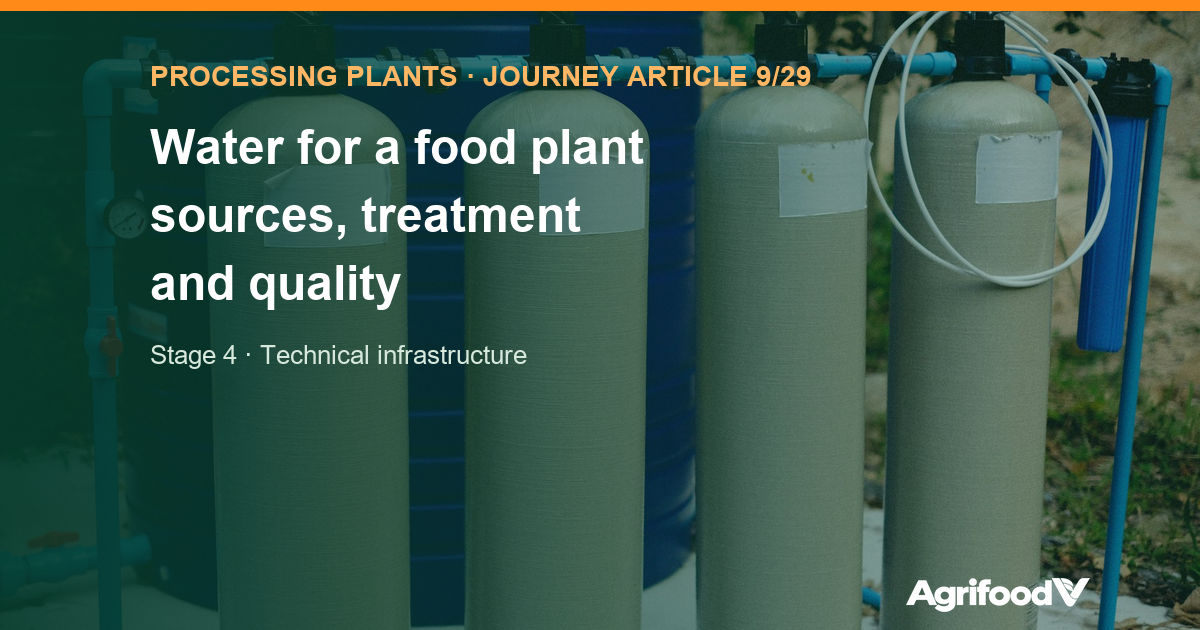
When groundwater, surface water or an unstable supply is used, design practice in Vietnam typically provides an on-site raw-water treatment plant with five stages:
- Coagulation and settling: dosing PAC (polyaluminium chloride) and polymer, then settling in a lamella clarifier to remove coarse solids.
- Filtration: pressure filters with quartz sand, anthracite and activated carbon to remove fine solids, colour, odour and organic matter.
- Softening: cation-exchange columns bring total hardness below 5 mg/L CaCO3 for cleaning-in-place and boiler use.
- Reverse osmosis: semi-permeable membranes remove most dissolved solids, silicates and microorganisms, producing water for beverage and dairy production.
- Disinfection: UV lamps or ozone or chlorine dioxide before the water reaches the storage tank.
For boilers, large dairy and beverage plants in Vietnam are moving from Na⁺ ion-exchange softening to ultrafiltration plus two-pass reverse osmosis, bringing boiler blowdown from about 10% down to below 1%. Boiler feed-water treatment is covered in detail in Article 10 on steam and energy systems.
The cooling tower is the water stream most often overlooked. Aly and Baker explain that makeup water equals evaporation loss plus drift loss plus blowdown, with evaporation the largest component, proportional to the circulating flow and the difference between inlet and outlet temperatures. Design practice in Vietnam calculates evaporation as E = 0.00153 × Fc × (T1 − T2), drift as about 0.05–0.2% of Fc, and blowdown as B = E/(COC − 1) − D, with cycles of concentration (COC) usually held at 3–5 by conductivity-controlled blowdown. A hypothetical example: a tower circulating 100 m³/h with a 5 °C range, 0.1% drift and a COC of 4. Evaporation is about 0.77 m³/h, drift 0.1 m³/h and blowdown about 0.16 m³/h; makeup is about 1 m³/h, or nearly 24 m³ per day of continuous operation. Reducing the temperature range through good process design, as Aly and Baker suggest, is the most direct way to lower this figure.
What companies should do
AgrifoodV recommendations:
- Draw up a water balance by process step, with peak flows and expansion needs, before applying for a mains connection or an abstraction licence.
- Sample and analyse the water source against all QCVN 01-1:2024/BYT parameters in both the rainy and dry seasons, together with the Langelier index, before fixing the treatment technology; run the abstraction licence in parallel with the environmental dossier.
- Require water supply drawings that separate potable water, process water, boiler water, cooling water and fire water, with colour identification and backflow prevention at every point where systems meet.
- Build recirculation of raw-material wash water and cleaning-in-place rinse water into the design from the start, with a quality control point for every recirculation loop.
AgrifoodV supports companies in defining the design brief, reviewing technical infrastructure and guiding the design of processing plants.
The journey of building an export processing plant (9/29)
- Previous article: Article 8: Floors, walls, ceilings, doors: food-grade materials and finishes
- Next article: Article 10: Steam and energy systems: the foundation of every thermal process (planned for 21 November 2026)
References
- Sutton, K.P. “Site Considerations”, chapter 11 in Baker, C.G.J. (ed.), Handbook of Food Factory Design. Springer Science+Business Media New York, 2013, pp. 283–298 (sections 11.4.2.10 mains water supply and 11.4.2.11 alternative water sources, pp. 292–294). DOI: 10.1007/978-1-4614-7450-0_11.
- Aly, A.A. and Baker, C.G.J. “Utilities and Their Conservation”, chapter 17 in Baker, C.G.J. (ed.), Handbook of Food Factory Design. Springer Science+Business Media New York, 2013, pp. 427–441 (section 17.3, Table 17.5, pp. 438–440). DOI: 10.1007/978-1-4614-7450-0_17.
- Regulation (EC) No 852/2004 of the European Parliament and of the Council of 29 April 2004 on the hygiene of foodstuffs, Annex II, Chapter VII, points 1–6; consolidated version of 24 March 2021. eur-lex.europa.eu.
- 21 CFR 117.37 “Sanitary facilities and controls”, paragraphs (a)–(b), Part 117 Subpart B (Current Good Manufacturing Practice), Electronic Code of Federal Regulations, consulted on 17 November 2026. ecfr.gov.
- QCVN 01-1:2024/BYT National Technical Regulation on the Quality of Clean Water for Domestic Use, issued with Circular 52/2024/TT-BYT of the Ministry of Health dated 31 December 2024, in force from 1 July 2025.
- Law on Water Resources No. 28/2023/QH15 of 27 November 2023, in force from 1 July 2024, amended and supplemented by Law No. 146/2025/QH15 of 11 December 2025.
- Compiled from food plant design practice in Vietnam.
Article by AgrifoodV, compiled and interpreted from the sources above (accessed 17 November 2026). This content is not a substitute for design advice or legal advice for any specific project. Cover image: Alexey Demidov / Pexels.
Looking at Vietnam as a sourcing origin or a place to build a value chain?
Tell us your product, target market and expected volumes. In a 30–45 minute online call, AgrifoodV reviews buyers, standards, processing capacity and growing areas with you, starting from the market.
Book a call →Sourcing from Vietnam© 2026 AgrifoodV. Nội dung được phép trích dẫn khi ghi rõ nguồn và đặt liên kết tới bài gốc; không sao chép toàn văn. Xem Điều khoản sử dụng nội dung.