AgrifoodV ·
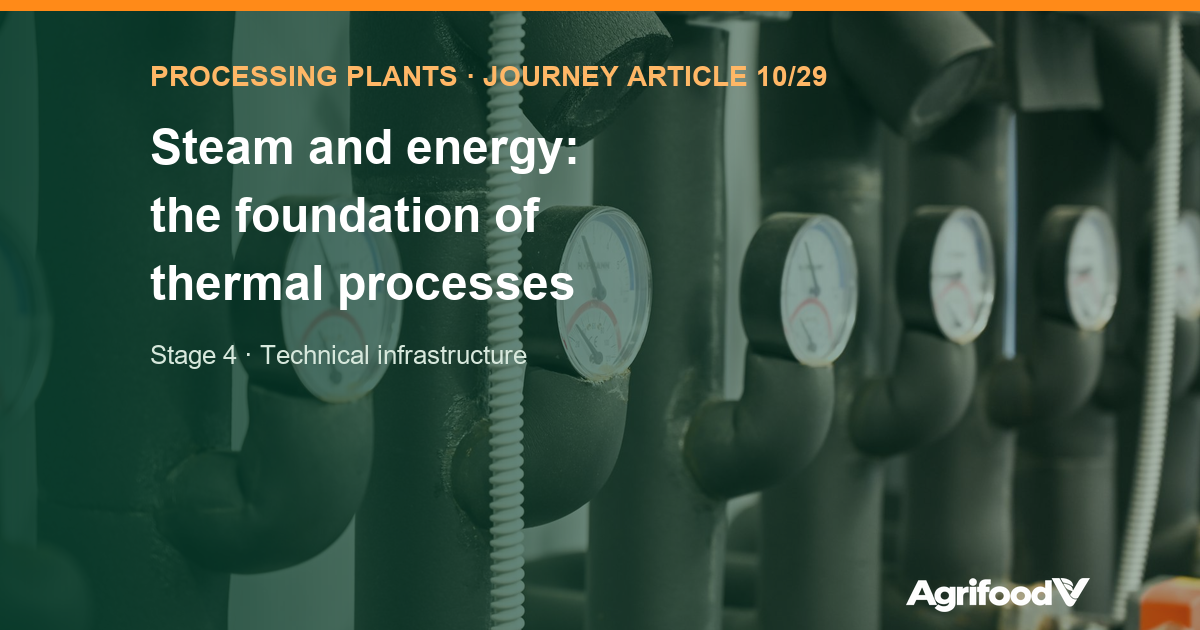
The journey of building an export processing plant · Article 10/29 · Stage 4: Technical infrastructure. See the full journey
Pasteurisation, evaporation, blanching, drying and hot cleaning-in-place all depend on steam. Yet boilers are often chosen by the formula “maximum load plus a margin”, while pipework, steam traps and condensate return are left to the mechanical and electrical contractor, so that steam reaches equipment at too low a pressure and condensate runs straight to drain. Article 9 dealt with water; Article 10 moves on to steam and energy systems, so that investors ask the right questions before signing contracts for thermal equipment.
Key points
- Steam pressure is set by the most demanding equipment; high-pressure distribution allows smaller pipes but increases leakage and heat losses.
- Condensate still holds about 20% of the heat from the fuel; recovering it pays, but any condensate suspected of contamination must not go back to the boiler.
- Steam in direct contact with food has its own requirements in both the EU and the US, including for boiler water treatment chemicals.
- In Vietnam, coal- and biomass-fired boilers are still common; boiler emissions are checked against QCVN 19:2024/BTNMT, and liquid and gaseous fuels carry their own risks depending on climate and site layout.
Why steam, and at what pressure
N. Riches, author of the chapter “Steam Systems” in the Handbook of Food Factory Design (2013), explains the advantage of steam: a large latent heat, released at constant temperature at the point of use. At atmospheric pressure, raising 1 kg of water from 0 °C to 100 °C takes 419 kJ, but turning that 1 kg into steam takes a further 2,258 kJ. The higher the pressure, the higher the boiling point but the lower the useful latent heat per kg of steam; for example, a material that must reach 170 °C needs steam at no less than 7 bar, and more steam is needed for the same amount of heat.
Steam should be generated at the pressure required by the most demanding equipment. Riches sets out the cost of high-pressure distribution: pipes are smaller and need less insulation, but pipework and fittings may have to be thicker-walled; leakage rises in proportion to pressure, twice as much at 10 bar as at 5 bar; heat loss per square metre at 10 bar is some 15% higher than at 5 bar; and steam reduced in pressure through a valve may need desuperheating before use. A steam load schedule by item of equipment, stating the pressure and temperature required, is therefore the first document an investor should ask for.
Choosing boilers and fuel
According to Riches, if operated correctly, all modern boiler types are more or less equally efficient, at about 74–82% on the gross calorific value of the fuel depending on type. Multi-tubular shell boilers suit most industrial applications; a water-tube boiler is only really needed for an individual output above 20 MW, pressures above 25 bar or steam temperatures above 340 °C, because water-tube boilers cost more for a given steam output. A large, steady load suits large boilers; a load that fluctuates by hour, day or season is met more efficiently by several smaller boilers. For a fruit and vegetable plant running on a harvest season, this decision deserves careful calculation. When selecting a new boiler plant, Riches advises always considering combined heat and power; according to Aly and Baker, citing Fantozzi et al. (2000), cogeneration is technically viable when electrical and thermal loads are suitably balanced, there is simultaneous demand for both, there is demand for low-temperature heat, and the plant is sited close to the user.
Choosing a fuel means balancing equipment capital, fuel price, operating and maintenance costs and emission rules. Singh and Heldman, in Introduction to Food Engineering, note that combustible waste materials from processing have become a viable alternative boiler fuel, especially where they are available in large quantities and are hard to dispose of. The two authors also stress the role of the burner: with too little air, combustion produces hazardous carbon monoxide and releases far less heat; with too much, the surplus air carries heat away in the flue gas. In the book’s natural gas example, flue gas losses are about 15.6% of the fuel energy.
Under Vietnamese conditions, each fuel carries its own risks:
- Coal and biomass: still common in Vietnam, but coal storage, coal handling and ash sit poorly with the clean environment of a food plant. In AgrifoodV’s assessment, the boiler house location and the coal truck route should be fixed together with the zoning drawing in Article 7.
- Heavy fuel oil (FO): a sulphur content of 2.0–3.5% makes an SO2 removal unit for the flue gas unavoidable; the oil must be heated in the tank and before the burner.
- Diesel oil (DO): can form wax crystals and block filters at plants in northern Vietnam and the mountains in winter; filter sets and outdoor fuel lines need insulation and trace heating.
- LPG: LPG vapour is heavier than air and collects in trenches, manholes and cable ducts; the tank station goes outside the production building, in an open, well-ventilated spot away from low points. Most investors lease the tank station so that the supplier carries the inspection obligations for the pressure vessels.
On emissions, QCVN 19:2024/BTNMT, the National Technical Regulation on Industrial Emissions, issued with Circular 45/2024/TT-BTNMT and in force since 1 July 2025, replaces QCVN 19:2009/BTNMT and sets separate limits for industrial boilers by fuel type; existing facilities have a transition period. Facilities on the list required to inventory greenhouse gases also have obligations under Decree 06/2022/ND-CP and its amending instruments. Design practice in Vietnam therefore recommends that new plants favour multi-fuel burners or a roadmap towards biomass.
Boiler feed water: the first line of defence
Riches stresses that the consequences of getting feed-water treatment wrong, through corrosion or fouling, can be catastrophic. Base-exchange softening almost eliminates hardness but does not reduce alkalinity, total dissolved solids, chloride or silica; demineralisation removes all of them; reverse osmosis can reject up to 99.5% of impurities. Deaeration, most commonly by heating the water with steam, can cut the amount of oxygen scavengers needed by up to 75% and also reduces thermal shock as the water enters the boiler.
Practice in Vietnam shows that a scale layer only 1 mm thick on heat-transfer tubes can cut heat-transfer efficiency by 3–5% and raise the risk of tube overheating. Large dairy and beverage plants in Vietnam are moving from Na⁺ softening to ultrafiltration plus two-pass reverse osmosis, bringing boiler blowdown from about 10% down to below 1%. The choice of technology depends on raw-water quality, so the water source analysis from Article 9 is a mandatory input to boiler house design.
Steam distribution, steam traps and condensate
Riches gives recommended velocities for sizing steam pipes:
| Steam condition | Recommended velocity in the pipe |
|---|---|
| Superheated steam | 50–70 m/s |
| Saturated steam | 30–40 m/s |
| Wet or exhaust steam | 20–30 m/s |
Source: Riches (2013), section 14.8.3.
Wet steam carries water droplets that strike the pipe wall at bends, valves and fittings and cause erosion, which is why its permitted velocity is lower. A steam trap must remove condensate at least as fast as it forms, hold back the steam and vent non-condensable gases.
Condensate is the part most often wasted. According to Riches, condensate still holds about 20% of the original heat from the fuel; condensate that has not touched the product is chemically pure and needs little treatment beyond pH adjustment, so recovering it cuts both water treatment costs and blowdown losses. Condensate at 5 bar is at 159 °C and holds 671 kJ/kg; released to atmospheric pressure it can hold only 419 kJ/kg, and the remaining 252 kJ produces flash steam that can be recovered. Riches sets one rule that overrides every energy-saving calculation: wherever there is any doubt about the purity of the condensate, it must not be reused as boiler feed water, because contaminated condensate can cause fouling, metal overheating and boiler failure.
For steam in direct contact with food, Regulation (EC) 852/2004, Annex II, Chapter VII, point 5 requires that it contain no substance that presents a hazard to health or is likely to contaminate the food. In the United States, Title 21 of the Code of Federal Regulations (21 CFR), section 173.310 allows boiler water additives made only from listed substances when the steam contacts food, in amounts not exceeding what their function requires.
Energy for thermal processes: evaporators, dryers, electricity
Aly and Baker, authors of the chapter “Utilities and Their Conservation”, explain that an ideal N-effect evaporator evaporates N kg of water per kg of steam; in practice the economy is lower than N, and the number of effects is a trade-off between equipment capital and steam cost. A worked example from design practice in Vietnam, for a fruit juice evaporator removing 3,622 kg of water per hour:
| Evaporator configuration | Steam consumption | Saving versus single effect |
|---|---|---|
| Single effect | 3,813 kg/h | Baseline |
| Two effects | 2,012 kg/h | 47.2% |
| Three effects | 1,500 kg/h | 60.7% |
Source: compiled from food plant design practice in Vietnam.
Mechanical or thermal vapour recompression adds further savings, but according to Aly and Baker current technology allows a temperature rise of only about 16 °C on recompression, so vapour from the final effect cannot be used for the first. For fruit juice, the juice passes through the aroma recovery unit first and only then enters the evaporator; this sequence is covered in Article 16. For convective dryers, the two authors cite Gilmour et al. (1998): fuel cost over the working life of the dryer is around five times its capital cost, and retrofitting heat recovery later is often difficult, so energy efficiency must be a selection criterion from the start.
On electricity, Aly and Baker note that pump and fan power is roughly proportional to the cube of the flow, so running at 80% of flow with a variable speed drive needs only about half the power, instead of throttling with a valve. In Vietnam, electricity buyers with a power factor below 0.9 pay for reactive power, so capacitor banks must be included in the substation design from the start.
What companies should do
AgrifoodV recommendations:
- Draw up a steam load schedule by item of equipment, by hour and by season, stating the pressure and temperature required, before choosing the number and size of boilers.
- Include condensate and flash steam recovery in the tender package from the outset, together with the rule of isolating condensate at risk of contamination.
- Require the contractor to demonstrate compliance with QCVN 19:2024/BTNMT in the design documents, and choose burners or fuels with regional climate, site layout and an emission-reduction roadmap in mind.
- Require boiler chemical suppliers to demonstrate that their products are acceptable for steam in contact with food in each export market.
AgrifoodV supports companies in defining the design brief, reviewing energy infrastructure and guiding the design of processing plants.
The journey of building an export processing plant (10/29)
- Previous article: Article 9: Water for a food plant: sources, treatment, quality
- Next article: Article 11: Ventilation, air conditioning and positive pressure: controlling air in the plant (planned for 23 November 2026)
References
- Riches, N. “Steam Systems”, chapter 14 in Baker, C.G.J. (ed.), Handbook of Food Factory Design. Springer Science+Business Media New York, 2013, pp. 357–383 (sections 14.2–14.3 feed-water treatment, 14.4 boiler types and Table 14.1, 14.5 boiler and fuel selection, 14.8.1–14.8.3 raising steam, pressure, pipe sizing, 14.8.5 steam trapping, 14.8.6 condensate and flash steam recovery). DOI: 10.1007/978-1-4614-7450-0_14.
- Aly, A.A. and Baker, C.G.J. “Utilities and Their Conservation”, chapter 17 in Baker, C.G.J. (ed.), Handbook of Food Factory Design. Springer Science+Business Media New York, 2013, pp. 427–441 (section 17.2 electricity, cogeneration, steam and hot water, dryers, pp. 428–437). DOI: 10.1007/978-1-4614-7450-0_17.
- Singh, R.P. and Heldman, D.R. “Energy and Controls in Food Processes”, chapter 3 in Introduction to Food Engineering, 4th edition. Academic Press, 2009, pp. 187–211 (sections 3.1 steam generation and 3.2 fuel utilization, pp. 189, 207–209).
- Regulation (EC) No 852/2004 of the European Parliament and of the Council of 29 April 2004 on the hygiene of foodstuffs, Annex II, Chapter VII, point 5; consolidated version of 24 March 2021. eur-lex.europa.eu.
- 21 CFR 173.310 “Boiler water additives”, Electronic Code of Federal Regulations, consulted on 17 November 2026. ecfr.gov.
- QCVN 19:2024/BTNMT National Technical Regulation on Industrial Emissions, issued with Circular 45/2024/TT-BTNMT of the Ministry of Natural Resources and Environment dated 30 December 2024, in force from 1 July 2025.
- Decree 06/2022/ND-CP of the Government dated 7 January 2022 on greenhouse gas emission mitigation and ozone layer protection, and its amending and supplementing instruments.
- Compiled from food plant design practice in Vietnam.
Article by AgrifoodV, compiled and interpreted from the sources above (accessed 17 November 2026). This content is not a substitute for design advice or legal advice for any specific project. Cover image: Vladimir Srajber / Pexels.
Looking at Vietnam as a sourcing origin or a place to build a value chain?
Tell us your product, target market and expected volumes. In a 30–45 minute online call, AgrifoodV reviews buyers, standards, processing capacity and growing areas with you, starting from the market.
Book a call →Sourcing from Vietnam© 2026 AgrifoodV. Nội dung được phép trích dẫn khi ghi rõ nguồn và đặt liên kết tới bài gốc; không sao chép toàn văn. Xem Điều khoản sử dụng nội dung.