AgrifoodV ·
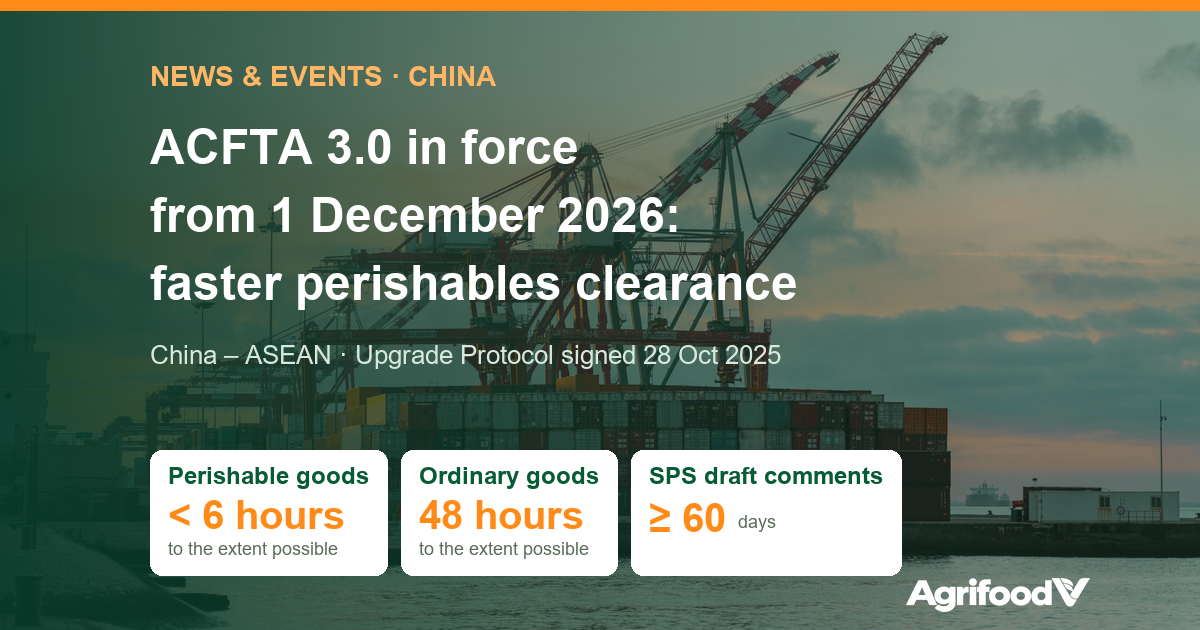
Leaders of China and ASEAN announced in Manila on 16 November 2026 that the Protocol to upgrade the ASEAN–China Free Trade Agreement (ACFTA 3.0) will enter into force on 1 December 2026. China’s Ministry of Commerce said the Protocol does not add new tariff concessions and focuses instead on customs procedures, sanitary and phytosanitary measures, standards and supply chains. For Vietnamese fruit, vegetables, seafood and food products shipped to China, the most relevant parts are the commitments on clearing perishable goods and on transparency of SPS measures.
Key points
- Signed on 28 October 2025 in Kuala Lumpur; the 1 December 2026 entry-into-force date was announced at the China–ASEAN leaders’ meeting on 16 November 2026.
- No new tariff cuts. Main content: customs procedures and trade facilitation, sanitary and phytosanitary (SPS) measures, standards and conformity assessment, digital economy, green economy, supply chain connectivity.
- Perishable goods: each Party must release them in the shortest possible time, to the extent possible in less than 6 hours after arrival and submission of all required information; ordinary goods, to the extent possible, within 48 hours.
- Viet Nam has an instrument of approval for the Protocol, signed by the Minister of Foreign Affairs on 1 June 2026.
Background: from tariff cuts to rule alignment
According to China’s Ministry of Commerce, version 1.0 of the ASEAN–China free trade area was completed in 2010, when both sides applied zero tariffs to more than 90% of tariff lines. Version 2.0 was signed in 2015 and fully in force in 2019. Negotiations on version 3.0 began in November 2022, concluded in May 2025, and the Protocol was signed in October 2025. Two-way China–ASEAN trade exceeded USD 1 trillion in 2025.
In a question-and-answer statement published on 16 November 2026, the head of the Ministry’s Department of International Trade and Economic Affairs made clear that the Protocol does not directly involve market access concessions. Its aim is to align rules and standards across the region. The full Chinese and English texts have been published on China’s free trade agreement information website.
Under Article 6 of the Protocol, it enters into force 60 days after China and at least five ASEAN Member States have notified the ASEAN Secretary-General that their internal procedures are complete. For countries that notify later, the Protocol enters into force 60 days after the date of their notification.
Customs procedures: commitments on perishable goods
Chapter 3 (Customs Procedures and Trade Facilitation) defines perishable goods as goods that rapidly decay due to their natural characteristics, in particular without appropriate storage. This is the group closest to fresh fruit, vegetables and chilled seafood.
| Provision | Commitment |
|---|---|
| Article 3.19 – Release of goods | Clearance within no longer than necessary; to the extent possible, within 48 hours of arrival and lodgement of all necessary information. |
| Article 3.19 – Perishable goods | To the extent possible, in less than 6 hours; in exceptional cases, release outside business hours; priority when scheduling examinations; proper storage allowed while awaiting release. |
| Article 3.15 – Pre-arrival processing | Documents, including in electronic form, may be submitted before arrival to speed up release. |
| Article 3.14 – Advance rulings | Written advance rulings on tariff classification, origin and customs valuation; to the extent possible, within 90 days of receiving all necessary information. |
Source: ACFTA 3.0 Upgrade Protocol, Chapter 3. Table summarised by AgrifoodV, not an official translation.
The 6-hour and 48-hour benchmarks apply only where “all regulatory requirements have been met” and “to the extent possible”. Article 3.19 also confirms that each Party keeps the right to examine, detain or confiscate goods under its own law. Consignments without a growing-area code, packing-house code or production-facility registration will still be handled as they are today.
SPS and food safety: more transparency, with deadlines
Chapter 5 (Sanitary and Phytosanitary Measures) adds a number of procedural obligations for importing Parties:
- Notify draft measures that may significantly affect trade and allow at least 60 days for comments, except in urgent health situations (Article 5.13).
- On request, provide the documents or a summary of the requirements of a draft notified to the WTO, in English, within 30 days (Article 5.13).
- Do not stop imports of a product solely because a measure is under review, if the product was permitted when the review began, except for emergency measures (Article 5.8).
- Notify emergency measures immediately in writing to the exporting Party; the exporting Party may request discussions and a review (Article 5.12).
- Notify the importer of non-compliance found during import checks; significant or recurring non-compliance may be discussed by both sides to agree remedial action (Article 5.11).
- Hold technical consultations within 30 days of receiving a request, aiming to resolve the matter within 180 days (Article 5.15). Certificates issued by the exporting Party are in English unless both sides agree otherwise (Article 5.10).
The chapter also covers recognition of pest- or disease-free areas and areas of low prevalence (Article 5.7) and systems-based audits (Article 5.9). These give Vietnamese authorities a basis to ask China to explain its process and timeline when reviewing applications to open new products. The Protocol does not replace the bilateral phytosanitary protocols already signed for individual fruits.
Standards, supply chains and digitalisation
According to China’s Ministry of Commerce, in Chapter 4 on standards, technical regulations and conformity assessment, the Parties for the first time recognise that, where no international standard is available as a reference, they may consider the other Party’s standards, and they encourage mutual recognition of conformity assessment results. The Protocol also has a separate chapter on supply chain connectivity (Chapter 11); according to China, this is the first time both sides have included a stand-alone chapter on supply chain cooperation in a free trade agreement. The digital economy part refers to cooperation on single windows, e-invoicing, e-payments and electronic bills of lading.
What companies should do
The following are recommendations from AgrifoodV, not content of the Protocol or of the Chinese Ministry of Commerce statement.
- Do not wait for further tariff cuts: Chapters 1 and 2 of the Protocol only reaffirm the existing trade-in-goods commitments and rules of origin; the new benefits are in clearance times, transparency and consultation mechanisms.
- Standardise electronic documents for pre-arrival processing: the phytosanitary certificate, certificate of origin, growing-area code, packing-house code and production-facility registration number must all match before the truck or vessel reaches the border.
- Record every delayed or rejected consignment (arrival time, document submission time, reason) and send it to Viet Nam’s SPS focal point: this is the evidence authorities need to request technical consultations under Article 5.15.
- Request advance rulings on classification or origin for new processed products (puree, fruit juice, processed spices) before signing large contracts, to avoid classification disputes at the border.
- Confirm the date of application for Viet Nam through the Ministry of Industry and Trade before relying on the new commitments in contracts or complaints.
Companies reassessing their China market strategy may refer to AgrifoodV’s market advisory services. China’s new food exporter registration rules are summarised in the article on GACC Announcement 150/2026.
References
- Ministry of Commerce of China, 商务部国际司负责人就中国—东盟自贸区3.0版升级议定书生效实施答记者问 [Head of the Department of International Trade and Economic Affairs answers questions on the entry into force of the ACFTA 3.0 Upgrade Protocol], 16 November 2026. mofcom.gov.cn (accessed 21 November 2026).
- ASEAN and China, Protocol to Further Upgrade the Framework Agreement on Comprehensive Economic Co-operation and Certain Agreements thereunder between ASEAN and the People’s Republic of China (ACFTA 3.0 Upgrade Protocol), signed in Kuala Lumpur on 28 October 2025, English text. agreement.asean.org (accessed 21 November 2026).
- Ministry of Foreign Affairs of Viet Nam, Instrument of Approval of the ACFTA 3.0 Upgrade Protocol, signed in Ha Noi on 1 June 2026. agreement.asean.org (accessed 21 November 2026).
Article by AgrifoodV, compiled from the sources above (accessed 21 November 2026). The table and summaries of provisions were prepared by AgrifoodV from the English text of the Protocol and are not an official translation. This content is not a substitute for legal advice.
Cover image: thorl5 / Pexels
Looking at Vietnam as a sourcing origin or a place to build a value chain?
Tell us your product, target market and expected volumes. In a 30–45 minute online call, AgrifoodV reviews buyers, standards, processing capacity and growing areas with you, starting from the market.
Book a call →Sourcing from Vietnam© 2026 AgrifoodV. Nội dung được phép trích dẫn khi ghi rõ nguồn và đặt liên kết tới bài gốc; không sao chép toàn văn. Xem Điều khoản sử dụng nội dung.