AgrifoodV ·
Take one lot of pineapple juice reconstituted from concentrate at 11.5°Bx: in Japan it still meets the JAS threshold, but in the EU it is not enough to be called “pineapple juice from concentrate”, and in the United States it cannot be labelled “100% juice”. The EU, the United States, Japan and Codex all have tables of minimum Brix, but each uses the figure for a different purpose. This article sets the four tables side by side for the fruits in which Vietnam is strong.
Key points
- Minimum Brix applies mainly to juice and purée reconstituted from concentrate. Directly expressed juice (NFC) is not held to a common Brix threshold; it carries the natural Brix of the fruit.
- The EU uses the Brix threshold as a condition of the name “fruit juice from concentrate”; the United States uses it to calculate the percentage of juice declared on the label; Japan uses it in the JAS standard; Codex is the international reference.
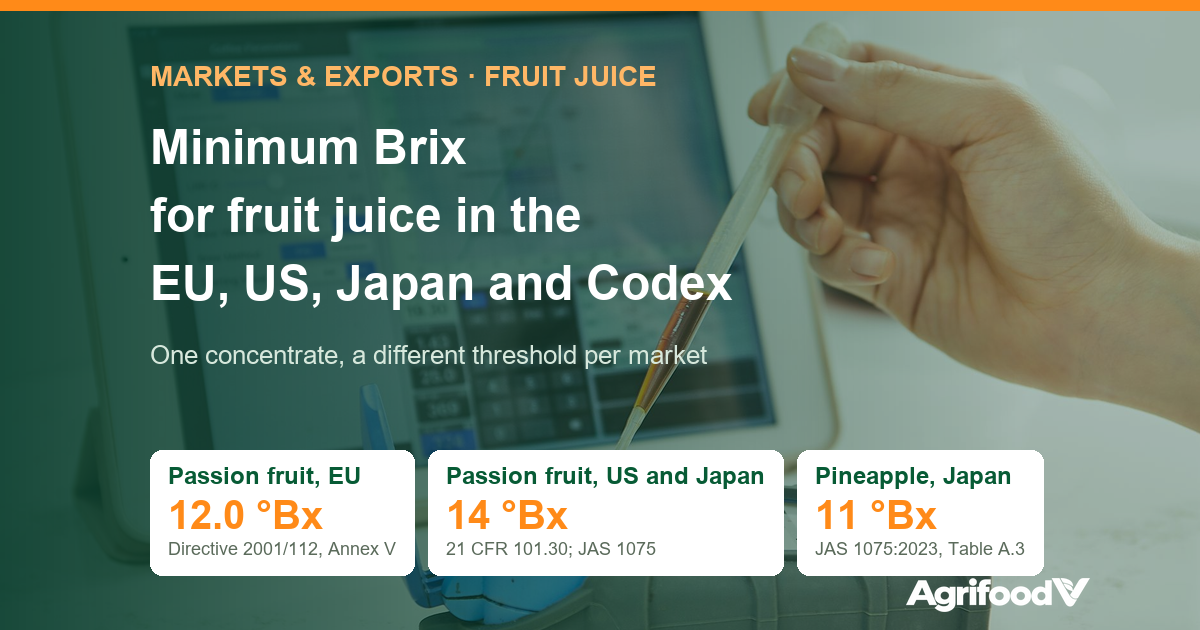
- The widest gap is for passion fruit: 12.0 in the EU and Codex, 14 in the United States and Japan. Japan is lower than the EU for pineapple (11 against 12.8).
- A common trap: the figure 4.5 for lemon in the US table is percent citric acid, not °Bx. Japan also measures lemon and lime by acidity.
Four rulebooks use Brix thresholds for four different purposes
Brix is the soluble solids content measured with a refractometer at 20 °C, close to the percentage of sugar by weight. When a plant concentrates juice and the buyer reconstitutes it, the Brix threshold shows how much water may be added for the product still to be called fruit juice.
- EU. Directive 2001/112/EC (consolidated version of 14 June 2026), Annex I, requires fruit juice from concentrate, once reconstituted, to reach the minimum Brix in Annex V. For fruits not listed in Annex V, the threshold is the Brix of the juice as extracted from the fruit used to make the concentrate. For juices (marked *), the threshold is determined as relative density against water at 20/20 °C; for purées (marked **), only an uncorrected Brix reading (without acid correction) is used.
- United States. 21 CFR 101.30 requires beverages containing juice to declare the percentage of juice. Paragraph (h)(1) lists the Brix values FDA uses to calculate the percentage of juice from concentrate: a product reconstituted below the threshold may not be labelled 100%. Juice directly expressed, not concentrated and reconstituted, is considered 100% juice (paragraph (i)). Pineapple juice also has a standard of quality in §146.185: at least 10.5°Bx without added water and at least 12.8°Bx from concentrate.
- Japan. JAS 1075:2023 for fruit beverages (last amended by MAFF Notification No. 606 of 25 May 2023) has two tables: Table A.1 is the threshold for a product to be called concentrated juice, Table A.3 is the threshold for reconstituted juice. For fruits not in the tables, the threshold is the average Brix of the expressed juice (A.3) or twice that figure (A.1). JAS is a standard of Japan’s Ministry of Agriculture, Forestry and Fisheries (MAFF); the threshold applies to products seeking the JAS mark and is commonly used as a reference by Japanese buyers.
- Codex. CXS 247-2005, the general standard for fruit juices and nectars, has an Annex of minimum Brix for reconstituted juice and purée. For some fruits such as pineapple, Codex notes that juice from countries where the natural Brix is consistently lower than the threshold is still acceptable in international trade if it meets the authenticity methods, but pineapple juice may not be below 10°Bx.
Minimum Brix reference table for tropical fruits
| Fruit | EU (2001/112, Annex V) | US (21 CFR 101.30(h)(1)) | Japan (JAS 1075, Table A.3) | Codex (CXS 247) |
|---|---|---|---|---|
| Passion fruit | 12.0 | 14.0 | 14 | 12.0 (acid corrected) |
| Pineapple | 12.8 | 12.8 | 11 | 12.8 (acid corrected; not below 10) |
| Mango | 13.5 (purée) | 13.0 | 13 | 13.5 |
| Guava | 8.5 (purée) | 7.7 | 8 | 8.5 |
| Soursop | Not listed (Brix of the fruit) | 16.0 | Not listed | 14.5 |
| Papaya | Not listed | 11.5 | 9 | No data yet |
| Banana | 21.0 (purée) | 22.0 | 23 | No data yet |
| Coconut (coconut water) | 4.5 | Not listed | Not listed | 5.0 |
| Lychee | Not listed | Not listed | Not listed | 11.2 |
| Lemon / lime | Lemon 8.0; lime not listed | 4.5% acid (not °Bx) | Measured by acidity: lemon 4.5%, lime 6% (Table A.4) | 8.0 (acid corrected) |
Unit: °Bx at 20 °C, except where % acid is shown. “Not listed”: the fruit is not in the table of the text; the threshold is then the Brix of the juice extracted from the fruit used for the concentrate (EU, US, Japan). “No data yet”: Codex states that no data are available. Codex coconut water is water taken directly from the nut, without pressing the meat.
Three points matter for Vietnamese plants. First, passion fruit concentrate sold to the United States and Japan must allow the customer to reconstitute to 14°Bx to qualify as 100% juice; the EU’s 12.0 is not enough for these two markets. Second, soursop going to the United States has a threshold of 16.0, higher than Codex’s 14.5, so the Brix of the variety and ripeness must be checked before accepting an order. Third, coconut water has had an EU threshold since Directive (EU) 2024/1438 added the “coconut” line at 4.5 to Annex V; the United States and Japan have no specific threshold.
Nectars: the threshold is juice content, not Brix
A nectar is fruit juice with added water and, optionally, sugar. Here the rules set no Brix threshold but a minimum content of juice or purée by volume of the finished product.
| Nectar made from | EU (2001/112, Annex IV) | Codex (CXS 247) |
|---|---|---|
| Passion fruit, mango, guava, papaya, soursop | 25% | 25% |
| Pineapple | 50% | 40% |
| Lychee | 25% | 20% |
| Lemon, lime | 25% | According to the legislation of the importing country |
The EU places pineapple in the group of “fruits with juice palatable in the natural state”, together with apples and oranges, so pineapple nectar must be at least half pineapple juice. The United States has no general standard of identity for nectars; the label must still declare the percentage of juice under §101.30. In Korea, the MFDS Food Code defines “fruit and vegetable juice” as a product containing at least 95% fruit or vegetable juice.
Traps when reading the tables
- The 4.5 for lemon in the US table. The footnote to 21 CFR 101.30(h)(1) states that for lemon and lime, 4.5 is percent anhydrous citric acid by weight. Converting this figure into °Bx is wrong.
- Acid correction. Codex lists passion fruit, pineapple and lemon as Brix corrected for total acidity. Passion fruit is very acidic, so the Brix read directly on a refractometer and the acid-corrected Brix may differ; the contract must state the method.
- Purée versus juice. The EU lists mango, guava and banana as purée with uncorrected Brix; do not use these figures for clear mango juice. AgrifoodV’s earlier article on Brix, product form and packaging specifications explains why product form must be fixed together with Brix.
- No added sugar to reach the threshold. The EU prohibits adding sugar to fruit juice; Codex allows sugars but forbids adding both sugars and acidifying agents to the same juice. For pineapple juice entering the United States, §146.185 counts soluble solids exclusive of added sugars.
- Codex is the 2005 version. The official PDF on the FAO server carries the 2005 adoption year and no amendment note; buyers in many countries apply national law first and Codex second.
What companies should do
The following are AgrifoodV’s recommendations.
- Write into the product specification the Brix threshold of the strictest market in your customer list, together with the method (direct reading or acid corrected, at 20 °C) and the reference text.
- For passion fruit and soursop, measure the Brix of expressed juice by growing area and harvest month before signing concentrate contracts for the United States or Japan; if natural Brix is low, prove authenticity with analytical data from your own growing areas.
- For lime and seedless lime, prepare titratable acidity test reports, not only Brix.
- Check the juice content of nectar recipes against each market, especially pineapple nectar for the EU.
AgrifoodV helps companies review product standards by market and organise growing areas with lot-level quality data. Tariffs and standards for each product are covered in the pillar articles on passion fruit juice and mango and soursop purée.
References
- Council of the EU. Council Directive 2001/112/EC relating to fruit juices and certain similar products intended for human consumption, consolidated version CELEX 02001L0112-20260614 (including amendments by Directive 2012/12/EU and (EU) 2024/1438), Annexes I, IV, V. eur-lex.europa.eu.
- FDA. 21 CFR 101.30 Percentage juice declaration for foods purporting to be beverages that contain fruit or vegetable juice, paragraphs (h), (i); 21 CFR 146.185 Pineapple juice, paragraph (b). eCFR, current version. ecfr.gov; ecfr.gov.
- Ministry of Agriculture, Forestry and Fisheries of Japan (MAFF). JAS 1075:2023 果実飲料 [Fruit beverages], Annex A, Tables A.1–A.4. maff.go.jp.
- Codex Alimentarius Commission (FAO/WHO). CXS 247-2005 General Standard for Fruit Juices and Nectars, section 3.1.2 and Annex. fao.org.
- Ministry of Food and Drug Safety of Korea (MFDS). 식품의 기준 및 규격 [Food Code], Notification 2026-55 of 31 July 2026, Chapter 5, item 9-3. foodsafetykorea.go.kr.
Article by AgrifoodV, compiled from the sources above (accessed 17 October 2026 and 29 October 2026). The figures in the tables were read directly from the original texts; the Gulf standard GSO 1820:2021 is a paid document and is not included in the table. The recommendations are AgrifoodV’s assessment. This content is not a substitute for legal advice. Cover image: 찬희 윤 / Pexels.
Looking at Vietnam as a sourcing origin or a place to build a value chain?
Tell us your product, target market and expected volumes. In a 30–45 minute online call, AgrifoodV reviews buyers, standards, processing capacity and growing areas with you, starting from the market.
Book a call →Sourcing from Vietnam© 2026 AgrifoodV. Nội dung được phép trích dẫn khi ghi rõ nguồn và đặt liên kết tới bài gốc; không sao chép toàn văn. Xem Điều khoản sử dụng nội dung.