AgrifoodV ·
For aloe gel, aloe powder and extracts, one chemical parameter decides whether a lot is sold or rejected: the content of aloin and other hydroxyanthracene derivatives. The EU has prohibited aloe leaf preparations containing these substances in food since 2021, California requires a warning for non-decolorized whole-leaf extract, and large buyers apply the industry association’s 10 ppm standard. This article rereads each text, shows which numbers are law and which are practice, and what a plant must do to prove compliance for every lot.
Key points
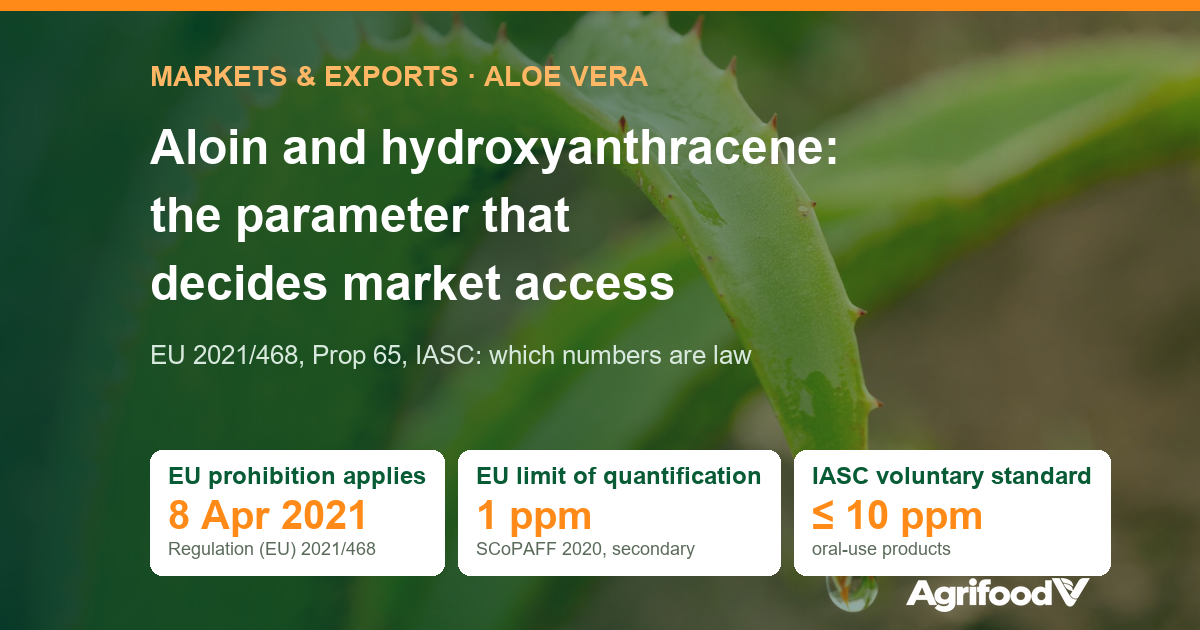
- Regulation (EU) 2021/468 added “preparations from the leaf of Aloe species containing hydroxyanthracene derivatives”, aloe-emodin, emodin and danthron to Annex III Part A (prohibited) of Regulation (EC) 1925/2006, applicable from 8 April 2021, with no transition period.
- EU law sets no ppm figure. The 1 ppm level for the sum of aloins A and B is a limit of quantification agreed by the Member States in 2020 (secondary source), not a “permitted level”.
- The EU General Court annulled these prohibition entries on 13 November 2024, but the European Commission has appealed; under the Statute of the Court, an annulment does not take effect while the appeal is pending, so the prohibition still applies.
- In the US, California’s Prop 65 applies only to non-decolorized whole-leaf extract; the IASC limit of 10 ppm aloin is voluntary.
Where aloin sits in the leaf
The aloe leaf (Aloe vera, also known as Aloe barbadensis Miller) has two very different parts. The inner fillet holds the gel, more than 99% water, with acemannan as the main polysaccharide. Next to the rind is a yellow latex containing aloin and anthraquinones, the group of substances referred to as hydroxyanthracene derivatives (Ramachandra and Srinivasa Rao, 2008). The question “does the product contain aloin?” is therefore really a question of how well the plant separates the latex from the gel.
There are two approaches. Hand filleting removes the base, tip and edges of the leaf and strips the rind so that the latex does not mix into the gel; it is labour-intensive but yields less anthraquinone. Whole-leaf grinding gives higher throughput but requires activated-carbon filtration to decolorize the product and remove aloin and aloe-emodin. According to US patents cited in the review, activated carbon can bring aloin down to about 0.1–0.5 ppm, but it also removes many other components of the gel. Time is also a variable: leaves begin to lose biological activity about 6 hours after cutting if kept at ambient temperature, and filleting should be finished within 36 hours of harvest.
EU: a prohibition, a working number and two court cases
Regulation (EU) 2021/468 of 18 March 2021 (OJ L 96, 19 March 2021) added four entries to Annex III Part A, the list of substances prohibited in food, of Regulation (EC) 1925/2006: aloe-emodin and all preparations in which this substance is present; emodin and all preparations in which this substance is present; danthron and all preparations in which this substance is present; preparations from the leaf of Aloe species containing hydroxyanthracene derivatives. The same act placed preparations of Rheum, Cassia senna and Rhamnus containing hydroxyanthracene derivatives in Part C (under Union scrutiny). The regulation entered into force on the twentieth day after publication, that is 8 April 2021, and the current consolidated version of 1925/2006 (CELEX 02006R1925-20251126) still contains all these entries.
The scientific basis is EFSA’s 2018 opinion (EFSA Journal 2018;16(1):5090): aloe-emodin, emodin and danthron are genotoxic in vitro, aloe-emodin is genotoxic in vivo, and whole-leaf aloe extract and danthron are carcinogenic; EFSA could not set a safe daily intake. The recitals of 2021/468 also state that hydroxyanthracene derivatives can be removed through a series of filtering processes, leaving them only at trace levels as impurities. This is the point a plant needs to grasp: the law prohibits preparations “containing” these substances; it does not prohibit aloe gel from which hydroxyanthracene derivatives have been removed.
The law contains no number. The 1 ppm level that European laboratories apply to the sum of aloins A and B, and to aloe-emodin and emodin, is a limit of quantification agreed by the Standing Committee on Plants, Animals, Food and Feed (SCoPAFF) in 2020 to interpret the word “containing”, according to a secondary source; AgrifoodV has not been able to read the original document. Writing “the EU permits aloin below 1 ppm” is wrong: in practice, a product with a result of 1 ppm or more is considered to contain the substances and falls under the prohibition.
Since 2024 there has been another legal layer. On 13 November 2024, the EU General Court delivered two judgments: Case T-189/21 (Aloe Vera of Europe v Commission) annulled the entry prohibiting aloe leaf preparations; Case T-302/21 (Aboca and Others v Commission) annulled the three entries for aloe-emodin, emodin and aloe leaf preparations, and the whole part placing Rheum, Cassia and Rhamnus under scrutiny. The European Commission appealed both to the Court of Justice (Case C-38/25 P lodged on 22 January 2025 and Case C-48/25 P lodged on 24 January 2025). Under Article 60 of the Statute of the Court of Justice, a General Court decision declaring a regulation void takes effect only from the date the appeal is dismissed. As of 29 October 2026, AgrifoodV had found no judgment on the appeals, so exporters must treat the prohibition as still applicable.
The US, Korea and the industry standard
At US federal level, FDA issued a final rule on 9 May 2002 (67 FR 31125, effective 5 November 2002) removing aloe from the list of over-the-counter drug active ingredients because no data on mutagenicity, genotoxicity and carcinogenicity had been submitted as requested. The rule applies to drugs, not to food, but it is the reason US buyers treat aloin as an exclusion criterion. In California, non-decolorized whole-leaf Aloe vera extract has been on the Prop 65 list of carcinogens since 4 December 2015 (OEHHA); the word “non-decolorized” was added after public comment, so inner-leaf gel and decolorized products are not covered by that entry.
The International Aloe Science Council (IASC) runs a voluntary certification programme under which products for oral use must contain no more than 10 ppm aloin (according to trade press; AgrifoodV has not been able to read the original certification documents). In Korea, under the health functional food standards issued by the Ministry of Food and Drug Safety (MFDS), aloe gel used in health functional foods must contain no more than 10 mg/kg of aloins A and B combined, calculated on 100% gel.
| Where it applies | Text | Number | Nature |
|---|---|---|---|
| EU | Regulation (EU) 2021/468, Annex III Part A of 1925/2006 | None in the law; limit of quantification 1 ppm (SCoPAFF 2020, secondary source) | Mandatory; prohibits leaf preparations containing HADs. The 2024 annulment is under appeal |
| US, federal | FDA, 67 FR 31125 (2002) | No threshold for food | Applies to over-the-counter drugs |
| California | Prop 65 (OEHHA), from 4 December 2015 | No threshold; applies to non-decolorized whole-leaf extract | Mandatory warning |
| Korea | Health functional food standards (MFDS) | Aloin A + B ≤ 10 mg/kg (gel for health functional foods) | Mandatory for health functional foods |
| Global buyers | IASC certification programme | Aloin ≤ 10 ppm (oral products) | Voluntary, by contract |
How a plant proves it
A number without a measurement method is worthless to a buyer. AOAC International has recognised Method 2016.09, high-performance liquid chromatography for aloin A, aloin B and aloe-emodin in aloe raw materials and finished products, at Final Action status (press release June 2025, secondary source). For EU-bound product, the method’s limit of quantification must be below 1 ppm for the result to answer the question “does it contain or not”.
AgrifoodV’s view: the aloin parameter shapes the plant layout more than it shapes the laboratory. The plant must be inside the growing area to fillet within the allowed time; the filleting area must separate the flow of rind and latex from the flow of gel; and if activated carbon is used, the plant must accept losing part of the gel’s valuable components. The market also affects price: aloe extract (1302.19.91) of Vietnamese origin entering the US carries an extra 12.5% under Section 301, while the EU and Korea are at 0%. The overall picture of growing areas, products and duties is in the pillar article Vietnamese aloe vera: from fresh leaf to gel, powder and extracts.
What companies should do
Recommendations from AgrifoodV:
- Design to the strictest level of the target market: if selling into the EU, treat any result of 1 ppm aloin or more as a failed lot, even if other buyers accept 10 ppm.
- State the product form clearly in the file: inner-leaf gel or whole-leaf preparation, decolorized or not, because each text applies to different forms.
- Analyse aloin A, B and aloe-emodin for every lot with a recognised method, at a laboratory with a limit of quantification below 1 ppm; retain samples and records by lot.
- Follow the two appeals C-38/25 P and C-48/25 P; do not change product specifications until there is a final judgment and a new consolidated text.
- Do not make health claims on labels or sales material unless the regulator of the importing market allows them.
AgrifoodV supports market-by-market analysis of import requirements and processing plant development.
References
- European Union. Regulation (EU) 2021/468 of 18 March 2021 amending Annex III to Regulation (EC) 1925/2006 as regards botanical species containing hydroxyanthracene derivatives, OJ L 96, 19 March 2021, p. 6 (CELEX 32021R0468). eur-lex.europa.eu.
- European Union. Regulation (EC) 1925/2006, Annex III, consolidated version CELEX 02006R1925-20251126 (read 29 October 2026). eur-lex.europa.eu.
- EFSA ANS Panel. Scientific Opinion on the safety of hydroxyanthracene derivatives for use in food. EFSA Journal 2018;16(1):5090. efsa.europa.eu.
- General Court of the European Union. Judgments of 13 November 2024, Case T-189/21, Aloe Vera of Europe v Commission (CELEX 62021TJ0189); Case T-302/21, Aboca and Others v Commission (CELEX 62021TJ0302). eur-lex.europa.eu (T-189/21); eur-lex.europa.eu (T-302/21).
- Court of Justice of the European Union. Appeals C-38/25 P (lodged 22 January 2025, OJ C/2025/1414) and C-48/25 P (lodged 24 January 2025, OJ C/2025/1416) by the European Commission. eur-lex.europa.eu (C-38/25 P); eur-lex.europa.eu (C-48/25 P).
- European Union. Statute of the Court of Justice (Protocol No 3), Article 60, consolidated version CELEX 12016E/PRO/03. eur-lex.europa.eu.
- FoodChain ID. Article on the limit of quantification for hydroxyanthracene derivatives agreed at SCoPAFF in 2020 (secondary source). foodchainid.com.
- FDA, United States. Status of Certain Additional Over-the-Counter Drug Category II and III Active Ingredients, Final rule, 67 FR 31125, 9 May 2002. govinfo.gov.
- OEHHA (California). Aloe vera, non-decolorized whole leaf extract, Prop 65 list from 4 December 2015. oehha.ca.gov.
- NutraIngredients-USA. Prop 65 listing shouldn’t apply to properly made aloe products, IASC says, 9 December 2015 (IASC certification programme, aloin maximum 10 ppm). nutraingredients-usa.com.
- Ministry of Food and Drug Safety of Korea (MFDS). Notice 2025-318 (23 July 2025) on health functional food standards; Food Today (September 2026). mfds.go.kr; foodtoday.or.kr.
- Ramachandra C.T., Srinivasa Rao P. Processing of Aloe Vera Leaf Gel: A Review. American Journal of Agricultural and Biological Sciences 3(2):502–510, 2008. doi.org.
- AOAC International via Business Wire. AOAC Method 2016.09 for aloin A, B and aloe-emodin by HPLC recognised as Final Action, 11 June 2025 (secondary source). businesswire.com.
- USTR. Section 301 notice of final action, 23 July 2026; USITC, HTSUS 2026 (code 1302.19.91). ustr.gov (PDF); hts.usitc.gov.
Article by AgrifoodV, compiled from the sources above (accessed 25–29 October 2026). The EU 1 ppm level, the IASC 10 ppm standard and the recognition status of AOAC Method 2016.09 come from secondary sources; AgrifoodV has not been able to read the 2020 SCoPAFF document or the original IASC certification documents. The status of the two appeals was checked up to 29 October 2026 and may change before this article is read. The legal status of aloe gel in Japan and China could not be verified from original documents. This content is not a substitute for legal advice. Cover image: Godfrey Claud / Pexels.
Looking at Vietnam as a sourcing origin or a place to build a value chain?
Tell us your product, target market and expected volumes. In a 30–45 minute online call, AgrifoodV reviews buyers, standards, processing capacity and growing areas with you, starting from the market.
Book a call →Sourcing from Vietnam© 2026 AgrifoodV. Nội dung được phép trích dẫn khi ghi rõ nguồn và đặt liên kết tới bài gốc; không sao chép toàn văn. Xem Điều khoản sử dụng nội dung.