AgrifoodV ·
A container of fresh lychee bound for the US, Australia or Japan is not rejected for lack of a tariff preference. It is rejected because a treatment dose was recorded wrongly, a carton had no insect-proof mesh, or a fruit came from an orchard that was not on the monitored list. Each premium market opens to Vietnamese lychee through its own treatment method and its own set of documents. This article goes back to the original texts of the US, Australia, Japan and the EU so that investors know how growing areas, packhouses and treatment facilities have to be designed together.
Key points
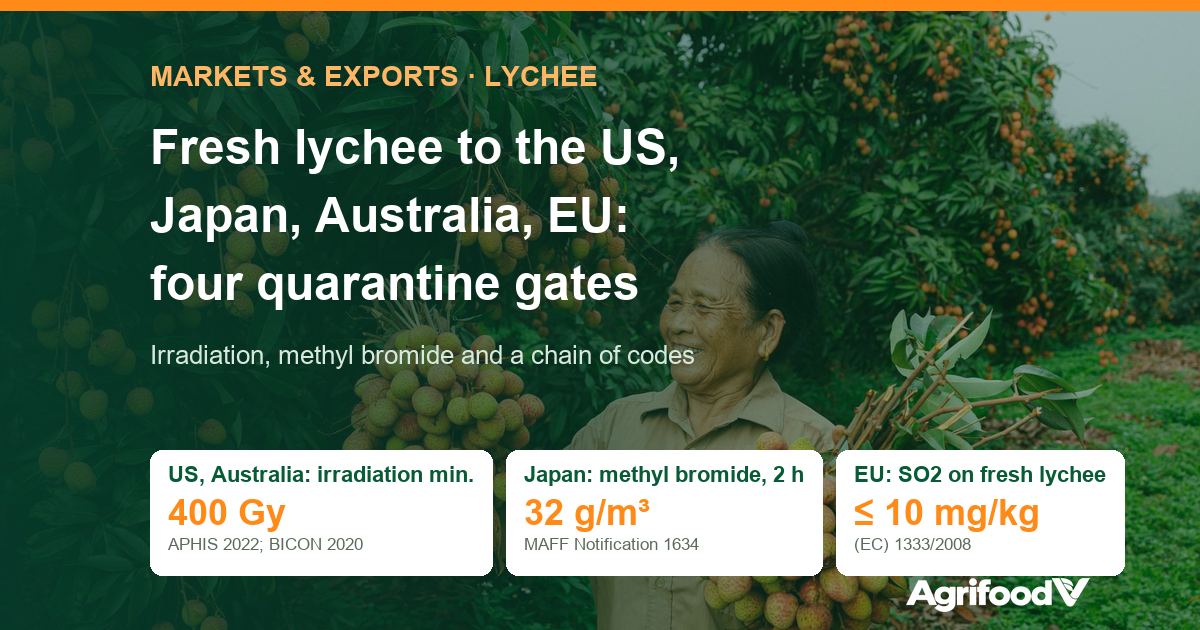
- US and Australia: irradiation at a minimum absorbed dose of 400 Gy at an approved facility in Vietnam. The US also requires registered orchards monitored free of litchi erinose mite and litchi downy blight, and bars distribution into Florida.
- Japan: accepts only the Thieu variety, fumigated with methyl bromide at 32 g/m³ for 2 hours with fruit at 27.1 °C or above; every package must be sealed and marked “FOR JAPAN”.
- EU: no specific phytosanitary treatment for lychee, only a phytosanitary certificate; Vietnamese lychee is not subject to increased checks. On the other hand, fruit irradiated for the US or Australia cannot be redirected to the EU.
- Growing-area codes: Government Resolution 36/2026/NQ-CP suspended the 10 ha minimum of Decree 38/2026/ND-CP from 31 July 2026 and moved code issuance to the chair of the commune-level People’s Committee.
Four markets, four different phytosanitary gates
The pillar article Vietnamese lychee: markets, tariffs, standards and deep processing for premium export showed that for fresh fruit the first question is whether the fruit may enter at all. The table below goes one level deeper: the treatment parameters and operating requirements that treatment facilities and packhouses must meet, according to each country’s own texts.
| Market | Mandatory treatment | Growing-area, packing and marking conditions | Legal basis |
|---|---|---|---|
| United States | Irradiation at a minimum of 400 Gy (APHIS treatment schedule T105-a-2) at an APHIS-certified facility in Vietnam; FDA maximum 1 kGy | Orchards registered with and monitored by the Plant Protection Department, free of the litchi erinose mite (Aceria litchii) and Phytophthora litchii; cartons marked with the production unit code, treatment facility code, packinghouse code, packing date, lot number, the words “Treated by irradiation” and the Radura symbol; stamped “Not for importation into or distribution within FL” | Vietnam–US irradiation workplan (October 2022); 7 CFR 305.9; 21 CFR 179.26 |
| Australia | Irradiation at a minimum of 400 Gy at a facility approved by the Vietnamese authority; maximum 1 kGy under the Australia New Zealand Food Standards Code | No import permit required; phytosanitary certificate stating “Irradiation at a minimum 400 Gy”, facility name and number, treatment date; irradiation certificate showing minimum and maximum dose; sealed cartons or vents covered with mesh of no more than 1.6 mm; cartons printed with the treatment facility code and treatment identification number | BICON “Fresh longan and lychee for human consumption”, version effective 25 April 2020 |
| Japan | Methyl bromide fumigation at 32 g/m³ for 2 hours, fruit temperature 27.1 °C or above; each load no more than 34.8% of chamber volume | Thieu variety grown in Vietnam only, shipped directly by sea or air; phytosanitary certificate declaring freedom from the oriental fruit fly species complex and the treatment; packing in a screened area, vents with mesh of no more than 1.6 mm; each package sealed and marked “PLANT QUARANTINE VIETNAM” and “FOR JAPAN” | MAFF Notification 1634 (13 December 2019, amended 30 April 2021); implementing rules (last amended 16 March 2026) |
| EU | No specific phytosanitary treatment for lychee | Phytosanitary certificate; Vietnamese lychee is not on the increased-checks list (Vietnam now has only durian and okra on it); SO₂ on fresh lychee no more than 10 mg/kg in the edible part | Regulations (EU) 2019/2072, 2019/1793, (EC) 1333/2008, consolidated versions |
| South Korea | AgrifoodV has not found any text from the Korean plant quarantine authority opening the market to fresh Vietnamese lychee; treat fresh fruit as not yet exportable | AgrifoodV check of 29 October 2026 | |
US and Australia: irradiation does not replace a clean growing area
The operational workplan addendum for irradiation of Vietnamese articles into the continental United States (October 2022 version, superseding all earlier versions) places lychee in the 400 Gy group alongside dragon fruit, longan, mango, rambutan and star apple; pomelo alone is at 150 Gy. A 400 Gy dose neutralises fruit flies, mealybugs and the eggs and larvae of Lepidoptera, but the text states clearly that irradiation does not mitigate the erinose mite, fungi, bacteria, or the pupae and adults of Lepidoptera. This is why the US requires lychee orchards to be registered and monitored by the Plant Protection Department, and why a lot is rejected as soon as preclearance inspection finds a single pest “not targeted by irradiation”, or a single fruit fly.
Three other details shape the packhouse layout. First, the minimum inspection sample is 149 fruit per lot for external pests and 29 cut fruit for internal pests; for lychee, all fruit in at least 5 boxes must be inspected. Second, fruit treated with SO₂ or sodium metabisulfite is rejected immediately, because the US does not allow sulfites on fruit sold fresh. Third, under 7 CFR 305.9, irradiated and non-irradiated articles must be kept in separate areas and never share a carton, pallets must be shrink-wrapped or strapped, and the facility must keep lot records for one year. Australia follows the same logic: consignments with leaves, stems or pests that the irradiation dose does not address are held and then treated, re-exported or destroyed at the importer’s expense.
Japan: methyl bromide and a single lychee variety
Notification 1634 of Japan’s Ministry of Agriculture, Forestry and Fisheries (MAFF) applies only to “fresh fruit of the Thieu variety of lychee produced in Vietnam”. The fumigation parameters are written as numbers in the text: 32 g of methyl bromide per cubic metre of chamber, fruit temperature of 27.1 °C or above, and an exposure time of 2 hours. The accompanying implementing rules require an airtight chamber in which gas concentration and temperature can be measured from outside, with airtightness tested every year before the season.
The Japanese text still states that treatment and inspection are confirmed by Japanese plant protection officers, in principle jointly with Vietnam’s plant protection authority; according to the Department of Crop Production and Plant Protection (May 2025), Japan has delegated supervision of the treatment step to Vietnam. The biggest risk sits at the port of entry: if a fruit fly is found, the whole lot is destroyed or returned and Japan suspends import inspection until both sides identify the cause. One orchard getting it wrong can close the season for every exporter.
EU: the easiest gate, but no irradiated fruit
Under Regulation (EU) 2019/2072 (consolidated 15 October 2026), all fresh fruit from third countries needs a phytosanitary certificate except pineapple, coconut, durian, banana and dates. Lychee has no specific entry in Annex VII of that regulation. Implementing Regulation (EU) 2019/1793 (consolidated 30 June 2026) lists only Vietnamese durian and okra for increased checks. The practical barriers in the EU are pesticide residues and SO₂.
What is easy to overlook: the EU’s common list of foods authorised for irradiation (Directive 1999/3/EC) covers only dried aromatic herbs, spices and vegetable seasonings, and irradiated food must be treated at a facility on the EU list; Vietnam has no facility on that list. Lychee irradiated for the US or Australia therefore cannot be sold into the EU when those markets slow down. Production planning has to split orchards and lots by market before harvest.
Growing-area codes: domestic rules are changing
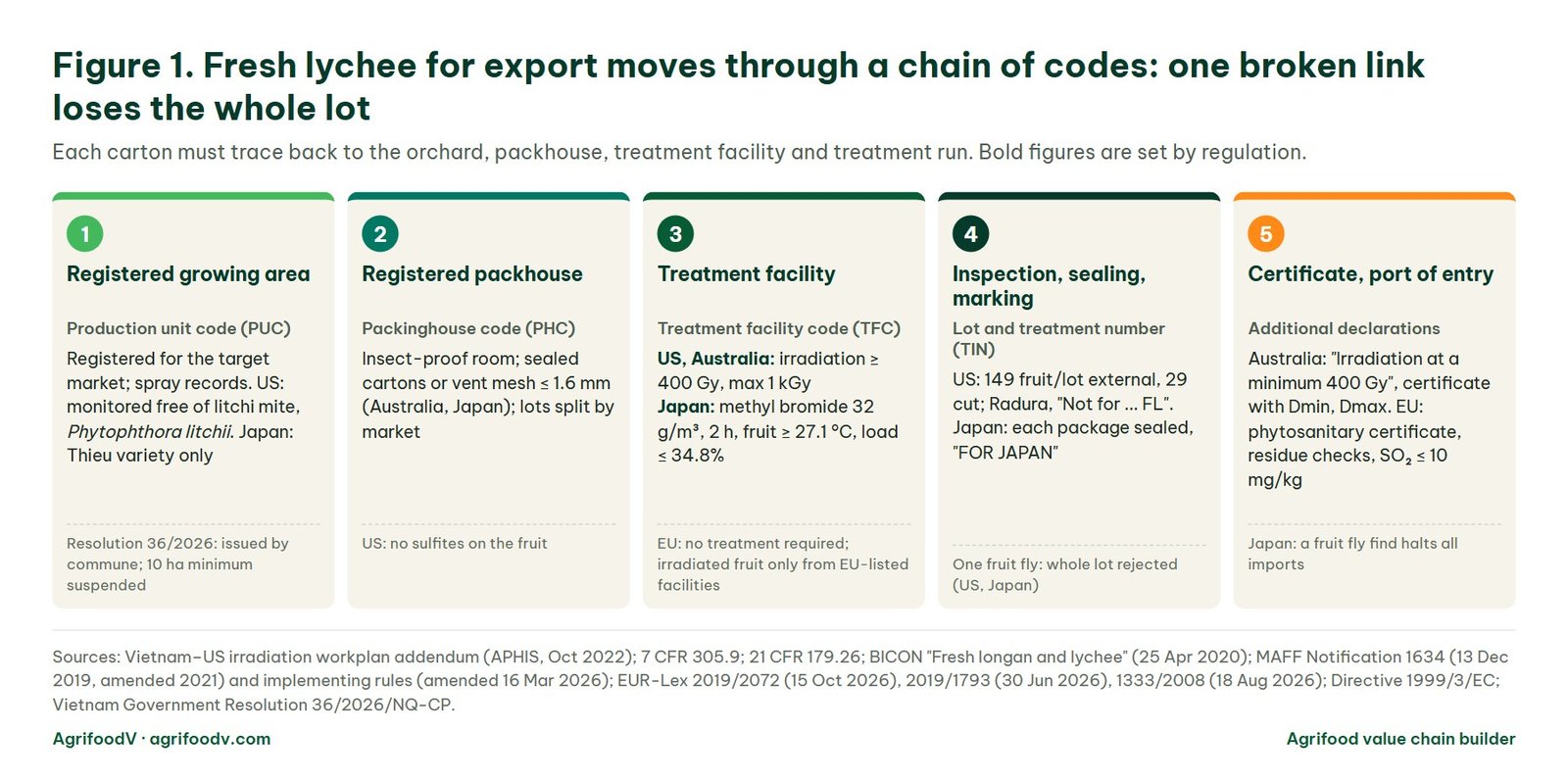
The US, Australian and Japanese protocols are all built on a chain of codes: growing-area code, packhouse code, treatment facility code and lot number. According to the Department of Crop Production and Plant Protection (May 2025), Vietnam has 469 lychee growing-area codes covering more than 19,300 ha, 55 packhouse codes, 3 irradiation facilities and 3 fumigation facilities serving exports. In Bac Ninh alone (the Luc Ngan area, formerly Bac Giang), the 2026 season review recorded 243 codes covering 17,451 ha, of which 126 codes for China, 40 for Japan, 29 for Australia, 25 for Thailand and 21 for the US (Nhan Dan newspaper, 30 July 2026). Volumes to premium markets remain small: by 23 June 2026, Bac Ninh had shipped about 260 tonnes to Japan and 110 tonnes to the EU.
The domestic legal framework changed in mid-2026. Resolution 36/2026/NQ-CP, signed on 31 July 2026 and effective from the date of signing, suspended clause 1 of Article 6 of Decree 38/2026/ND-CP (the 10 ha minimum for perennial crops) and several provisions on application files and procedures, until an amending decree takes effect. Applications go to the chair of the commune-level People’s Committee through the National Public Service Portal; processing takes 10 working days with an on-site inspection when registering for export to a market that requires codes, and 3 working days with post-inspection otherwise. A draft decree amending Decree 38 was put out for comment in September 2026; as of 29 October 2026, AgrifoodV had not seen the amending decree issued. Companies should check the text in force before preparing files. How codes and growing-area logs serve as raw-material records for a processing plant is analysed in the article Raw-material growing areas for a plant: area, harvest calendar and growing-area codes.
AgrifoodV’s view: removing the 10 ha threshold makes codes easier to obtain, but it does not make importing countries’ requirements any easier. The US still requires orchards monitored free of pests that irradiation does not address; Japan still halts the whole trade over a single fruit fly. Many small codes, each covering a handful of households, means more points of failure.
What companies should do
AgrifoodV recommendations:
- Choose the market before choosing the orchard: orchards for the US, Australia and Japan need codes registered for the right market, complete spray records and a monitoring plan for erinose mite and downy blight; split lots by market at harvest, because irradiated fruit cannot be sold in the EU.
- Design the packhouse to the strictest requirement: a screened, enclosed area, separate zones for treated and untreated fruit, cartons with vent mesh of no more than 1.6 mm (Australia, Japan) or 0.8 mm for non-palletised air shipments (US), and all codes pre-printed on cartons.
- Plan the time from orchard to treatment chamber: fruit must be at 27.1 °C when fumigated with methyl bromide for Japan, so pre-cooling schedules have to be set market by market.
- Ban sulfites from the entire line for the US and test SO₂ on EU shipments; record every post-harvest chemical in the file to declare to the plant quarantine authority.
AgrifoodV supports companies in designing raw-material growing areas and growing-area code files to the requirements of the target market.
References
- USDA APHIS and Vietnam Plant Protection Department. Operational Work Plan Addendum for Irradiation Treatment of Articles from Vietnam into the Continental United States, October 2022 (signed by APHIS 14 October 2022), sections 2.2, 2.3, 2.6, 3.4, 4.3, 5. ppd.gov.vn.
- United States. 7 CFR 305.9, Irradiation treatment requirements. law.cornell.edu.
- United States. 21 CFR 179.26, Ionizing radiation for the treatment of food (b), (c). law.cornell.edu.
- USDA APHIS. Importation of Litchi and Longan Fruit From Vietnam Into the Continental United States, final rule, 79 FR 52543, 4 September 2014. federalregister.gov.
- Australian Department of Agriculture, Water and the Environment. BICON, Fresh longan and lychee for human consumption, version effective 25 April 2020 (republished by the Vietnam Plant Protection Department). sansangxuatkhau.ppd.gov.vn.
- Japan Ministry of Agriculture, Forestry and Fisheries (MAFF). Notification No. 1634 of 13 December 2019 on standards for fresh Thieu lychee from Vietnam (amended by Notification 715 of 30 April 2021). maff.go.jp.
- Japan Ministry of Agriculture, Forestry and Fisheries, Food Safety and Consumer Affairs Bureau. Implementing rules for plant quarantine of fresh Thieu lychee from Vietnam (13 December 2019, amended 30 April 2021, 26 November 2024, 16 March 2026). maff.go.jp.
- European Union. Implementing Regulation (EU) 2019/2072, Annex XI Parts B and C, consolidated 15 October 2026. eur-lex.europa.eu.
- European Union. Implementing Regulation (EU) 2019/1793, Annexes I and II, consolidated 30 June 2026. eur-lex.europa.eu.
- European Union. Regulation (EC) 1333/2008 on food additives, Annex II Part E (category 04.1.1), consolidated 18 August 2026. eur-lex.europa.eu.
- European Union. Directive 1999/3/EC establishing a Community list of foods treated with ionising radiation; Decision 2002/840/EC on the list of approved irradiation facilities in third countries (consolidated 28 January 2022). eur-lex.europa.eu; eur-lex.europa.eu.
- Government of Vietnam. Resolution 36/2026/NQ-CP of 31 July 2026 on simplifying administrative procedures for growing-area codes and packing-facility codes. datafiles.chinhphu.vn.
- Government of Vietnam. Decree 38/2026/ND-CP of 24 January 2026 on the import of plants with soil balls and on growing-area codes and packing-facility codes. ppd.gov.vn.
- Government Electronic Newspaper. Đơn giản hóa TTHC trong cấp, quản lý mã số vùng trồng, mã số cơ sở đóng gói [Simplifying procedures for issuing and managing growing-area and packing-facility codes] (draft decree amending Decree 38/2026), 11 September 2026. baochinhphu.vn.
- Department of Crop Production and Plant Protection, 2025 lychee season data, cited in Bao Dau tu, 12 May 2025. baodautu.vn.
- Nhan Dan newspaper. Vụ vải thiều Bắc Ninh năm 2026: sản lượng giảm, giá cao kỷ lục [Bac Ninh 2026 lychee season: lower output, record prices], 30 July 2026. nhandan.vn.
- Bac Ninh Department of Industry and Trade, lychee export data to 23 June 2026, cited in Dai bieu Nhan dan newspaper, 23 June 2026. daibieunhandan.vn.
Article by AgrifoodV, compiled from the sources above (accessed 29 October 2026). Current US import conditions are published by APHIS in its agricultural commodity import requirements database, and Australian conditions in the BICON system; the Australian version quoted here is the 2020 version republished by the Vietnam Plant Protection Department. Companies should check the current versions with the plant protection authority before each season. This content is not a substitute for legal advice. Cover image: HONG SON / Pexels.
Looking at Vietnam as a sourcing origin or a place to build a value chain?
Tell us your product, target market and expected volumes. In a 30–45 minute online call, AgrifoodV reviews buyers, standards, processing capacity and growing areas with you, starting from the market.
Book a call →Sourcing from Vietnam© 2026 AgrifoodV. Nội dung được phép trích dẫn khi ghi rõ nguồn và đặt liên kết tới bài gốc; không sao chép toàn văn. Xem Điều khoản sử dụng nội dung.