AgrifoodV ·
Acemannan is the main polysaccharide in aloe vera gel and the reason buyers in the functional food sector pay more for “standardised” raw material. Yet on the market, the acemannan content of products labelled “aloe” varies enormously, and in most major markets regulators have not authorised any health claim linked to it. This article separates three questions: how acemannan is measured, what each market allows on the label, and where the scientific evidence currently stands.
Key points
- Acemannan is easily degraded and deacetylated by heating, drying or fermentation. A survey of 15 aloe beverages (Gels, 2023) found that 4 of the 8 samples labelled above 99% aloe contained less than 35 mg acemannan/100 g.
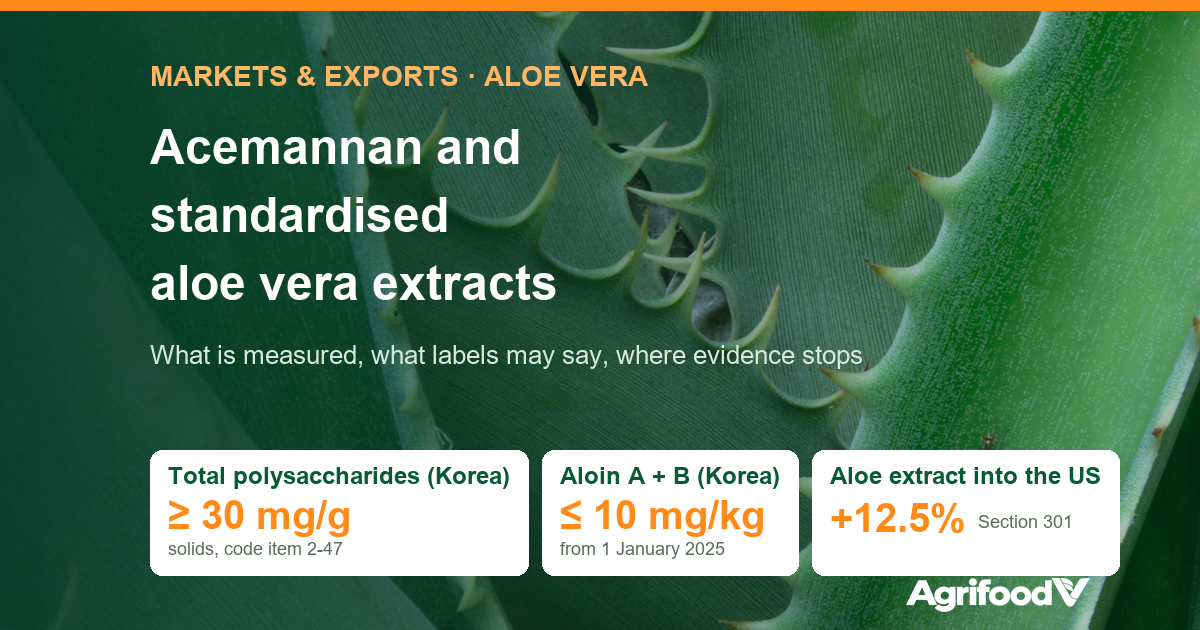
- South Korea has the clearest regulation: aloe gel is a notified functional food ingredient, standardised on total polysaccharides (at least 30 mg/g of solids), with aloin A + B at most 10 mg/kg and an intake of 110–420 mg total polysaccharides per day from 1 January 2025.
- EU: the Register of nutrition and health claims (data checked on 30 October 2026) has no entry for aloe. US: dietary supplements may only carry structure/function claims, must notify FDA within 30 days and must print the mandatory disclaimer.
- Aloe extract (1302.19) of Vietnamese origin pays an additional 12.5% under Section 301 in the US; 0% in the EU, Japan and Korea.
What acemannan is, and why “standardisation” is hard
According to the review by Liu and colleagues (Molecules, 2019), acemannan is a polysaccharide rich in mannose units that are partly or fully acetylated, and it is regarded as the main bioactive component of aloe vera gel. The gel, however, is more than 99% water (Ramachandra and Srinivasa Rao, 2008), so to sell acemannan as a concentrate or powder a plant must remove a very large amount of water without damaging the very molecule it is selling. The same 2008 review cites research showing that aloe polysaccharides are modified when dried at 30–80 °C. The steps from leaf to gel and powder are covered in the pillar article Vietnam Aloe Vera: From Fresh Leaves to Gel, Powder and Extracts for Premium Markets.
Two independent surveys show why buyers do not trust labels. Bozzi and colleagues (Food Chemistry, 2007) analysed 9 commercial aloe gel powders: according to the abstract, only 3 had satisfactory acemannan (about 10% by weight), 2 had only about 1%, 4 showed enzymatic degradation and bacterial fermentation, and one contained about 30% free glucose. Comas-Serra and colleagues (Gels, 2023) measured 15 beverages containing aloe: the 7 flavoured samples contained less than 30 mg acemannan/100 g and most were fully deacetylated; of the 8 unflavoured samples labelled above 99% aloe, only 3 exceeded 160 mg/100 g and 4 were below 35 mg/100 g; the degree of acetylation of all samples but one was below 35%, which the authors attribute possibly to pasteurisation. The implication for a plant: acemannan content is decided at heat treatment, drying and gel holding time, not at labelling.
What buyers measure
| Parameter | Method, basis | What to know |
|---|---|---|
| Total polysaccharides | South Korea, Health Functional Food Code item 2-47: at least 30 mg/g of solids; finished product at least 80% of the labelled amount; according to a method-improvement study, the code uses the phenol–sulphuric acid method | The method measures total sugars, so the code requires polysaccharides from other ingredients (for example fillers) to be declared separately |
| Acemannan, degree of acetylation | Mannose quantified after acid hydrolysis, plus ¹H nuclear magnetic resonance (¹H-NMR) spectroscopy (Bozzi 2007; Comas-Serra 2023) | Distinguishes intact gel from degraded or fermented gel |
| Whole-leaf markers, adulteration | Quantitative ¹H-NMR, the method used by the IASC certification programme; the programme’s testing laboratory lists measurable compounds including acemannan, glucose, malic acid, isocitrate (a whole-leaf marker) and maltodextrin (a filler) | Voluntary standard; certification thresholds must be obtained from IASC in their current version |
| Aloin | South Korea: aloin A + B at most 10 mg/kg, calculated on 100% gel, from 1 January 2025. IASC: at most 10 ppm for ingestible products (voluntary) | The EU prohibits preparations from aloe leaf containing hydroxyanthracene derivatives (Regulation 2021/468) |
The table shows that “standardised extract” has no single meaning. Korean buyers standardise on total polysaccharides because their regulation is written that way; buyers who need IASC certification ask for NMR results; premium supplement manufacturers may ask for both acemannan and degree of acetylation. A plant must know which parameter its customer standardises on before designing the process and the testing plan.
What each market allows on the label
South Korea. Aloe gel is listed in the Health Functional Food Code of the Ministry of Food and Drug Safety (MFDS), item 2-47, as amended by Notice 2023-91 (27 December 2023, applicable from 1 January 2025). The raw material must be the gel portion of Aloe vera leaves after the rind is removed; the permitted functionality statement is that it may help skin health, intestinal health and immune function; the daily intake is 110–420 mg of total polysaccharides. This is the claim wording set by the code, not wording a company writes itself.
EU. Under Article 10 of Regulation (EC) 1924/2006, health claims are prohibited unless authorised and included in the lists. AgrifoodV checked the data behind the EU Register of claims on 30 October 2026 (2,337 entries): none mentions aloe. In addition, the EU prohibits the use in food of preparations from aloe leaf containing hydroxyanthracene derivatives. Raw material sold into the EU is therefore sold on technical specification, not on function.
US. Dietary supplements may carry structure/function claims but not disease claims. Under 21 CFR 101.93, the company must notify FDA no later than 30 days after first marketing a product bearing such a claim, and the label must carry the statement “This statement has not been evaluated by the Food and Drug Administration. This product is not intended to diagnose, treat, cure, or prevent any disease.” On safety, the US National Toxicology Program (NTP, report TR-577, 2013) gave rats and mice a non-decolorized whole-leaf extract in drinking water for 2 years and recorded large-intestine cancers in male and female rats; California listed this extract under Prop 65 from 4 December 2015. These results apply to non-decolorized whole-leaf extract, not to inner-leaf gel from which the yellow latex has been removed, and they are why US buyers ask for documentation of latex removal.
Where the scientific evidence stops
The 2019 review compiles many activities of acemannan, mostly from in vitro and animal experiments; clinical applications are described mainly in dentistry and wound care. For orally consumed aloe, the meta-analysis by Suksomboon and colleagues (2016) covered 8 randomised trials and 470 participants and recorded small changes in some glycaemic measures; the authors themselves concluded that the evidence is limited, results vary widely between studies, and large, high-quality trials using standardised preparations are needed. AgrifoodV cites these results to describe the limits of the evidence, not to suggest a benefit: none of the markets discussed in this article allows a company to turn them into its own label claim.
On duties, according to AgrifoodV’s data set consulted on 25 October 2026: aloe extract and gel powder under 1302.19 enter the EU at 0%; in the US, line 1302.19.91 has a 0% MFN rate but pays an additional 12.5% under Section 301 (the aloe-specific exclusion covers only 8 countries, not Vietnam); Japan line 1302.19-239 is 0%; Korea line 1302199010 “aloe extract” is 0% under VKFTA; China 9.5% falls to 0% under ACFTA. How to put these parameters into the specification sheet for customers is explained in From market requirements to product specifications: Brix, product form, packaging.
What companies should do
AgrifoodV recommendations:
- Choose the buyer and its standard first (Korean-style total polysaccharides, IASC-style NMR, or acemannan with degree of acetylation), then choose the pasteurisation, concentration and drying regime.
- Measure acemannan or total polysaccharides at three points: gel after filleting, after heat treatment, and finished product; the loss between points shows which step is destroying the product.
- Do not put health benefits in raw-material sales documents; let customers in each market make claims under their own law, and give them lot-by-lot test records for aloin, microbiology and the standardisation parameter.
- For the US, include the 12.5% Section 301 duty in the offer price; for Korea, check the current version of code item 2-47 before every contract.
AgrifoodV supports companies with market and buyer requirement analysis before investing in a processing line.
References
- Liu C. et al. “Extraction, Purification, Structural Characteristics, Biological Activities and Pharmacological Applications of Acemannan, a Polysaccharide from Aloe vera: A Review”. Molecules 24(8):1554, 2019. DOI: 10.3390/molecules24081554.
- Ramachandra C.T., Srinivasa Rao P. “Processing of Aloe Vera Leaf Gel: A Review”. American Journal of Agricultural and Biological Sciences 3(2):502–510, 2008. DOI: 10.3844/ajabssp.2008.502.510.
- Bozzi A. et al. “Quality and authenticity of commercial aloe vera gel powders”. Food Chemistry 103(1):22–30, 2007 (abstract). DOI: 10.1016/j.foodchem.2006.05.061.
- Comas-Serra F. et al. “Evaluation of Acemannan in Different Commercial Beverages Containing Aloe Vera (Aloe barbadensis Miller) Gel”. Gels 9(7):552, 2023. DOI: 10.3390/gels9070552.
- MFDS, South Korea. Health Functional Food Code (건강기능식품의 기준 및 규격), item 2-47 알로에 겔 [aloe gel], as amended by Notice 2023-91 (27 December 2023, applicable 1 January 2025), extract. item 2-47 extract; consultation notice 2023-370 (25 July 2023): mfds.go.kr.
- Study improving the determination of total polysaccharides in Aloe vera gel (in Korean), KoreaScience. koreascience.kr.
- Process NMR Associates. “Aloe Vera Analysis by NMR” (NMR testing laboratory for the IASC certification programme). process-nmr.com.
- European Union. Regulation (EC) 1924/2006 on nutrition and health claims, Article 10. eur-lex.europa.eu; EU Register of claims (data checked 30 October 2026): ec.europa.eu.
- European Union. Regulation (EC) 1925/2006, Annex III Part A (as amended by Regulation (EU) 2021/468), consolidated version of 26 November 2025. eur-lex.europa.eu.
- United States. 21 CFR 101.93, Certain types of statements for dietary supplements. law.cornell.edu.
- National Toxicology Program. TR-577: Toxicology and carcinogenesis studies of a nondecolorized whole leaf extract of Aloe barbadensis Miller (Aloe vera) in F344/N rats and B6C3F1 mice, 2013. PubMed: 24042237.
- OEHHA (California). Aloe vera, non-decolorized whole leaf extract, Prop 65 listing from 4 December 2015. oehha.ca.gov.
- Suksomboon N. et al. “Effect of Aloe vera on glycaemic control in prediabetes and type 2 diabetes: a systematic review and meta-analysis”. Journal of Clinical Pharmacy and Therapeutics 41(2):180–188, 2016. DOI: 10.1111/jcpt.12382.
- WholeFoods Magazine. “Aloe Vera: Here to Stay” (IASC certification programme, aloin at most 10 ppm for ingestible products). wholefoodsmagazine.com.
- USTR. Notice of final action under Section 301 on goods of Vietnam, Federal Register, 23 July 2026. ustr.gov.
Article by AgrifoodV, compiled from the sources above (accessed 25–30 October 2026). This article describes regulations and the level of evidence; it gives no health advice and is not a claim for any product. HS codes and duty rates should be confirmed by a customs broker for each product. This content is not a substitute for legal advice. Cover image: john kokajko / Pexels.
Looking at Vietnam as a sourcing origin or a place to build a value chain?
Tell us your product, target market and expected volumes. In a 30–45 minute online call, AgrifoodV reviews buyers, standards, processing capacity and growing areas with you, starting from the market.
Book a call →Sourcing from Vietnam© 2026 AgrifoodV. Nội dung được phép trích dẫn khi ghi rõ nguồn và đặt liên kết tới bài gốc; không sao chép toàn văn. Xem Điều khoản sử dụng nội dung.