AgrifoodV ·
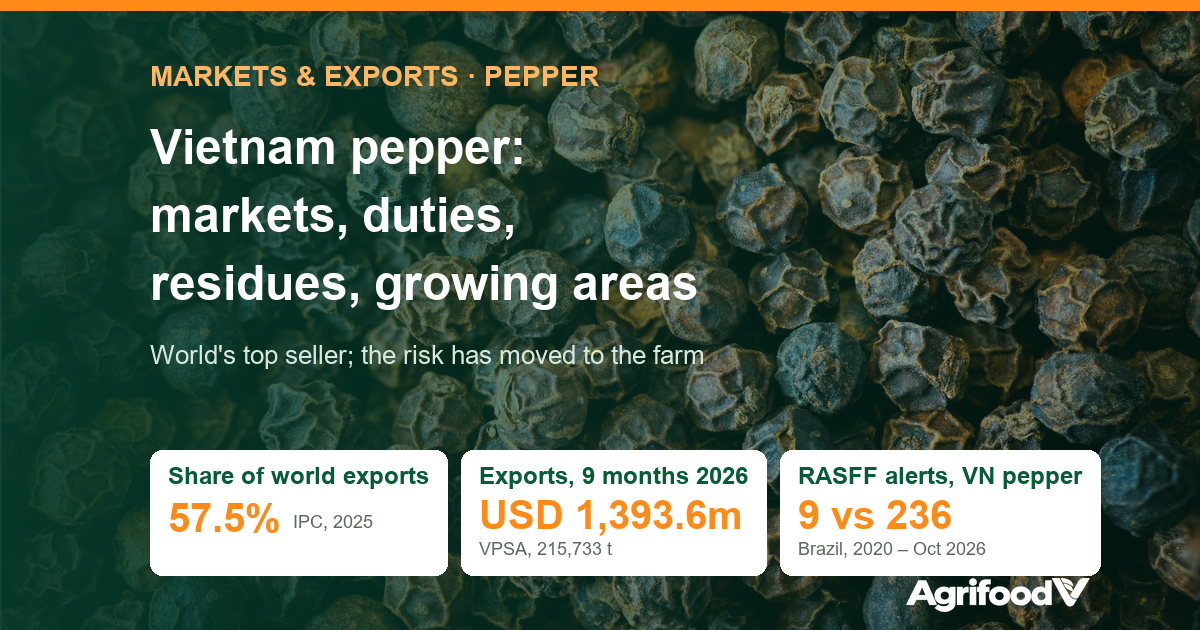
Vietnam ships more than half of the world’s exported black pepper and supplies around 80% of the pepper the US imports. Duties are close to zero in every major market, including the US, where spices are exempt from the additional 12.5% duty. Yet most pepper still leaves port as unground berries, and the risk of rejection has moved from the plant to the farm: the EU alerts on Vietnamese pepper in 2026 were all pesticide residues. This article sets out four areas side by side, markets, duties, residues and growing areas, from the perspective of an export processing plant.
Key points
- In the first nine months of 2026, Vietnam exported 215,733 tonnes of pepper worth USD 1,393.6 million: volume up 15.4%, value up only 10.2% (VPSA). In 2025, 80.5% of export volume was unground.
- Duties: whole pepper enters the EU at 0%, ground pepper falls from 4% to 0% under EVFTA; the US charges no duty and exempts it from the 12.5% Section 301 duty; bulk pepper enters Japan at 0%. Duty is no longer a competitive advantage.
- From 2020 to 10 October 2026, RASFF recorded 9 alerts on pepper of purely Vietnamese origin, against 236 for Brazil. The four alerts in 2026 were all pesticide residues; the EU default limit is 0.01 mg/kg.
- Pepper area fell from about 151,900 ha (2017) to 110,500 ha at the end of 2024. The 10 ha minimum for growing-area codes for perennial crops is suspended under Government Resolution 36/2026/NQ-CP. Pepper has two geographical indications: Chu Se (No. 00115) and Tien Phuoc (No. 00152).
Markets: the world’s largest seller, but at the lowest rung
According to the International Pepper Community (IPC, an intergovernmental body), the world produced 537,432 tonnes of pepper in 2025, of which Vietnam 195,000 tonnes (36.3%); world exports were 430,372 tonnes, of which Vietnam 247,482 tonnes (57.5%) and Brazil 83,027 tonnes. Vietnam’s output figures differ widely between sources: FAOSTAT records 262,230 tonnes for 2024 (an official figure reported by the country), IPC 180,000 tonnes for the same year, and VPSA forecasts 170,000 tonnes for 2026. No output figure is commonly accepted, so a plant’s raw-material plan cannot rely on a national average.
On exports, Vietnam Customs recorded 246,132 tonnes worth USD 1,660.9 million in 2025, an average of USD 6,748 per tonne. For the first nine months of 2026, according to the Vietnam Pepper and Spice Association (VPSA), the average fell to about USD 6,460 per tonne: more volume at lower prices. The US is the largest market with 50,621 tonnes (23.5%), followed by China with 24,904 tonnes, Thailand, India and the Netherlands. Seen from the US side, Vietnamese pepper made up 80.4% of import volume in the first seven months of 2026 (ITC data via Industry and Trade Magazine). In Japan, by contrast, Vietnam accounted for only about 29.8% of pepper import value in 2024 (UN Comtrade, Japan-reported), even though bulk pepper enters Japan duty-free.
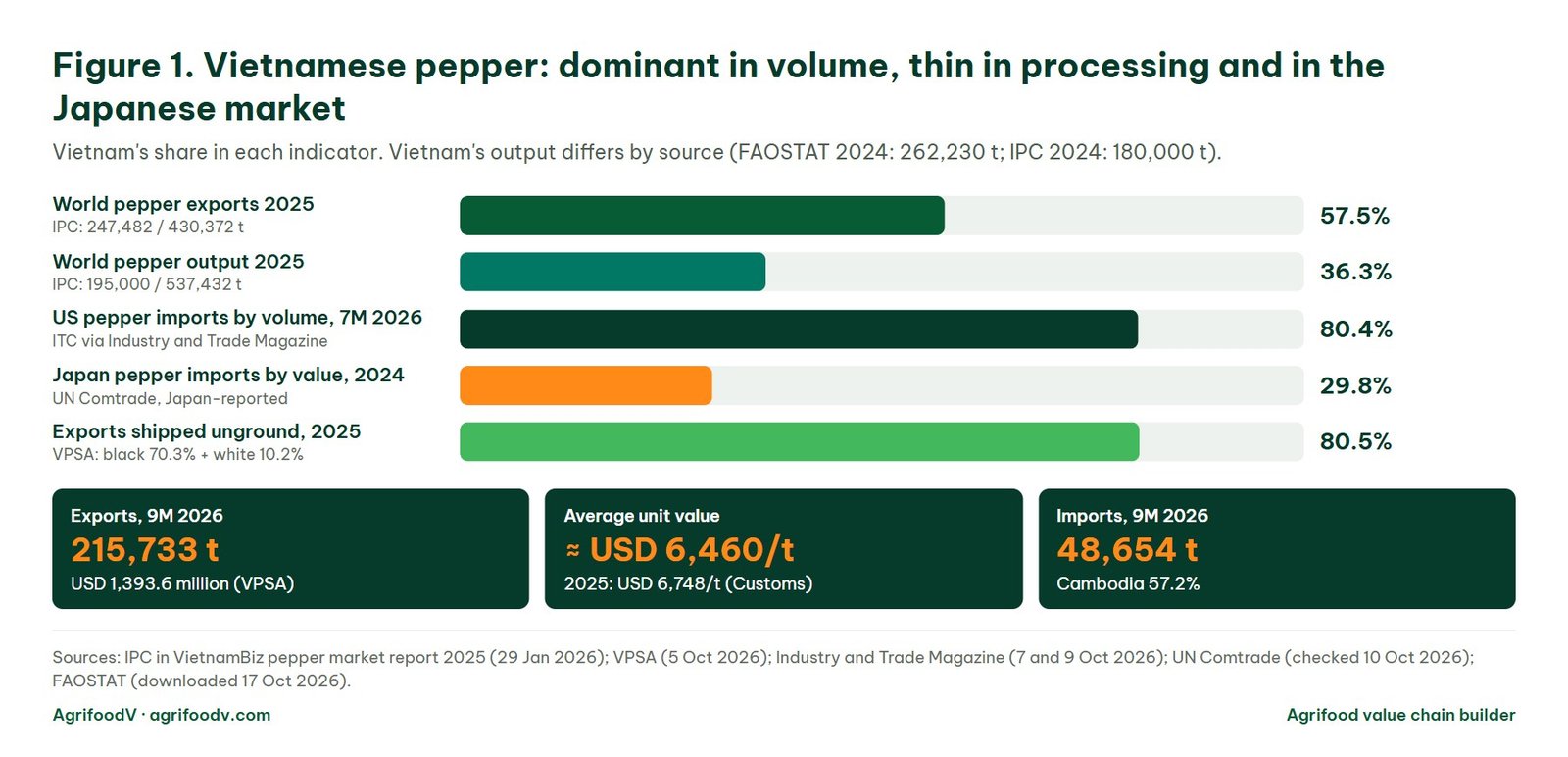
The product mix shows the limits of the current model. In 2025, whole black pepper accounted for 70.3% and whole white pepper 10.2% of export volume; ground pepper only 19.2%. White pepper sells about 30% above black (USD 8,629 against 6,607 per tonne in 2025, according to VPSA). At bulk level, however, ground pepper earns only about 5–21% more than whole pepper depending on the market (UN Comtrade, importer-reported 2024 data), and in Japan even less. Grinding alone does not create value; value lies in what comes with it: microbial reduction, certification, lot-by-lot documentation and packaging for the end buyer.
One detail matters for plants: in the first nine months of 2026, Vietnam imported a record 48,654 tonnes of pepper worth USD 280.3 million, with Cambodia supplying 57.2% and Brazil about 26% (Industry and Trade Magazine). Vietnamese plants are already the processing hub of the region, which raises two problems: separating lots by origin to declare correctly under each agreement’s rules of origin, and controlling residues in raw material from growing areas the plant does not manage.
Duties: close to zero, so the advantage must come from elsewhere
| Market | Whole pepper (0904.11) | Ground pepper (0904.12) | Note |
|---|---|---|---|
| EU | 0% | MFN 4% → EVFTA 0% | Duty only makes a difference for ground pepper with an EVFTA certificate of origin |
| US | Free | Free | Spices 0904–0910 exempt from the 12.5% Section 301 duty (Note 52(b), Chapter 99) |
| Japan | Bulk 0%; retail 4.2% → VJEPA, CPTPP 0% | As previous column | FTAs only matter for retail-packed goods |
| Korea | MFN 8% → VKFTA 0% | 8% → 0% | From UNCTAD TRAINS, not checked against the original schedule |
| China | MFN 20% → ACFTA 5% | 20% → 5% | From UNCTAD TRAINS; pepper is on the sensitive list |
A point to remember when planning deep processing: in the US, the 12.5% exemption applies only to raw and ground spices. Pepper oleoresin (3301.90.10) pays 3.8% plus 12.5%, i.e. 16.3%, as analysed in our pillar article on spice and herb processing plants for export. In the EU, Japan and Korea, duties do not distinguish a good plant from a poor one; what does is the safety record of each lot.
Residues and microbiology: the risk has moved from the plant to the farm
In the EU, Vietnamese pepper is not on the increased-control list of Implementing Regulation (EU) 2019/1793 (consolidated 30 June 2026); for Vietnamese goods, the list now covers only durian, okra, dragon fruit and fresh or frozen chilli. Competitors are listed: unground black pepper from Brazil is checked for Salmonella at 30% of consignments and must carry an official certificate (Annex II); pepper and dried chilli from India are checked for ethylene oxide at 20% (Annex I).
AgrifoodV searched RASFF by alert title from 2020 to 10 October 2026: 291 alerts on pepper, of which Brazil 236 (almost all Salmonella) and Vietnam 11, of which 9 concern pepper of purely Vietnamese origin (the other 2 involve multi-origin goods). By hazard, Vietnamese pepper had 6 pesticide alerts, 2 PAH alerts (78.8 and 51.2 µg/kg, a sign of smoke drying), 1 Salmonella, 1 ethylene oxide and 1 metal foreign body. In 2026 alone there were 4 alerts, all pesticide residues, including one case of thiamethoxam at 0.17 mg/kg against a maximum of 0.05 mg/kg. RASFF has no denominator of imported lots, so these figures are not violation rates.
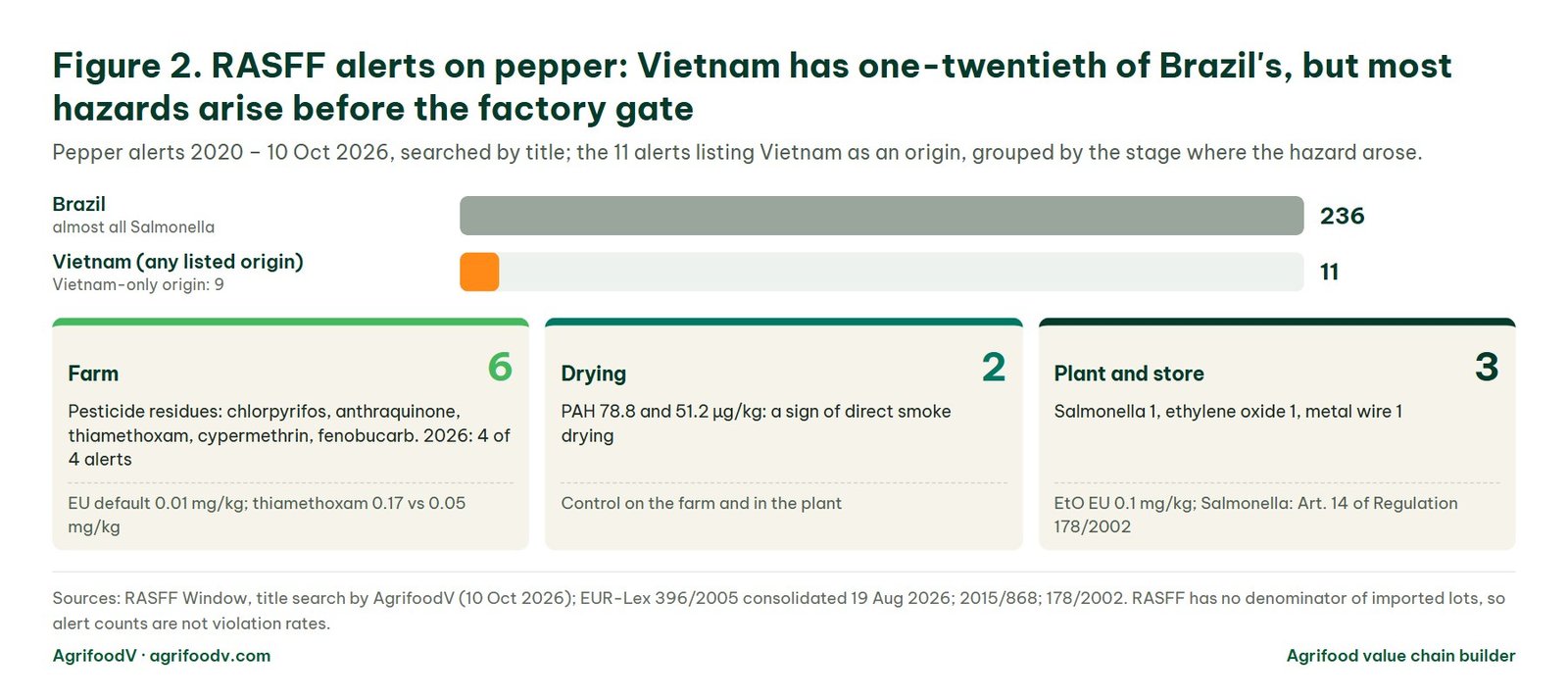
The EU limit framework is strict for active substances without a specific level: a default of 0.01 mg/kg (Regulation (EC) 396/2005), and ethylene oxide at 0.1 mg/kg as the sum of ethylene oxide and 2-chloroethanol. A VPSA survey of 284 pepper samples in 2021–2022 detected 38 active substances, with 16.7% of results failing EU maximum levels (according to the Agriculture and Environment newspaper). For Salmonella, the EU has no numeric criterion for spices in Regulation (EC) 2073/2005; contaminated lots are handled under Article 14 of Regulation (EC) 178/2002 on unsafe food.
In the US, the main pressure is microbiological: FDA Import Alert 99-19 on Salmonella lists 57 Vietnamese companies, 21 of the entries being pepper (checked by AgrifoodV on 17 October 2026). The US still allows ethylene oxide fumigation of spices; under the EPA interim decision (January 2025), pepper may be fumigated until 1 January 2032, after which only re-treatment is allowed. In Japan, Vietnamese pepper is not under an inspection order for fiscal year 2026 (Ministry of Health, Labour and Welfare, amended 8 October 2026), but Japan bans irradiation of spices and applies a uniform limit of 0.01 ppm to active substances without a specific level. The EU deforestation regulation (EUDR) does not apply to spices 0904–0910.
AgrifoodV’s view: two of the three main hazard groups for Vietnamese pepper in the EU (pesticides and PAH) arise before the pepper enters the plant. A plant with a good microbial reduction line will still have shipments rejected if it cannot control the farms and the smallholders’ drying.
Growing areas: where the shipment is decided
According to the Department of Crop Production and Plant Protection (via Industry and Trade Magazine), pepper area peaked at about 151,900 ha in 2017 and stood at 110,500 ha at the end of 2024, with an average yield of 2.6 tonnes per hectare; the 2030 target is to keep 80,000–100,000 ha. FAOSTAT records 98,616 ha for 2024. The main pepper areas are now in Dak Lak, Gia Lai, Lam Dong, Dong Nai and Ho Chi Minh City after the provincial mergers. On 15 October 2026, black pepper prices in these areas ranged from VND 138,000 to 140,500 per kg (VPSA).
On the legal side, Decree 38/2026/ND-CP (24 January 2026) governs the issuance and management of growing-area codes. Government Resolution 36/2026/NQ-CP, effective from its signing on 31 July 2026, suspends Article 6(1) of that decree, i.e. the 10 ha minimum area for perennial crops, until an amending decree is issued. For dried pepper sold to the EU and the US, a growing-area code is not an import requirement; its value for the plant is the ability to trace each lot back to the farm and its spray records, which decides whether the lot passes residue testing. How to connect growing-area data with the plant is set out in our article on raw-material growing areas for processing plants.
The Intellectual Property Office of Vietnam has granted two geographical indications for pepper: “Chu Se” (Certificate No. 00115, Decision 6163/QD-SHTT of 27 December 2021, managed by the Gia Lai Provincial People’s Committee) and “Tien Phuoc” (No. 00152, Decision 179/QD-SHTT of 29 April 2026, now part of Da Nang City). For comparison, Kampot pepper from Cambodia, a geographical indication protected in the EU, sells for about USD 17–30 per kg (according to VietnamBiz’s 2025 pepper market report), while the offer price of Vietnamese black pepper 500 g/l on 9 October 2026 was USD 5,950 per tonne (IPC). In the organic segment, according to CBI (Netherlands), Vietnam supplies about 280 tonnes of organic pepper to Europe and Sri Lanka about 540 tonnes. Geographical indications and organic certification only earn a premium when backed by residue records for each lot.
Three problems for an export pepper plant
First, raw material from many sources. With pepper imports in the first nine months of 2026 already equal to about one fifth of export volume, mainly from Cambodia and Brazil, the plant must separate lots by origin from the intake gate, keep stock records by lot and declare Vietnamese origin only when the lot meets the rules of the relevant agreement.
Second, residue control at intake. Sample, run a multi-residue screen and retain samples before warehousing, not after blending. One non-compliant lot blended into ten compliant lots spoils all eleven. The sequence is described in our article on raw-material intake and incoming checks.
Third, choosing microbial reduction by market. The EU, Japan and Korea do not accept ethylene oxide; Japan bans irradiation of spices; Vietnam has no irradiation facility on the EU-approved list (Decision 2002/840/EC). The technology choice must therefore follow the market decision. Direct smoke drying, on farms and in plants, must also be eliminated to avoid PAH.
What companies should do
AgrifoodV recommendations:
- Choose the market before the machines: the US (microbiology, Import Alert 99-19), the EU (residues, PAH, ethylene oxide) and Japan (residues, irradiation ban) are three different sets of requirements for the same peppercorn.
- Invest in contracted growing areas with spray records and pre-harvest residue analysis instead of only buying through collectors; use growing-area code data for traceability, even while the 10 ha minimum is suspended.
- Run multi-residue screens on every incoming lot, separate lots by origin, retain samples; set internal limits at the level of the strictest market the plant sells to.
- Look again at Japan: zero duty, no inspection order, yet Vietnam holds less than 30% of import value. It is a market that pays for documentation, not for low prices.
- Invest in deep processing (oleoresin, essential oil) for the US only after pricing in the 12.5% Section 301 duty; in the EU and Japan these lines enter at 0%.
AgrifoodV supports market and import-requirement analysis, processing plant direction and growing-area design for the pepper sector.
References
- Vietnam Pepper and Spice Association (VPSA). Pepper exports from January to September 2026, 5 October 2026; market bulletin of 15 October 2026. vpsaspice.org.
- VietnamBiz. Báo cáo thị trường hồ tiêu năm 2025 [Pepper market report 2025] (compiling Vietnam Customs, VPSA, IPC), 29 January 2026. vietnambiz.vn (PDF).
- Thue & Hai quan Online. Xuất khẩu hồ tiêu tiếp tục tăng trưởng [Pepper exports continue to grow], 6 October 2026. thuehaiquan.tapchikinhtetaichinh.vn.
- Industry and Trade Magazine. Pepper prices of 7 October (pepper imports in nine months of 2026) and 9 October 2026 (US market share, IPC offer prices). tapchicongthuong.vn; tapchicongthuong.vn.
- FAO. FAOSTAT, crops production dataset (downloaded 17 October 2026). fao.org.
- United Nations. UN Comtrade, importer-reported data for HS 0904.11–0904.12 in 2024 (checked 10 October 2026). comtradeplus.un.org.
- European Union. Implementing Regulation (EU) 2019/1793, consolidated CELEX 02019R1793-20260630 (read 29 October 2026). eur-lex.europa.eu.
- European Commission. RASFF Window, search by pepper alert title, 2020 – 10 October 2026 (including 2021.5861, 2022.3545, 2022.6905, 2024.0976, 2024.8309, 2025.6526, 2025.9878, 2026.4784). webgate.ec.europa.eu.
- European Union. Regulation (EC) 396/2005 on maximum residue levels, consolidated CELEX 02005R0396-20260819; Regulation (EC) 178/2002, Article 14. eur-lex.europa.eu.
- Agriculture and Environment newspaper. VPSA survey of pesticide residues in pepper, 16 November 2023 (secondary source). nongnghiepmoitruong.vn.
- FDA. Import Alert 99-19 (Salmonella) and 28-02, 28-04 (checked 17 October 2026). accessdata.fda.gov.
- US EPA. Ethylene Oxide Interim Registration Review Decision, Case 2275, January 2025. epa.gov (PDF).
- Ministry of Health, Labour and Welfare of Japan. Imported foods monitoring plan for fiscal year 2026 (amended 8 October 2026). mhlw.go.jp.
- European Commission, TARIC (0904 11, 0904 12, origin Vietnam, checked 17 October 2026); USITC, HTSUS 2026 Rev. 21 and Chapter 99, Note 52; Japan Customs, tariff schedule of 1 April 2026; UNCTAD TRAINS via WITS (Korea, China). ec.europa.eu; hts.usitc.gov; customs.go.jp.
- Industry and Trade Magazine. Pepper cultivation area in Vietnam declines (data from the Department of Crop Production and Plant Protection). tapchicongthuong.vn.
- Government of Vietnam. Decree 38/2026/ND-CP (24 January 2026) on growing-area codes and packing-facility codes; Resolution 36/2026/NQ-CP (31 July 2026). chinhphu.vn.
- Ministry of Industry and Trade. Bảo hộ chỉ dẫn địa lý “Chư Sê” cho sản phẩm hạt tiêu [Protection of the “Chu Se” geographical indication for pepper], 27 April 2022; VnEconomy. Đà Nẵng công bố chỉ dẫn địa lý “Tiên Phước” cho sản phẩm hạt tiêu [Da Nang announces the “Tien Phuoc” geographical indication for pepper], 26 May 2026. moit.gov.vn; vneconomy.vn.
- CBI (Netherlands Ministry of Foreign Affairs). What is the demand for spices and herbs on the European market?, 4 February 2026. cbi.eu.
- European Union. Decision 2002/840/EC (list of approved irradiation facilities in third countries), consolidated CELEX 02002D0840-20220128. eur-lex.europa.eu.
Article by AgrifoodV, compiled from the sources above (accessed 10–29 October 2026). Korean and Chinese duty rates come from UNCTAD TRAINS and have not been checked against the original schedules; the VPSA residue survey figures come from press reports. Sources on Vietnam’s pepper output differ by up to about 90,000 tonnes, so every output figure in the article names its source. The 10-digit HS code and the rules of origin for each lot must be confirmed by a customs broker. This content is not a substitute for legal advice. Cover image: Frank Cone / Pexels.
Looking at Vietnam as a sourcing origin or a place to build a value chain?
Tell us your product, target market and expected volumes. In a 30–45 minute online call, AgrifoodV reviews buyers, standards, processing capacity and growing areas with you, starting from the market.
Book a call →Sourcing from Vietnam© 2026 AgrifoodV. Nội dung được phép trích dẫn khi ghi rõ nguồn và đặt liên kết tới bài gốc; không sao chép toàn văn. Xem Điều khoản sử dụng nội dung.