AgrifoodV ·
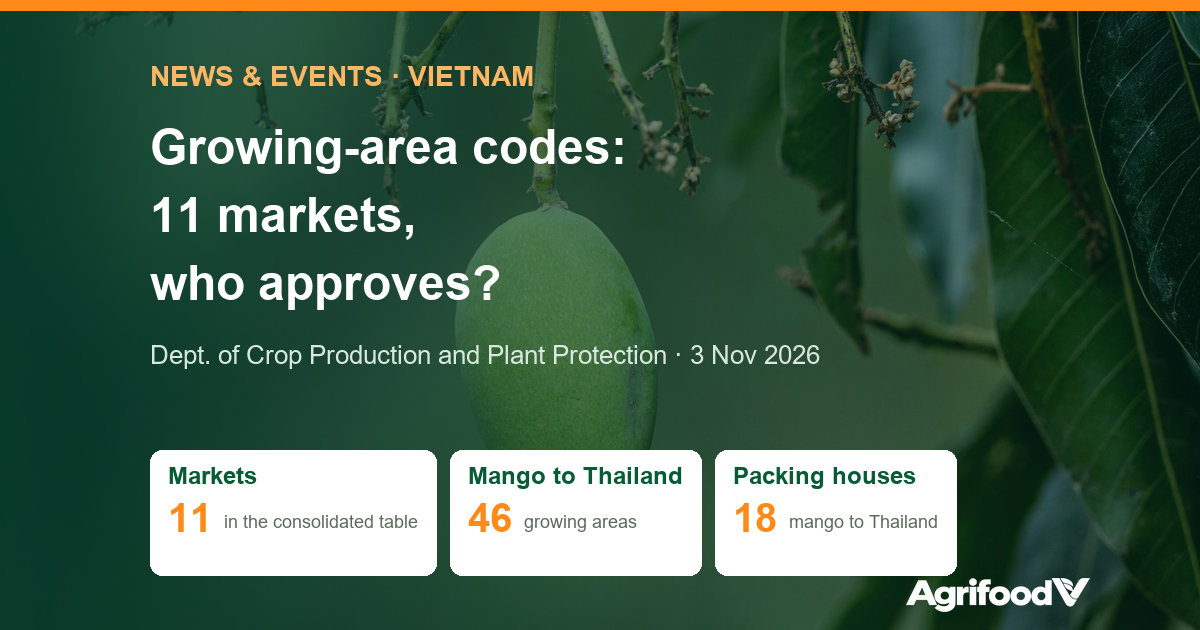
On 3 November 2026, Vietnam’s Department of Crop Production and Plant Protection (Ministry of Agriculture and Environment) published a consolidated table of the growing-area code and packing-house code requirements that 11 importing markets apply to Vietnamese fruit and vegetables. On the same day, the Department posted the list of 46 growing areas and 18 packing houses approved to export mangoes to Thailand. Together, the two documents show that the same product may have to pass through very different approval mechanisms depending on its destination.
Key points
- The consolidated table covers 49 market–product pairs plus one general requirement row for the United States, across 11 markets: China, the United States, South Korea, Japan, Taiwan, Malaysia, Thailand, Australia, New Zealand, Chile and the EU.
- China, the United States, Taiwan and Malaysia require codes to be sent for approval by the importing side; Thailand, New Zealand and Chile leave the lists to Vietnam to manage; the EU does not require codes to be registered with the EU.
- Passion fruit appears for two markets in the table: China (first signed in 2025, every code must be approved by GACC) and Australia (first signed in 2024, Australia accepts registration and approval by Vietnam).
- The list of mango exporters to Thailand contains 46 growing areas with a combined listed area of about 1,605 ha, concentrated in Dong Thap and An Giang.
Background: growing-area codes are a market-access condition, not just paperwork
Growing-area codes (PUC) and packing-house codes (PHC) allow the importing country to trace a consignment back to the exact orchard and packing facility, for the purpose of pest control. Each protocol or work plan signed with a given country sets out how codes are issued, who approves them and who supervises. Until now this information was scattered across individual documents; the Department’s new consolidated table puts them side by side, with the year first signed, requirements for growing areas and packing houses, the list of regulated pests and notes on the approval mechanism.
Who approves the codes: each market has its own mechanism
| Market | Products in the table | Mechanism for codes |
|---|---|---|
| China (GACC) | Passion fruit, lime and pomelo, banana, watermelon, jackfruit, coconut, mangosteen, chilli, durian, grass jelly | All growing-area and packing-house codes are sent to GACC for review and approval (grass jelly requires packing-house codes only) |
| United States (APHIS) | Dragon fruit, lychee, longan, mango, pomelo, rambutan, star apple, coconut | Codes are sent to APHIS for approval; APHIS assesses packing houses before approval; every consignment is supervised by APHIS and Vietnamese officers |
| Taiwan, Malaysia | Dragon fruit (Taiwan); chilli (Malaysia) | Codes are sent to the importing side for approval before export |
| South Korea (APQA) | Pomelo, dragon fruit, mango | APQA inspects and assesses growing areas and packing houses every year; for pomelo, growing-area codes are approved by Vietnam and packing-house codes are sent to Korea for approval |
| Japan (MAFF) | Lychee, Cat Chu mango, dragon fruit, longan | Japanese experts inspect treatment facilities before each export season |
| Australia (DAFF) | Pomelo, passion fruit, longan, dragon fruit, lychee, mango | Lists must be updated in the BICON system before any consignment is shipped; for pomelo, passion fruit and mango, Australia accepts registration and approval by Vietnam |
| Thailand, New Zealand, Chile | Lychee, mango, longan (Thailand); pomelo, mango, rambutan, dragon fruit, lime (New Zealand); pomelo, dragon fruit, mango (Chile) | Vietnam approves and manages the lists and provides them on request; the importing side retains the right to audit |
| EU | Mango, citrus, solanaceous fruit, vegetables and herbs, seeds | No list submission or code registration with the EU is required; controls follow Annex VII of Regulation (EU) 2019/2072 |
Source: Department of Crop Production and Plant Protection, consolidated table of import requirements (posted 3 November 2026). Grouped by AgrifoodV based on the notes column of the table.
Details companies tend to miss
- The United States has hard deadlines: production units must be registered with Vietnam’s plant protection authority at least 90 days before the export season; the official list must reach APHIS at least 30 days before the season or before new growing areas or packing houses are added. While packing programme fruit, a packing house may not pack non-programme fruit.
- Coconut to the United States is an exception: according to the table, coconuts with at least 75% of the husk removed are recognised by APHIS as minimally processed and require no growing-area or packing-house codes. Coconut to China is the opposite: growing areas and packing houses must be approved by both sides.
- Thailand delegates, but keeps post-audit rights: registration records must always be available to Thailand’s Department of Agriculture (DOA) on request; DOA may send auditors to Vietnam at Vietnam’s expense; if imports are suspended, DOA may re-audit the entire certification process.
- The EU issues no codes but still checks production areas: for mango, the production area must be recognised as free from the fruit flies of concern to the EU, or traps must be monitored at least once a month for three consecutive months before harvest. Codes issued by Vietnam serve traceability and the issuance of phytosanitary certificates.
- Taiwan and dragon fruit: fruit must undergo vapour heat treatment at a facility approved by both sides, at 46.8°C or higher for at least 40 minutes, with relative humidity of 90% or more.
Mango list for Thailand: 46 growing areas, 18 packing houses
According to the list posted by the Department on 3 November 2026, the 46 mango growing areas approved for Thailand are located in Dong Thap (24), An Giang (16), Lam Dong (4) and Dong Nai (2). The area column in the list adds up to about 1,605 ha. Four growing areas are marked as new. The packing-house list has 18 facilities: Dong Thap 8, Tay Ninh 4, An Giang 2, and the rest in Vinh Long, Lam Dong, Hue and Xuan Hoa commune; one facility is marked as new. Because Thailand lets Vietnam approve the codes itself, this list is the basis on which consignments receive phytosanitary certification.
What it means for Vietnamese produce
The consolidated table shows that the cost and time needed to bring a growing area into export differ between markets. For mango, lists going to Thailand, New Zealand, Chile or Australia are managed by Vietnam; for the United States, APHIS approval and a packing-house assessment are required; for South Korea, there is an annual assessment. For passion fruit, growing areas targeting China must be approved by GACC, while those targeting Australia are approved by Vietnam.
What companies should do
The following are AgrifoodV’s recommendations, not content of the Department of Crop Production and Plant Protection’s documents.
- Choose the market before applying for codes: match the product against the approval-mechanism column to know whether the growing area must wait for the importing side’s approval or only needs Vietnamese approval, and schedule ahead of the season.
- Work backwards from the harvest date: for the United States, count back at least 90 days; for markets that approve each code, allow extra time for the list to be updated.
- Keep records audit-ready even in markets that delegate to Vietnam: field logs, pest monitoring results and fruit intake records at the packing house.
- Download the original table and watch for updates on the Department’s website, as code lists are added in batches.
If your company needs to plan growing areas around the requirements of each market, see AgrifoodV’s growing-area advisory services.
References
- Department of Crop Production and Plant Protection, Yêu cầu nhập khẩu của các nước đối với một số sản phẩm trồng trọt có nguồn gốc xuất xứ từ Việt Nam [Import requirements of other countries for certain crop products originating from Vietnam], posted 3 November 2026, with the consolidated table file “Sum of Import Requirements PUCs, PHCs”. ppd.gov.vn (accessed 13 November 2026).
- Department of Crop Production and Plant Protection, Danh sách vùng trồng và cơ sở đóng gói xoài được phép xuất khẩu vào thị trường Thái Lan [List of mango growing areas and packing houses approved for export to Thailand], posted 3 November 2026, with the PUC and PHC list file. ppd.gov.vn (accessed 13 November 2026).
Article by AgrifoodV, compiled from the sources above (accessed 13 November 2026). The numbers of growing areas and packing houses and the total area were counted and summed by AgrifoodV from the list files; the protocols and work plans of each market are the documents that apply. This content is not a substitute for legal advice.
Cover image: Rajesh S Balouria / Pexels
Looking at Vietnam as a sourcing origin or a place to build a value chain?
Tell us your product, target market and expected volumes. In a 30–45 minute online call, AgrifoodV reviews buyers, standards, processing capacity and growing areas with you, starting from the market.
Book a call →Sourcing from Vietnam© 2026 AgrifoodV. Nội dung được phép trích dẫn khi ghi rõ nguồn và đặt liên kết tới bài gốc; không sao chép toàn văn. Xem Điều khoản sử dụng nội dung.