AgrifoodV ·
Premium beverage makers buy lychee ingredients for one thing: the smell of lychee. It is also the first thing lost on a processing line, because lychee aroma compounds are volatile and heating creates cooked notes. This article walks through the three industrial ingredient forms made from lychee (not-from-concentrate juice, lychee puree, and lychee juice concentrate with recovered aroma), explains why the aroma recovery unit must sit before the evaporator, and sets out the rules and duties a plant has to price in before it quotes a buyer.
Key points
- The signature aroma compound of lychee is cis-rose oxide (the highest odour activity value among odorants common to fresh and canned lychee, according to Ong and Acree, 1999). Heat-sterilised lychee juice develops a cooked off-flavour driven by sulphur compounds such as dimethyl sulfide, methional and dimethyl trisulfide (An et al., 2019).
- For lychee juice concentrate, the juice passes through the aroma recovery unit first; only the stripped juice then enters the vacuum evaporator. The recovered aroma is a separate product, sold with the concentrate or on its own.
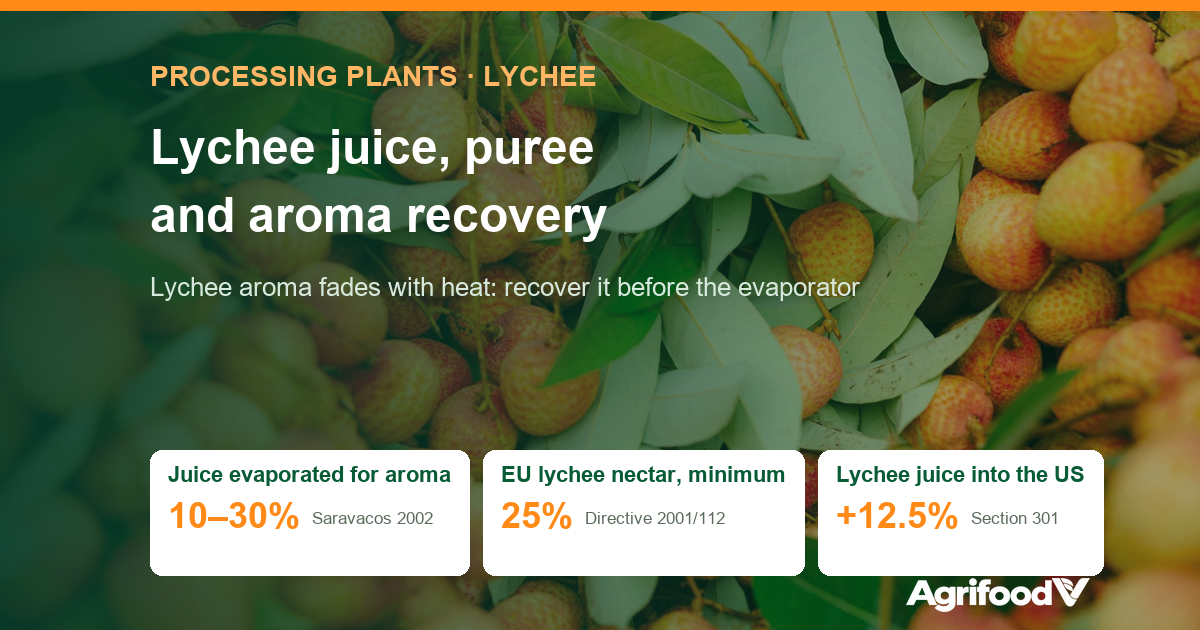
- In the EU, lychee has no minimum Brix in Directive 2001/112/EC: reconstituted lychee juice must reach the Brix of the juice extracted from the fruit used to make the concentrate, and lychee nectar must contain at least 25% juice or puree. The US has no standard Brix for lychee either.
- Duties: lychee juice enters the EU, Japan, Korea and China at 0% under FTAs; in the US, lychee juice and processed lychee carry an extra 12.5% under Section 301, while fresh and frozen lychee are exempt.
Three ingredient forms, three kinds of buyer
From the same fruit, a plant can make three ingredient forms for the beverage industry. Not-from-concentrate (NFC) lychee juice keeps the aroma best but ships the full water load and needs a cold chain or aseptic storage; buyers are usually premium juice brands and bar and café chains. Lychee puree keeps the fruit flesh and goes into smoothies, yoghurt, ice cream and desserts. Lychee juice concentrate is compact for transport, sells to large beverage blending plants, and comes with a fourth product, recovered lychee aroma, used to put the flavour back on reconstitution or as a flavour raw material. Where these forms sit on the lychee value ladder is covered in the pillar article Vietnam lychee: markets, duties, standards and deep processing for premium exports.
The choice of product form drives plant design, not the other way round. A plant that makes only NFC juice and puree needs no evaporator, but it does need aseptic filling or freezing capacity and enough cold storage for the whole season. A plant that makes concentrate needs both an aroma recovery unit and an evaporator, and must be able to sell two product streams instead of one.
Why lychee aroma is hard to keep
Ong and Acree (1999) compared the odorants of fresh lychee, canned lychee and Gewürztraminer wine using gas chromatography-olfactometry, and found that cis-rose oxide had the highest odour activity value among the odorants common to all three products. Aroma compounds of this kind are volatile: they leave the juice as soon as it is heated, stirred in open vessels or evaporated in the evaporator.
The second problem is that heat creates off-notes. An et al. (2019, Food Chemistry) compared fresh lychee juice with heat-sterilised lychee juice that smelled of cooked cabbage, potato, onion and garlic. Fifteen compounds had higher odour activity values in the heated juice; testing several lychee varieties, the authors concluded that dimethyl sulfide, methional, dimethyl disulfide, dimethyl trisulfide and 3-methylbutanal are the common cause of the cooked off-flavour. Heavily heat-treated lychee juice therefore loses lychee aroma and gains notes buyers do not want. Two consequences for the plant: reduce the total heat load on the juice, and take the aroma out of the juice before it reaches the hottest steps.
Aroma recovery: placed before the evaporator
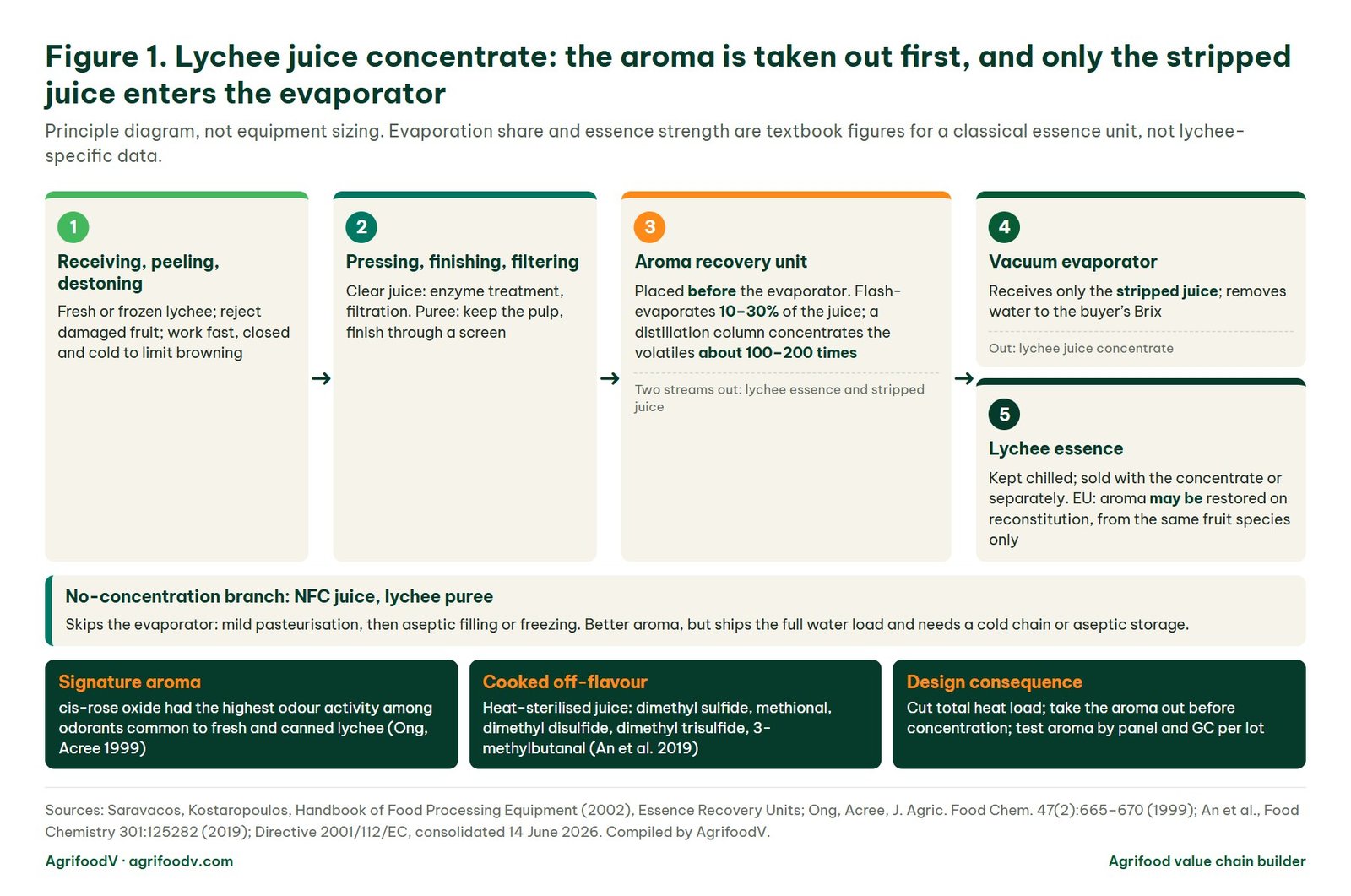
The correct sequence is: juice from pressing and filtering goes into the aroma recovery unit first. According to the food processing equipment handbook by Saravacos and Kostaropoulos (2002), a classical essence recovery system has a flash evaporator that evaporates about 10–30% of the juice, then sends the vapour to a distillation column that concentrates the volatiles into an aqueous essence about 100–200 times their original concentration in the juice. Only the stripped juice leaving this unit goes on to the vacuum evaporator, which removes water to the Brix the buyer specifies. Do not design the line to take aroma from the evaporator vapour: by then the volatiles have passed through the hot step and are diluted in a very large volume of vapour.
The figures of 10–30% and 100–200 times are parameters of a classical essence recovery system in the technical literature, not measurements specific to lychee. The evaporation share needed depends on the volatility of each aroma compound in lychee juice and must be set during commissioning trials, with sensory evaluation and gas chromatography for every essence lot. AgrifoodV found no public data it could verify on aroma recovery efficiency for lychee specifically.
Rules and duties to price in
EU. Under Directive 2001/112/EC (consolidated text of 14 June 2026), flavour, pulp and cells obtained by suitable physical means from the same species of fruit may be restored to fruit juice from concentrate; this is a permission, not an obligation. Lychee is not listed in Annex V (minimum Brix of reconstituted juice), so the Brix of reconstituted lychee juice must equal the Brix of the juice as extracted from the fruit used to make the concentrate. Lychee nectar must contain at least 25% fruit juice or puree (Annex IV). In practice, each concentrate lot file should carry the Brix of the original expressed juice, because EU buyers need this figure to reconstitute in line with the law.
United States. Lychee is not in the Brix table of 21 CFR 101.30(h)(1). In that case, under paragraph (h)(2), the labelled percentage juice is calculated on the soluble solids of the single-strength juice used to make the concentrate. AgrifoodV found no Codex standard for lychee juice; Codex standard CXS 196-1995 for litchi covers fresh fruit only. Do not invent a “standard Brix” for lychee juice when quoting; state the measured value of the lot and the method used.
| Tariff line (HS) | EU (EVFTA) | US | Japan (VJEPA) | Korea (VKFTA) | China (ACFTA) |
|---|---|---|---|---|---|
| Lychee juice, lychee juice concentrate (2009.89) | 10.5–11% → 0% | 0.5 cent/litre + 12.5% (Section 301, not exempt) | 0% | 0% | 5% → 0% |
| Prepared lychee, lychee in syrup (2008.99) | 11–18.4% → 0% | 7% + 12.5% (line 2008.99.35, not exempt) | 10–14% → 0% | 0% | 5% → 0% |
| Frozen lychee (0811.90) | 9–13% → 0% | 14.5%, exempt from Section 301 | 7.2–12% → 0% | 0% | 30% → 0% |
Table sources: TARIC (EU), USITC HTS and the USTR Section 301 notice of 23 July 2026 (US), Japan Customs tariff schedule of 8 August 2026, yesFTA portal (Korea), hsbianma (China, secondary site); AgrifoodV data set checked on 25 October 2026. The rate before the arrow is the standard duty; the rate after the arrow is the preferential duty for goods of Vietnamese origin. Which line lychee puree falls under depends on how it is processed (cooked, sweetened, frozen or aseptic): the 10-digit HS code must be confirmed by a customs broker.
The US market stands out: deep processing makes lychee products more expensive to ship to the US, because fresh and frozen lychee are exempt from the extra 12.5% while lychee juice and prepared lychee are not. For the EU, Japan, Korea and China, duty is not the barrier; the barriers are aroma quality and lot documentation. The wider picture of Vietnam’s fruit juice and puree exports is in the 2026 report on Vietnam’s fruit juice and puree exports.
What companies should do
AgrifoodV recommendations:
- Choose the product form by buyer before choosing equipment: NFC juice and puree for the premium segment need a cold chain and aseptic filling; concentrate only makes sense when both the concentrate and the recovered aroma can be sold.
- If making concentrate, place the aroma recovery unit before the evaporator from the first process drawing, and set the evaporation share through trial runs on actual lychee raw material, with sensory evaluation and gas chromatography.
- Control the total heat load: shorten the time from pressing to pasteurisation, choose the mildest heat treatment that meets safety requirements, and keep the temperature and time record of every batch.
- Record the Brix of the original expressed juice, the Brix of the concentrate and the measurement method in every lot file, because both the EU and the US calculate juice content from the original expressed juice when lychee has no standard Brix.
- Price US shipments with the 12.5% Section 301 duty for lychee juice and prepared lychee; confirm the 10-digit HS code of the puree before quoting.
AgrifoodV helps companies review the process, layout and documentation of processing plants against the requirements of the target market.
References
- Ong P.K.C., Acree T.E. “Similarities in the Aroma Chemistry of Gewürztraminer Variety Wines and Lychee (Litchi chinesis Sonn.) Fruit”. Journal of Agricultural and Food Chemistry 47(2):665–670, 1999. DOI: 10.1021/jf980452j.
- An K., Liu H., Fu M. et al. “Identification of the cooked off-flavor in heat-sterilized lychee (Litchi chinensis Sonn.) juice by means of molecular sensory science”. Food Chemistry 301:125282, 15 December 2019. DOI: 10.1016/j.foodchem.2019.125282.
- Saravacos G.D., Kostaropoulos A.E. Handbook of Food Processing Equipment. Kluwer Academic/Plenum, 2002, chapter Mass Transfer Equipment, section Essence Recovery Units.
- European Union. Directive 2001/112/EC relating to fruit juices and certain similar products (amended by Directive 2012/12/EU), consolidated text of 14 June 2026, Annexes I, IV, V. eur-lex.europa.eu.
- United States. 21 CFR 101.30, Percentage juice declaration, paragraphs (h)(1), (h)(2), eCFR version of 1 October 2026. ecfr.gov.
- USTR. Notice of final action under Section 301 on goods of Vietnam, Federal Register, 23 July 2026 (exclusions). ustr.gov.
- European Commission. TARIC, consultation by commodity code, origin Vietnam (reference date 25 October 2026). ec.europa.eu.
- Japan Customs. Customs tariff schedule, Chapters 8 and 20 (version of 8 August 2026). customs.go.jp.
- Codex Alimentarius. Standard for Litchi, CXS 196-1995. fao.org.
Article by AgrifoodV, compiled from the sources above (accessed 30 October 2026). The aroma recovery figures in this article are principle values from the technical literature, not design parameters for a specific plant. HS codes and duty rates must be confirmed by a customs broker for each product. This content is not a substitute for legal advice. Cover image: HONG SON / Pexels.
Looking at Vietnam as a sourcing origin or a place to build a value chain?
Tell us your product, target market and expected volumes. In a 30–45 minute online call, AgrifoodV reviews buyers, standards, processing capacity and growing areas with you, starting from the market.
Book a call →Sourcing from Vietnam© 2026 AgrifoodV. Nội dung được phép trích dẫn khi ghi rõ nguồn và đặt liên kết tới bài gốc; không sao chép toàn văn. Xem Điều khoản sử dụng nội dung.