AgrifoodV ·
The cosmetics industry is the most demanding buyer of aloe vera ingredients, but what it buys is not “aloe gel”. It buys an ingredient with the correct INCI name, a technical file complete enough for the EU responsible person to sign off the product safety assessment, and, if it is sold as organic, a certification from the right scheme. This article explains who carries the obligations under Regulation (EC) 1223/2009 on cosmetic products, what data an ingredient plant in Vietnam has to supply, how INCI names are assigned in the CosIng database, and why organic certification for cosmetics in the EU does not follow the organic food law.
Key points
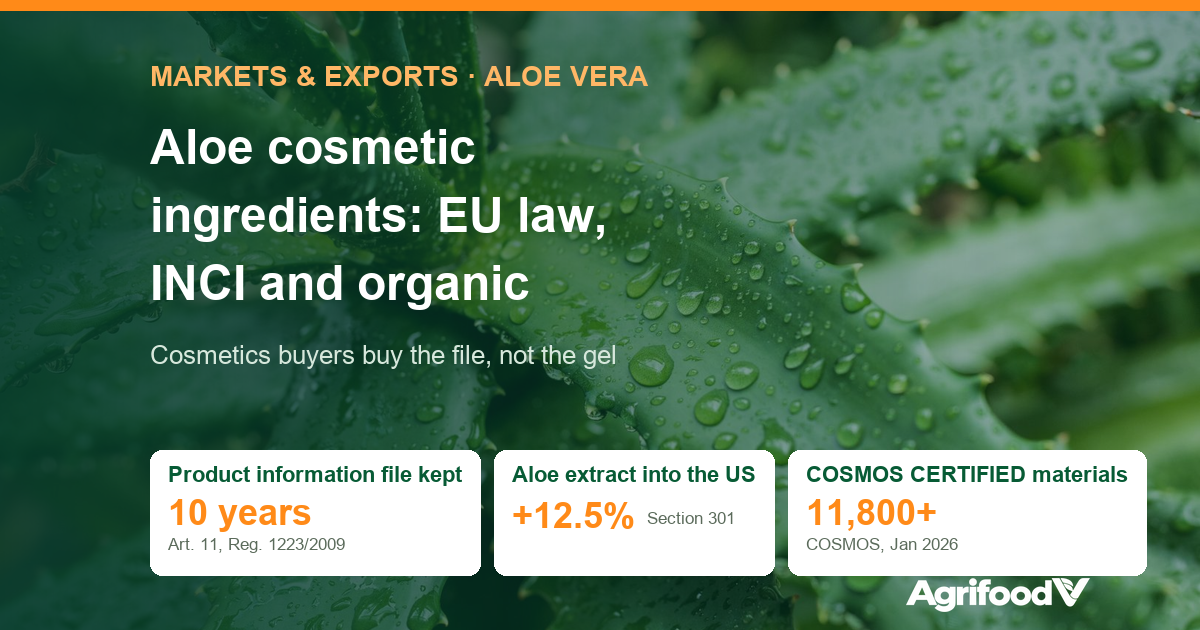
- Regulation 1223/2009 does not authorise ingredients; it requires the EU responsible person to have each product safety-assessed before sale, keep a product information file for 10 years and notify the product on the CPNP portal. The data for that assessment has to come from the ingredient supplier.
- CosIng lists several separate INCI names for aloe: Aloe Barbadensis Leaf Juice, Leaf Juice Powder, Leaf Extract, Leaf Powder, Leaf Water, Leaf Polysaccharides and more. Each name corresponds to a processing method; the wrong name means the wrong label for the customer.
- The consolidated text of Regulation 1223/2009 of 18 May 2026 has no entry named aloe in the lists of prohibited or restricted substances. The risk for aloe ingredients lies in the file: purity, impurities, microbiology, added preservatives.
- Organic Regulation (EU) 2018/848 covers agricultural products, food and feed; cosmetics are outside its scope. “Organic cosmetics” in the EU rely on private standards such as COSMOS, which has its own certification categories for ingredients.
What the cosmetics industry buys from aloe: ingredient forms and INCI names
The INCI name is the ingredient name printed on a cosmetic label. Under Article 19 of Regulation 1223/2009, the ingredient list on the label must use the common ingredient names in the glossary compiled by the European Commission under Article 33; the Commission’s CosIng database is where these names are looked up. For aloe, CosIng separates names by plant part and processing method. The table below shows the main names for the species Aloe barbadensis (checked on 30 October 2026).
| INCI name | CosIng description | Functions listed in CosIng |
|---|---|---|
| ALOE BARBADENSIS LEAF JUICE | Juice expressed from the leaves | Skin conditioning |
| ALOE BARBADENSIS LEAF JUICE POWDER | Powder obtained from the dried leaf juice | Skin conditioning |
| ALOE BARBADENSIS LEAF EXTRACT | Extract of the leaves | Emollient, humectant, oral care, skin conditioning |
| ALOE BARBADENSIS LEAF POWDER | Powder from the dried, ground leaves | Skin conditioning |
| ALOE BARBADENSIS LEAF POLYSACCHARIDES | Polysaccharide fraction isolated from the leaf | Emollient, film forming, humectant, skin conditioning |
| ALOE BARBADENSIS LEAF WATER | Aqueous solution of the steam distillate from the leaves | Fragrance |
Two notes. First, the name reflects the method: juice differs from extract, which differs from water, so the plant must choose the name that matches its actual process and keep that process stable. CosIng also has separate names for fermented and hydrolysed forms and an entry “ALOE VERA LEAF EXTRACT”; the name used must match the botanical name the supplier can prove through species identification. Second, any preservative, pH adjuster or carrier added (for example maltodextrin in a powder) is a separate ingredient and must be declared in the file so the customer can list it in full on the label. Where cosmetic ingredients sit on the aloe value ladder is covered in the pillar article Vietnam aloe vera: from fresh leaves to gel, powder and extracts for premium food and cosmetics markets.
Regulation 1223/2009: who carries the obligations, where the data comes from
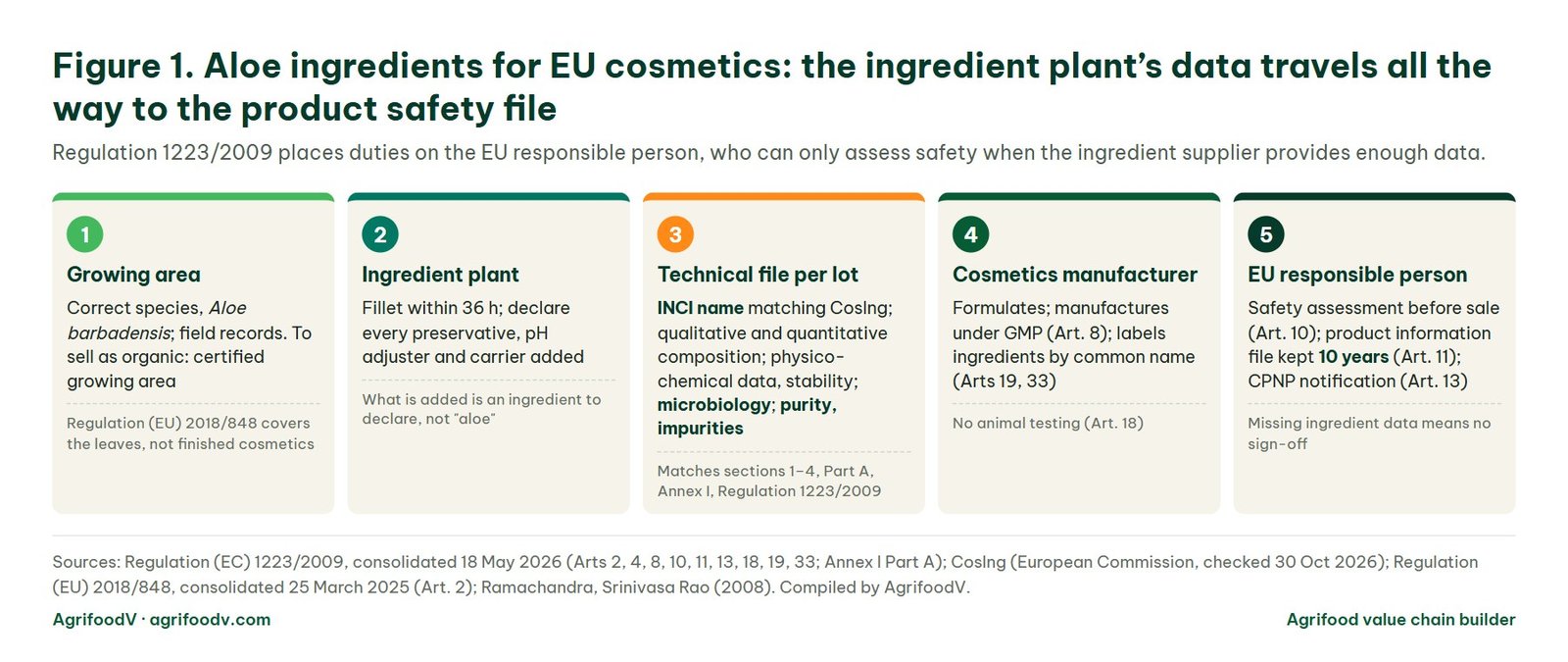
Under Article 4, only cosmetic products for which a “responsible person” is designated within the EU may be placed on the market; that person ensures the product complies with the Regulation. Before sale, under Article 10, the product must undergo a safety assessment and have a safety report drawn up in line with Annex I. Article 11 requires a product information file to be kept for 10 years after the last batch is placed on the market, including the safety report, a description of the manufacturing method and a statement of compliance with good manufacturing practice under Article 8. Article 13 requires the product to be notified on the Commission’s electronic system (CPNP) before sale. Article 18 prohibits placing on the market cosmetic products whose final formulation or ingredients have been tested on animals in the cases that article sets out.
An ingredient plant in Vietnam is not the responsible person, but it is the source of the data. Part A of Annex I lists what the safety report needs for each substance or mixture: qualitative and quantitative composition with chemical name, INCI and CAS number where possible (section 1); physical and chemical characteristics and stability (section 2); microbiological specifications (section 3); purity, impurities and traces of prohibited substances with evidence that they are technically unavoidable (section 4). Without this data for each lot, the safety assessor cannot sign, and the customer will change supplier.
For aloe, the impurity question usually centres on the yellow latex just under the leaf skin, which contains aloin and anthraquinones. The ban on aloe leaf preparations containing hydroxyanthracene derivatives under Regulation (EU) 2021/468 is food law and does not apply directly to cosmetics; but a filleting process that removes the latex cleanly and aloin results per lot make the impurity file much simpler. In the US, California added “aloe vera, non-decolorized whole leaf extract” to the Proposition 65 list from 4 December 2015, which means businesses that expose consumers in California to this substance through their products must give a warning unless an exemption applies.
Organic certification: food law does not cover cosmetics
Article 2 of Regulation (EU) 2018/848 (consolidated text of 25 March 2025) limits its scope to live or unprocessed agricultural products, processed agricultural products for use as food, feed, and certain other products listed in Annex I such as essential oils and natural gums and resins. Cosmetics are not within the scope. The consequence for an aloe supplier: aloe leaves and ingredients intended for food can be certified organic under EU law, while an “organic” claim on cosmetic ingredients and products relies on private standards.
The most widely used standard in Europe is COSMOS, managed by the non-profit COSMOS-standard AISBL (Brussels), whose founding members are BDIH, Cosmebio, Ecocert, ICEA and the Soil Association. COSMOS has two certification categories for ingredients: COSMOS CERTIFIED for raw materials with organic content and COSMOS APPROVED for raw materials without organic content; according to COSMOS figures (January 2026), more than 11,800 raw materials carry COSMOS CERTIFIED. In AgrifoodV’s view, for a manufacturer that wants an organic or natural label on its product, an ingredient that already holds such a certification reduces the work of proving compliance, which is a clear sales advantage. The logical order is: an organic-certified growing area first, then an assessment by the certification body of the processing method and chemicals the plant uses, and only then certification of each ingredient.
Duties on aloe extracts and powders
| Market | Tariff line (1302.19, plant extracts) | Duty on goods of Vietnamese origin |
|---|---|---|
| EU | 1302 19 70 | 0% (standard duty already 0%) |
| US | 1302.19.91 | Free of standard duty, but an extra 12.5% under Section 301; the specific exemption for aloe on this line applies to 8 other countries, not Vietnam |
| Japan | 1302.19-239 (other extracts) | 0% |
| Korea | 1302199010 (aloe extract) | 0% (VKFTA) |
| China | 1302.19.99 | 9.5% → 0% (ACFTA) |
Sources: TARIC, USITC HTS, USTR Section 301 notice of 23 July 2026, Japan Customs tariff schedule of 8 August 2026, Korea yesFTA portal, hsbianma (China, secondary site); AgrifoodV data set checked on 25 October 2026. Liquid leaf juice with preservatives, or blended mixtures, may fall under other lines: the HS code must be confirmed by a customs broker.
What companies should do
AgrifoodV recommendations:
- Choose one or two ingredient forms (leaf juice, leaf juice powder, extract) and the matching INCI name first, then lock the process so the name stays correct; do not sell the same product under several names.
- Build a technical file per lot following the first four sections of Part A, Annex I, Regulation 1223/2009: composition, physical and chemical characteristics and stability, microbiology, purity and impurities, with aloin results.
- Identify the aloe species by analysis and keep the results, so the botanical name in the INCI is backed by evidence.
- If targeting the organic segment, work with a certification body from the growing-area stage, and ask buyers which standard they accept before investing in certification.
- Price US shipments with the 12.5% Section 301 duty on aloe extracts of Vietnamese origin.
AgrifoodV helps companies research market requirements and prepare documentation for overseas buyers before investing in an ingredient plant.
References
- European Union. Regulation (EC) 1223/2009 on cosmetic products, consolidated text of 18 May 2026 (Articles 2, 4, 8, 10, 11, 13, 18, 19, 20, 33; Annex I). eur-lex.europa.eu.
- European Commission. CosIng, cosmetic ingredient database (Aloe barbadensis entries checked on 30 October 2026). ec.europa.eu.
- European Union. Regulation (EU) 2018/848 on organic production, consolidated text of 25 March 2025 (Article 2, Annex I). eur-lex.europa.eu.
- European Union. Regulation (EC) 1925/2006, Annex III Part A (amended by Regulation (EU) 2021/468), consolidated text of 26 November 2025. eur-lex.europa.eu.
- COSMOS-standard AISBL. Overview of the COSMOS standard and certification categories (January 2026 figures). cosmos-standard.org.
- OEHHA (California). Aloe vera, non-decolorized whole leaf extract, Proposition 65 list, effective 4 December 2015. oehha.ca.gov.
- Ramachandra C.T., Srinivasa Rao P. “Processing of Aloe Vera Leaf Gel: A Review”. American Journal of Agricultural and Biological Sciences 3(2):502–510, 2008. DOI: 10.3844/ajabssp.2008.502.510.
- USTR. Notice of final action under Section 301 on goods of Vietnam, Federal Register, 23 July 2026 (country-specific exclusions). ustr.gov.
- Japan Customs. Customs tariff schedule, Chapter 13 (version of 8 August 2026). customs.go.jp.
Article by AgrifoodV, compiled from the sources above (accessed 30 October 2026). INCI names and functions are taken from CosIng on the date checked; CosIng is a reference database, and the use of an ingredient in each product is assessed by the EU responsible person. HS codes and duty rates must be confirmed by a customs broker for each product. This content is not a substitute for legal advice. Cover image: Phil Evenden / Pexels.
Looking at Vietnam as a sourcing origin or a place to build a value chain?
Tell us your product, target market and expected volumes. In a 30–45 minute online call, AgrifoodV reviews buyers, standards, processing capacity and growing areas with you, starting from the market.
Book a call →Sourcing from Vietnam© 2026 AgrifoodV. Nội dung được phép trích dẫn khi ghi rõ nguồn và đặt liên kết tới bài gốc; không sao chép toàn văn. Xem Điều khoản sử dụng nội dung.