AgrifoodV ·
Gynostemma (giao co lam) already has international buyers, but each market opens a different door. In the EU, gynostemma leaf is considered “not novel” only when used in food supplements, while an extract standardised to 80% gypenosides is a novel food that has not been authorised. In Japan, the plant is on the list of ingredients not treated as drugs. In China, it is an ingredient for health foods, not ordinary food. This article reads each door from the texts and sets out what a processing plant must have in place before it signs a contract.
Key points
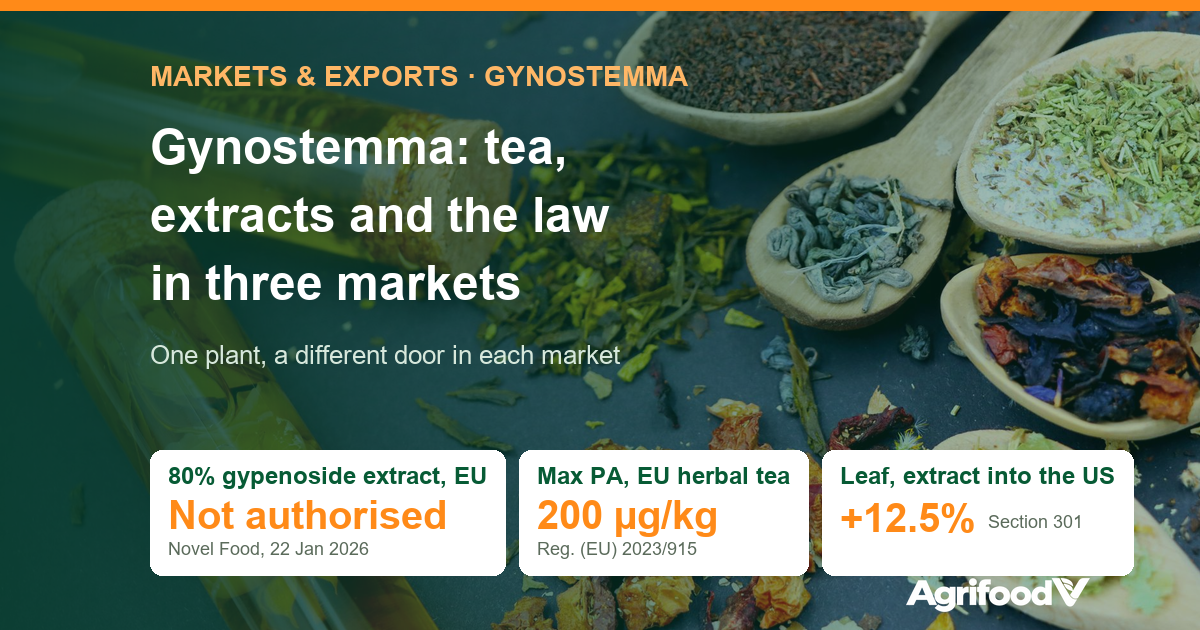
- EU (Novel Food Catalogue, entry created on 22 January 2026): Gynostemma pentaphyllum leaf is “not novel in food supplements”; an extract standardised to 80% gypenosides is “not yet authorised”. There is no basis for saying “gynostemma tea is freely sold in the EU”.
- Japan (list of the Ministry of Health, Labour and Welfare, updated 5 August 2026): アマチャヅル (G. pentaphyllum), whole plant, is on the list of ingredients not treated as drugs unless drug-like claims are made.
- China (according to secondary sources): gynostemma is on the 2002 list of items permitted in health foods and is not on the “medicine and food homology” list.
- All of the above applies only to the species G. pentaphyllum. In Vietnam the name “giao co lam” is used for several plant forms; every lot must be identified to species by analysis.
One name, several plant forms: species identification comes first
On the Vietnamese market, “giao co lam” is a common name used for several plant forms of the genus Gynostemma, often told apart by the number of leaflets. Domestic and international literature records several Gynostemma species being grown, collected and used interchangeably. Meanwhile, the entries in the EU and Japanese lists name exactly one species: Gynostemma pentaphyllum (Thunb.) Makino. AgrifoodV does not assign a scientific name to each folk name, because there is no botanical source it could verify; what is certain is that overseas buyers only accept goods when the lot can prove its species by analysis (morphology, microscopy, chromatographic fingerprinting or DNA) carried out by a competent laboratory.
The active compounds used as the standardisation marker are a group of saponins called gypenosides. Research in Vietnam is mostly phytochemistry, cell culture and reviews; this article does not discuss health effects, because in all three markets health claims are tightly regulated and can themselves turn a product into a medicine. Where gynostemma sits in the wider picture of industrial spices and herbs is covered in the pillar article Spice and herb plants for export: from raw material to products that meet EU, US and Japanese standards.
Four legal doors by market and product form
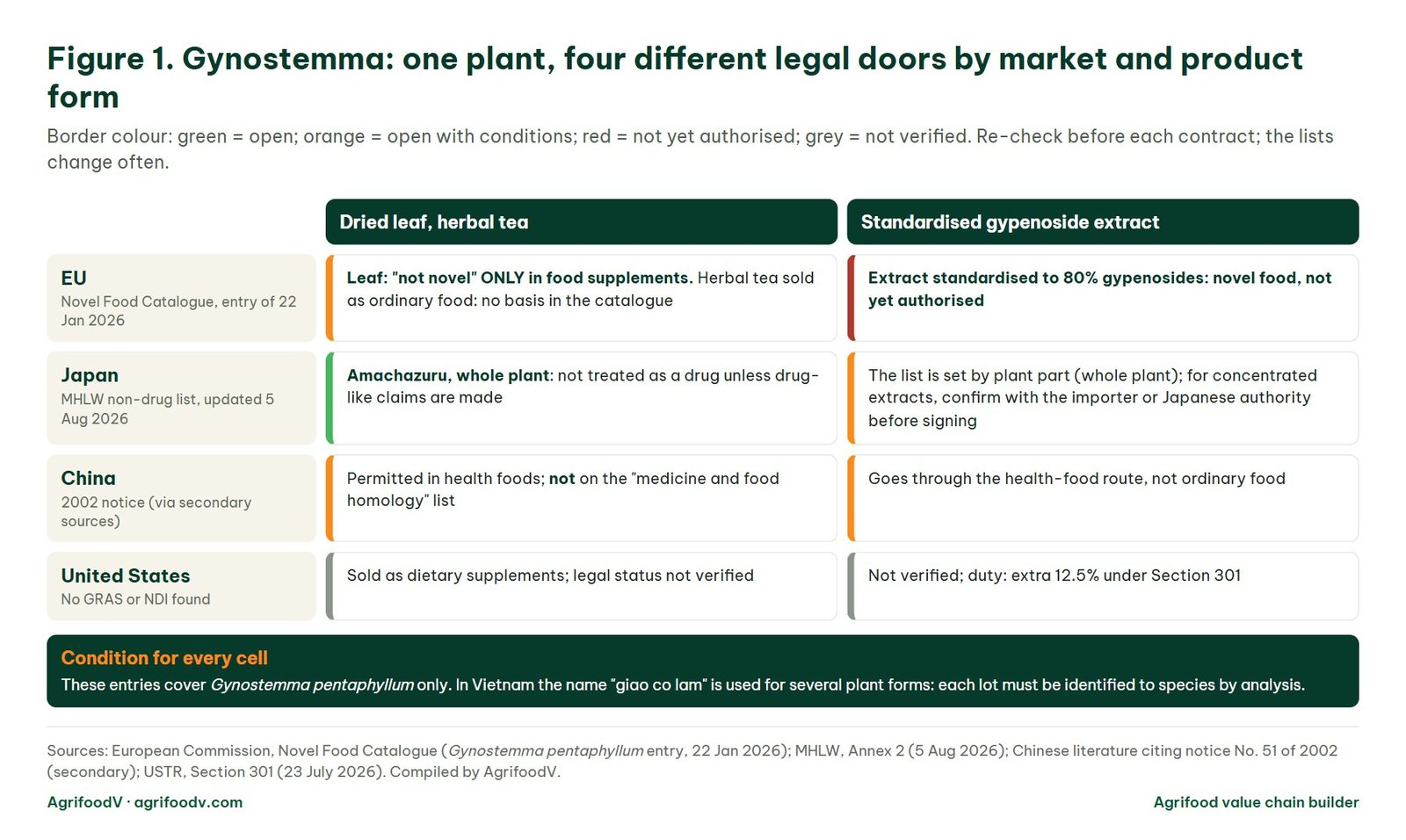
EU. The European Commission’s Novel Food Catalogue has an entry for Gynostemma pentaphyllum, created on 22 January 2026, with two statuses. Leaf: “not novel in food supplements”, meaning it had significant use before May 1997, but only in food supplements. Extract standardised to 80% gypenosides: “not yet authorised novel food”, the outcome of a novel food status consultation led by the competent authority of the Czech Republic. The consequence: dried leaf and leaf powder in capsules sold as food supplements have a basis; gynostemma tea sold as an ordinary herbal tea has no basis in the catalogue; the 80% gypenoside extract must be authorised as a novel food before it can be sold.
Even for the permitted leaf form, EU shipments must meet contaminant limits. Under Regulation (EU) 2023/915 (consolidated text of 19 August 2026), pyrrolizidine alkaloids are limited to 200 µg/kg in dried herbal infusions and 400 µg/kg in dried herbs and plant-based food supplements; for ethylene oxide, the maximum residue level for tea and herbal infusions is 0.1 mg/kg, equal to the limit of quantification, calculated as the sum of ethylene oxide and 2-chloroethanol (Regulation (EU) 2015/868). Pyrrolizidine alkaloids usually come from weeds mixed in at harvest, so control must start in the growing area.
Japan. The list of “ingredients not judged to be drugs unless drug-like efficacy is claimed” (Annex 2) of the Ministry of Health, Labour and Welfare, updated on 5 August 2026, has the entry アマチャヅル, scientific name Gynostemma pentaphyllum (Thunb.) Makino, other name コウコラン, part used: whole plant. Gynostemma can therefore be sold in Japan as food, provided labels and advertising make no drug-like claims. The list is organised by plant part; for concentrated extracts, companies should confirm with the importer or the Japanese authority before signing. A note for searching: アマチャヅル is different from アマチャ (Hydrangea), which appears on the line just above.
China. According to Chinese sources citing notice 卫法监发〔2002〕51号, gynostemma (绞股蓝) is on the list of items permitted in health foods and is not on the “medicine and food homology” list (药食同源). AgrifoodV has not read the original 2002 annex, so this is recorded as information from secondary sources. If correct, gynostemma shipments to China follow the health-food ingredient route, with the procedures of that product group, not those of ordinary tea.
United States. AgrifoodV found no GRAS notice or new dietary ingredient (NDI) notification for G. pentaphyllum; products are on the US market as dietary supplements. The specific legal status should be confirmed by a US food law specialist before quoting.
Duties on dried leaf and extracts
| Product form (HS) | EU | US | Japan |
|---|---|---|---|
| Dried leaves, medicinal plants, single-species herbal tea (1211.90) | 1211 90 86 90: 0% | 1211.90.89: free of standard duty + 12.5% Section 301 (not exempt) | 1211.90-999: 2.5% → 0% (VJEPA) |
| Plant extracts (1302.19) | 1302 19 70: 0% | 1302.19.91: free of standard duty + 12.5% Section 301 (not exempt) | 1302.19-239: 0% |
| Multi-species herbal tea blends | 2106 90 98 69: 9% + agricultural component → 0% (EVFTA, from 1 January 2023) | 2106.90.99.87: 6.4% + 12.5% Section 301 | Depends on the line; mixed herbal beverage bases (1302.19-120) must be declared under CPTPP to get 0% |
Sources: TARIC (reference date 25 October 2026), USITC HTS 2026 and the USTR Section 301 notice of 23 July 2026, Japan Customs tariff schedule of 1 April 2026; AgrifoodV data set. In the US, tea of heading 0902 and raw spices are exempt from the extra 12.5%, while herbal teas and plant extracts are not. The 10-digit HS code must be confirmed by a customs broker.
The point to remember: deep processing does not avoid duty in the US, because both dried gynostemma leaf and gynostemma extract carry the extra 12.5%. In the EU and Japan duties are close to zero; the real door is the legal status of the product form and the contaminant limits.
What companies should do
AgrifoodV recommendations:
- Choose the market and the product form together: leaf and leaf powder for food supplements in the EU; herbal tea for Japan; health-food ingredients for China. Do not offer 80% gypenoside extract to EU buyers without a novel food authorisation.
- Build a raw-material growing area with species identification: planting stock clearly identified as G. pentaphyllum, species analysis results for each lot, and a harvesting procedure that removes weeds to control pyrrolizidine alkaloids.
- Test every lot against the limits of the target market: pyrrolizidine alkaloids, pesticide residues, ethylene oxide, heavy metals, microbiology; keep the results with the growing-area code.
- Keep labels and sales materials free of any disease-treatment claims, because in Japan and the EU drug-like claims can change the legal status of the product.
- Re-check the Novel Food Catalogue and the MHLW list before each contract; both lists are updated frequently.
AgrifoodV helps companies research legal requirements and choose markets and product forms before investing in a herbal processing plant.
References
- European Commission. Novel Food Catalogue, entry Gynostemma pentaphyllum (created 22 January 2026; checked 25 October 2026). ec.europa.eu.
- NutraIngredients. “Novel foods: major updates on botanical assessments”, 27 January 2026. nutraingredients.com.
- Ministry of Health, Labour and Welfare of Japan (MHLW). 別添2: 医薬品的効能効果を標ぼうしない限り医薬品と判断しない成分本質(原材料)リスト [Annex 2: list of ingredients not judged to be drugs unless drug-like efficacy is claimed], updated 5 August 2026. mhlw.go.jp.
- Chinese literature citing notice 卫法监发〔2002〕51号 on the list of items permitted in health foods (secondary source). sciengine.com.
- European Union. Regulation (EU) 2023/915 on maximum levels for certain contaminants in food, consolidated text of 19 August 2026, Annex I (pyrrolizidine alkaloids). eur-lex.europa.eu.
- European Union. Regulation (EU) 2015/868 amending the Annexes to Regulation (EC) 396/2005 (maximum residue levels for ethylene oxide). eur-lex.europa.eu.
- Frontiers in Chemistry, 2023. Review of the genus Gynostemma. DOI: 10.3389/fchem.2023.1203418.
- USTR. Notice of final action under Section 301 on goods of Vietnam, Federal Register, 23 July 2026. ustr.gov.
- Japan Customs. Customs tariff schedule, Chapters 12 and 13 (version of 1 April 2026). customs.go.jp.
Article by AgrifoodV, compiled from the sources above (accessed 30 October 2026). Information on China and the United States comes from secondary sources or is unverified, as stated in the article. The article does not assess the health effects of gynostemma. HS codes and duty rates must be confirmed by a customs broker for each product. This content is not a substitute for legal advice. Cover image: Marta Branco / Pexels.
Looking at Vietnam as a sourcing origin or a place to build a value chain?
Tell us your product, target market and expected volumes. In a 30–45 minute online call, AgrifoodV reviews buyers, standards, processing capacity and growing areas with you, starting from the market.
Book a call →Sourcing from Vietnam© 2026 AgrifoodV. Nội dung được phép trích dẫn khi ghi rõ nguồn và đặt liên kết tới bài gốc; không sao chép toàn văn. Xem Điều khoản sử dụng nội dung.