AgrifoodV ·
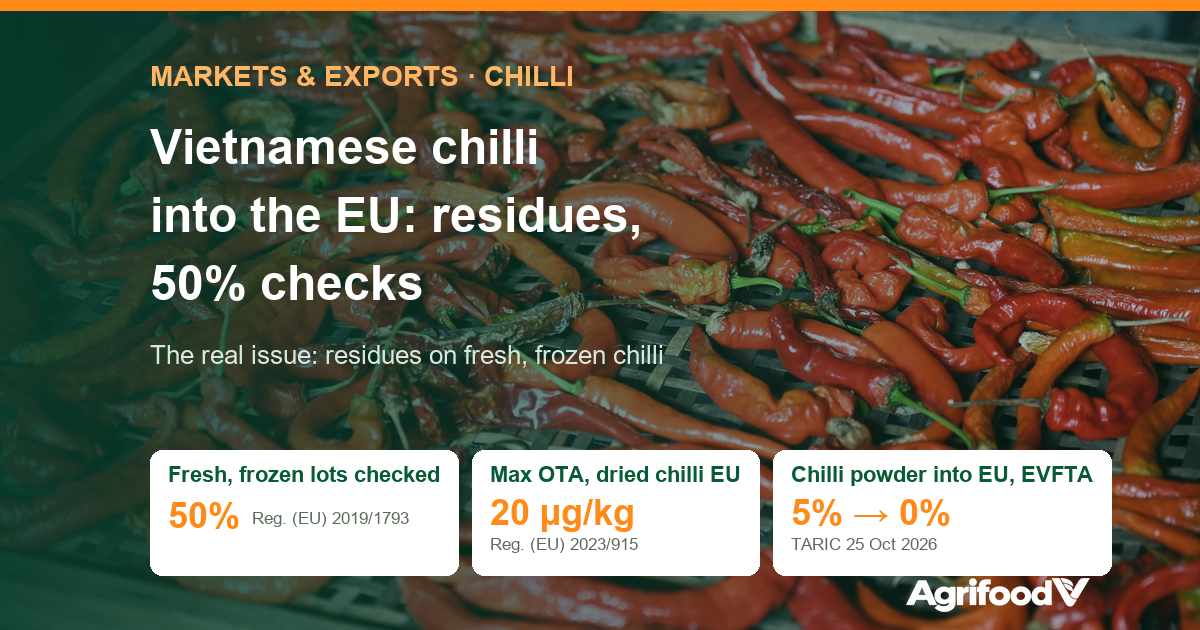
The real problem for Vietnamese chilli in the EU is not aflatoxin or Sudan dyes, but pesticide residues on fresh and frozen chilli. Under the consolidated version of Implementing Regulation (EU) 2019/1793 dated 30 June 2026, fresh, chilled and frozen hot chilli from Vietnam sits in Annex II: every consignment must carry an official certificate and analytical results, and 50% of consignments are physically checked at the EU border. Dried chilli, chilli powder and oleoresin pass through different gates, with different parameters. This article reads each gate and shows what a processing plant must meet at each level.
Key points
- 2019/1793, consolidated 30 June 2026 (including amendment 2026/1206): Vietnamese Capsicum peppers (other than sweet), fresh, chilled or frozen, are in Annex II, hazard pesticide residues, identity and physical check frequency 50%. A single 50% line covers both fresh and frozen goods.
- Vietnamese dried chilli and chilli powder are not on the increased-controls list. Limits to remember under Regulation (EU) 2023/915: ochratoxin A 20 µg/kg for dried Capsicum (not 15 as for other spices), aflatoxin B1 5 µg/kg, total 10 µg/kg.
- RASFF data, January 2020 to October 2026: at most 36 notifications likely concerning Vietnamese chilli, almost all for pesticide residues; no aflatoxin, ochratoxin A, Sudan dye or Salmonella notifications; only 1 notification on dried chilli.
- Moving up the processing ladder changes the duty picture: chilli powder into the EU drops from 5% to 0% with EVFTA origin; oleoresin enters the EU at 0%, but into the US pays 3.8% plus 12.5% under Section 301.
Fresh and frozen chilli: 50% of consignments checked, documents from Vietnam
Annex II of Regulation 2019/1793 is the heavier of the two lists. For goods in Annex II, Article 10 requires each consignment to be accompanied by the results of sampling and analysis carried out by the competent authority of the country of origin, in a laboratory accredited to ISO/IEC 17025; Article 11 requires an official certificate following the model in Annex IV, bearing the identification code of that exact consignment. At the EU border, 50% of consignments of Vietnamese hot chilli (codes ex 0709 60 99 and ex 0710 80 59) undergo identity and physical checks, which means resampling and analysis.
The scope of analysis is set in two footnotes. Footnote (3) refers to the active substances in the EU control programme under Article 29(2) of Regulation (EC) 396/2005 that can be analysed with GC-MS and LC-MS multi-residue methods. Footnote (7) adds three groups specifically for Vietnamese goods: dithiocarbamates (expressed as CS₂, including maneb, mancozeb, metiram, propineb, thiram, ziram), phenthoate and quinalphos. In other words, a standard multi-residue package is not enough; the results accompanying each consignment must cover these three groups as well.
Vietnam is not alone in this group. In the same consolidated text, fresh and frozen hot chilli from Thailand, Rwanda and Uganda is in Annex I at 50%, and chilli from India is in Annex II at 30%. The list is reviewed periodically; the article EU keeps increased controls on Vietnamese durian, dragon fruit, okra and chilli explains the mechanism: goods only leave the list when inspection data on export consignments show improved compliance.
RASFF data: pesticide residues, not aflatoxin
AgrifoodV searched the RASFF Window database for January 2020 to 25 October 2026, using 18 chilli-related keywords and filtering notifications with Vietnam among the origins. There were 23 notifications naming chilli explicitly (15 fresh or unspecified, 6 frozen, 1 chilli sauce, 1 dried chilli) and 13 naming only “peppers” but with active substances typical of fresh chilli; at most 36 notifications in total. Distribution by year: 2020: 2; 2021: 1; 2022: 4; 2023: 6; 2024: 20; 2025: 2; 2026: 1. Almost all hazards were pesticide residues, such as chlorfenapyr, chlorpyrifos, permethrin, tolfenpyrad, propiconazole, hexaconazole and chlorothalonil.
There was no notification for aflatoxin, ochratoxin A, Sudan dyes or Salmonella on Vietnamese chilli in this period. Dried chilli had only 1 notification (Norway, 21 August 2025, pesticide residues). Limitations of the search: RASFF is searched by words in the title and has no data on the number of consignments imported, so these figures are not violation rates.
Other markets also check Vietnamese chilli by active substance
| Market | Measure on Vietnamese chilli | Scope, duration |
|---|---|---|
| EU | Regulation 2019/1793, Annex II: certificate and analytical results for each consignment; physical checks on 50% | Fresh, chilled, frozen hot chilli; pesticide residues, plus dithiocarbamates, phenthoate, quinalphos |
| Japan | Nationwide inspection order of the Ministry of Health, Labour and Welfare (MHLW), fiscal year 2026 | Chilli (とうがらし), active substance etoxazole; annex last amended 8 October 2026 |
| South Korea | Inspection order of the Ministry of Food and Drug Safety (MFDS) | Chilli fruit, 31 March 2023 to 30 March 2027; permethrin, tricyclazole, isoprothiolane, quinalphos, thifluzamide |
| United States | FDA Import Alert 99-08 (pesticides) includes an entry for Vietnamese frozen chilli; fresh peppers are on the FSMA 204 traceability list | FSMA 204: FDA will not enforce before 20 July 2028 |
Sources: EUR-Lex (consolidated 30 June 2026); MHLW (notice of 31 March 2026, annex amended 8 October 2026); MFDS imported food portal; FDA (industry 28 import alert list, checked 10 October 2026; Food Traceability List page). AgrifoodV data files.
Quinalphos appears in both the EU and Korean measures. A residue control programme for export chilli growing areas should therefore be designed for several markets at once, rather than reacting to one notification at a time.
Moving up the processing ladder: dried chilli, chilli powder, oleoresin
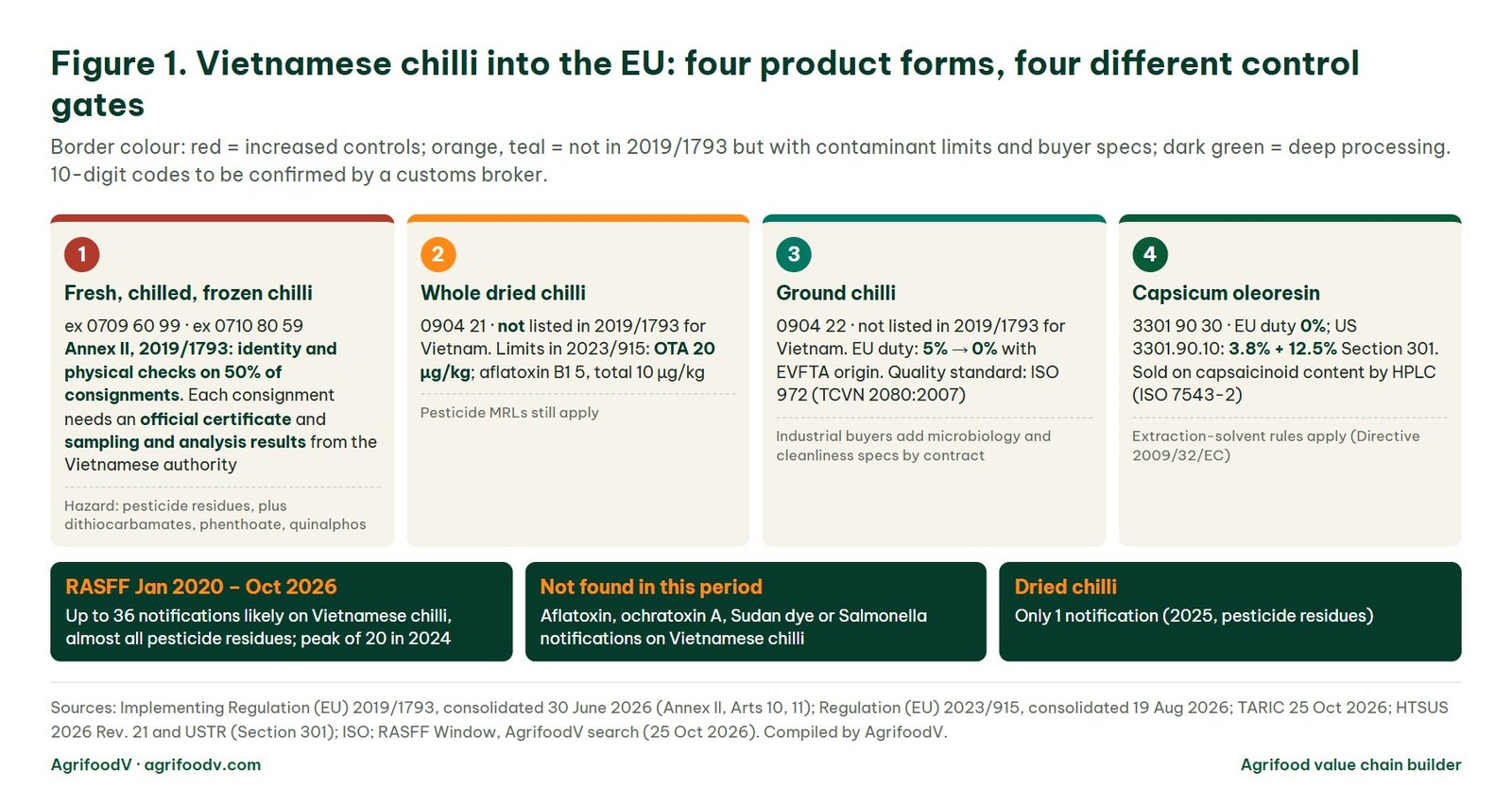
Whole dried chilli and chilli powder. Vietnamese goods under codes 0904 21 and 0904 22 are not in 2019/1793, but must meet the contaminant limits of Regulation (EU) 2023/915 (consolidated 19 August 2026): aflatoxin B1 5.0 µg/kg and total aflatoxins 10.0 µg/kg (entry 1.1.14), ochratoxin A 20 µg/kg for dried Capsicum (entry 1.2.18). RASFF data show this hazard has not occurred with Vietnamese chilli, but it is why competitors are checked: dried and ground chilli from Sri Lanka is checked for aflatoxins at 50%, Ethiopia’s heading 0904 at 30%. Fast drying, dry storage and moisture control are the conditions for keeping that advantage. On duties, ground chilli (0904 22 00) has an EU MFN rate of 5%, reduced to 0% with EVFTA origin. The reference quality standard is ISO 972:1997, equivalent to TCVN 2080:2007; industrial buyers add microbiology and cleanliness parameters in the contract.
Capsicum oleoresin. This is the deepest processing level: capsaicinoids and colour extracted into a concentrated form for food manufacturers. Oleoresin is sold on capsaicinoid content measured by HPLC (ISO 7543-2) or Scoville pungency (ISO 3513), and must meet extraction-solvent rules (Directive 2009/32/EC in the EU). The EU duty on code 3301 90 30 is 0%. The US is the opposite: code 3301.90.10 carries a 3.8% duty and is not exempt from the 12.5% under Section 301, while ground chilli is exempt. Deep processing for the US currently pays more duty than raw spice; this must be weighed before choosing the market for an extraction line.
All four levels share one foundation: growing areas that control pesticide use, and raw-material receiving with residue checks and retained samples at the plant. Chilli’s place in the wider picture of industrial spices and herbs is covered in the pillar article Spice and Herb Processing Plants in Vietnam: Meeting EU, US and Japan Standards.
Export picture and data limits
According to the Vietnam Pepper and Spice Association (VPSA), in the first nine months of 2026 Vietnam exported 4,553 tonnes of chilli worth USD 9.8 million (up 115.2% in volume and 22.1% in value), with Laos as the main market. Chilli data series differ by source and statistical scope (fresh chilli across land borders, dried chilli, chilli powder, chilli sauce), so years from different sources should not be joined into one trend. Customs data split by product form have not been verified by AgrifoodV.
What companies should do
AgrifoodV recommendations:
- For fresh and frozen chilli to the EU: plan pre-harvest and pre-shipment sampling, with an analytical package covering full multi-residue plus dithiocarbamates, phenthoate and quinalphos; use one consignment code across the analytical results, the certificate and the import documents.
- Design one list of banned and restricted active substances for growing areas covering the EU, Japan, Korea and the US; quinalphos, etoxazole, permethrin and tricyclazole are already named in inspection orders.
- For dried chilli and chilli powder: protect the clean record on aflatoxin and ochratoxin A through fast drying, dry storage and lot testing against 2023/915 limits; declare EVFTA origin to obtain 0% on ground chilli.
- For oleoresin: choose the market before investing in an extraction line; the EU and Japan are favourable on duty, the US adds 12.5%.
AgrifoodV supports companies with market requirement research and the choice of product form and target market before investing in a chilli or spice processing plant.
References
- European Union. Implementing Regulation (EU) 2019/1793, consolidated version of 30 June 2026 (Annex II, Articles 10, 11; latest amendment 2026/1206 of 9 June 2026). eur-lex.europa.eu.
- European Union. Regulation (EU) 2023/915 on maximum levels for certain contaminants in food, consolidated version of 19 August 2026, Annex I. eur-lex.europa.eu.
- European Commission. RASFF Window, search for chilli notifications with Vietnamese origin, January 2020 – 25 October 2026 (AgrifoodV search). webgate.ec.europa.eu.
- Ministry of Health, Labour and Welfare of Japan (MHLW). Imported food monitoring plan, fiscal year 2026, inspection orders (annex amended 8 October 2026). mhlw.go.jp.
- Ministry of Food and Drug Safety of Korea (MFDS). List of inspection orders for imported food. impfood.mfds.go.kr.
- FDA. Import alert list for industry 28 (spices, flavours), Import Alert 99-08 (checked 10 October 2026); Food Traceability List. accessdata.fda.gov; fda.gov.
- European Commission. TARIC, codes 0904 22 00, 3301 90 30, origin Vietnam (reference date 25 October 2026). ec.europa.eu.
- USITC. HTSUS 2026, Rev. 21, codes 3301.90.10, 0904.22, Chapter 99 U.S. note 52; USTR, notice of Section 301 action on goods of Vietnam, 23 July 2026. hts.usitc.gov; ustr.gov.
- ISO. ISO 972:1997 (chillies and capsicums, whole or ground, specification); ISO 7543-2:1993 (total capsaicinoids, HPLC); ISO 3513:1995 (Scoville index). iso.org.
- Vietnam Pepper and Spice Association (VPSA). Export data for other spices, first nine months of 2026 (8 October 2026). vpsaspice.org.
Article by AgrifoodV, compiled from the sources above (accessed 25–30 October 2026). RASFF counts are the result of an AgrifoodV keyword search, not violation rates. HS codes and duty rates should be confirmed by a customs broker for each product. The 2019/1793 lists are reviewed periodically; check the latest consolidated version before each contract. This content is not a substitute for legal advice. Cover image: SunLi S / Pexels.
Looking at Vietnam as a sourcing origin or a place to build a value chain?
Tell us your product, target market and expected volumes. In a 30–45 minute online call, AgrifoodV reviews buyers, standards, processing capacity and growing areas with you, starting from the market.
Book a call →Sourcing from Vietnam© 2026 AgrifoodV. Nội dung được phép trích dẫn khi ghi rõ nguồn và đặt liên kết tới bài gốc; không sao chép toàn văn. Xem Điều khoản sử dụng nội dung.